
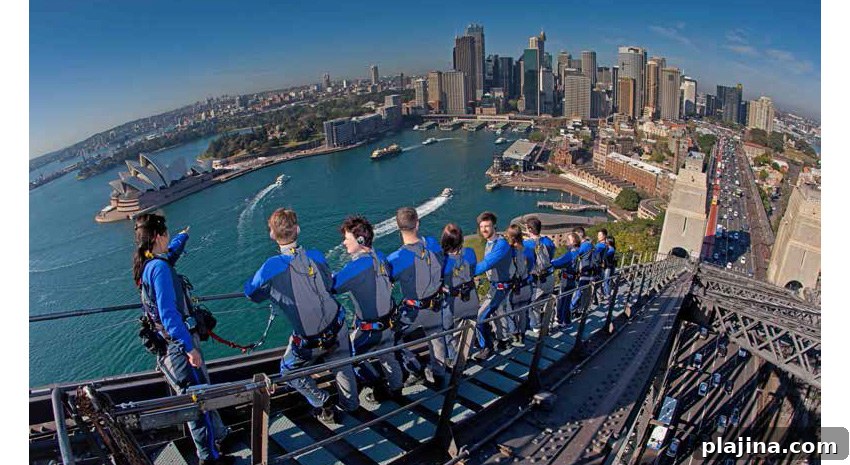
ABOUT HALFWAY UP the outer arch of the Sydney Harbour Bridge, I try to calm a rising panic by following advice from BridgeClimb’s website: “If you feel wobbly or light-headed, it can be comforting to ground yourself. Push your feet in your shoes against the solid pathway. Squeeze the hand rails to remind yourself that everything is sturdy and safe and you are in control.”
I press my foot against a gunmetal steel beam and grip the rail along the edge of the bridge, forcing myself not to look at the eight lanes of traffic speeding below.
I’m on a three-and-a-half-hour ascent of Sydney’s iconic Harbour Bridge, mainly to take in sweeping views of the Sydney Opera House and the city skyline, but also to face a personal fear of heights. At 440 feet, the Sydney Harbour Bridge is the world’s largest steel arch bridge and a defining feature of the harbor, linking the city’s northern and southern shores.
Long before formal climbs were offered, the bridge inspired dramatic crossings. In 1973, French high-wire artist Philippe Petit famously rigged a wire between the south-end pylons and crossed. And reportedly, soon after the bridge’s 1932 opening some members of the public climbed the arch unofficially—decades before BridgeClimb began operating.
Since 1998 BridgeClimb has allowed visitors to officially ascend the southern half of the arch, and the company says more than 3.2 million people from around the world have reached the summit. For those seeking a less intense experience, the pedestrian walkway on the eastern side offers a pleasant crossing with views from the South-East Pylon. BridgeClimb also runs the BridgeClimb Express, which follows steel paths to the top, and the BridgeClimb Sampler, which goes only halfway up. I chose the traditional full arch climb, both for the adventure and to confront my fear.
The day of my climb is a sunny spring afternoon with a noticeable breeze even at street level. My guide mentions the winds but reassures the group the bridge was engineered to withstand hurricane-force gusts of about 120 mph. After signing a waiver and completing a breathalyzer test, I attend a thorough safety briefing. We gear up in a BridgeSuit jumpsuit and fleece, fasten harnesses, and receive headsets so we can hear the guide. A short training session follows, where we practice operating harnesses, attaching safety hooks and climbing ladders.
The climb begins in The Rocks. After clipping in at the base beneath the roadway, we progress across a sequence of catwalks toward the South-East Pylon, where the views are, quite literally, breathtaking. For safety, guests cannot carry cameras; professional images are available for purchase afterward.
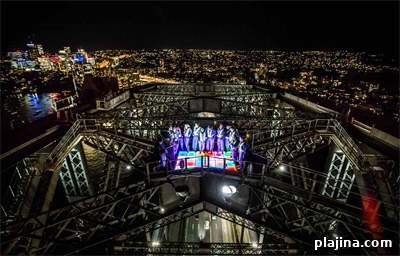
The illuminated dance floor atop the bridge for the Vivid Climb © BRIDGECLIMB
The most mentally demanding section comes next, where I climb four steep ladders to reach the upper arch. To keep from fixating on the drop, I listen to my guide recount the bridge’s history. Construction began in 1923 with more than 1,400 workers and took over eight years, at a cost of $4.2 million. The arch erection started in October 1928, beginning from the southern end and then the northern end.
The human cost was significant: 16 workers lost their lives during construction. The bridge’s creation also involved the displacement of many families—reports note up to 800 households lost homes to make way for the structure. Despite these hardships, the finished bridge remains a powerful and elegant presence above one of the world’s finest natural harbors.
As I near the top, wind gusts intensify and I tighten my grip on the rail. Taking a deep breath and avoiding a direct look down, I cross the bridge’s spine beneath two fluttering flags—the Australian flag and the New South Wales flag—before descending the opposite side. The harness, the guide’s steady encouragement and the careful procedures make the climb far less intimidating than I imagined. A few heart flutters are a small price to pay for the unrivaled panorama over Sydney Harbour.
At the end of the climb I receive a cap and a certificate of achievement, a keepsake that marks a personal victory and a memorable way to experience one of Sydney’s most famous attractions.
Sydney Info to Go
Sydney Airport sits about 13 minutes by train from the city center, with stations at both the international and domestic terminals served by the Airport Link. Bus services also connect the airport with the city, including routes that stop at both international (T1) and domestic (T3) terminals.