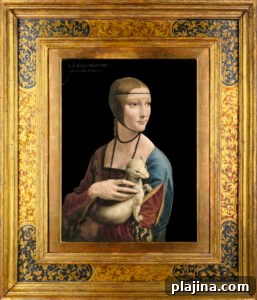
A visit to Krakow is incomplete without seeing the Lady with an Ermine, a masterpiece by Leonardo da Vinci often regarded as second only to the Mona Lisa. One of only four surviving portraits by da Vinci, it shows a young woman—mistress of Ludovico Sforza—cradling an unusually large ermine, a probable nod to Ludovico’s nickname, “the white ermine.” This national treasure is a centerpiece of the Czartoryski Museum, Poland’s oldest museum, which occupies three historic buildings: a 19th-century monastery, the 16th-century Municipal Arsenal, and a neo-Gothic palace constructed in the 19th century for the noble Czartoryski family. The museum’s origins trace back to Princess Izabela Czartoryska, who founded the collection in 1796.
Surrounding the museum is Krakow’s Old Town, Stare Miasto, centered on Rynek Główny, Europe’s largest town square and one of the earliest sites added to UNESCO’s heritage list. The city’s medieval fortifications once included a roughly two-mile defensive wall; the moat that ringed that wall has been transformed into a greenbelt that encloses the historical administrative district dating to the 13th century.
© Younsi | Dreamstime.com
Bisected by the Royal Road—the historic procession route used for coronations—Old Town remains lively, featuring more than 6,000 historical sites and charming buildings that now house restaurants, boutiques, pubs and cafés. Horse-drawn carriages carry visitors past notable landmarks such as the Town Hall Tower and Florian Gate, and by more than a dozen architecturally significant churches, two theaters, and numerous monuments and statues, including a monument to the astronomer Nicolaus Copernicus, who proposed that Earth rotates around the sun.
Street vendors sell flowers and obwarzanek krakowski, the twisted, ring-shaped pretzel that has become a city emblem. Traditional Polish dishes—pierogi dumplings, beetroot borscht, and various kielbasa sausages—are widely available in establishments such as Wierzynek Restaurant and in many pubs and cafés housed in historic tenement houses and medieval cellars with exposed timbers and vaulted ceilings.
Old Town is steeped in folklore. One popular local legend says the pigeons that crowd the square are knights turned to birds by an enchantress, and on the hour they scatter as a trumpeter from St. Mary’s Church tower sounds the five-note hejnal mariacki, the traditional Polish bugle call that marks the time.