
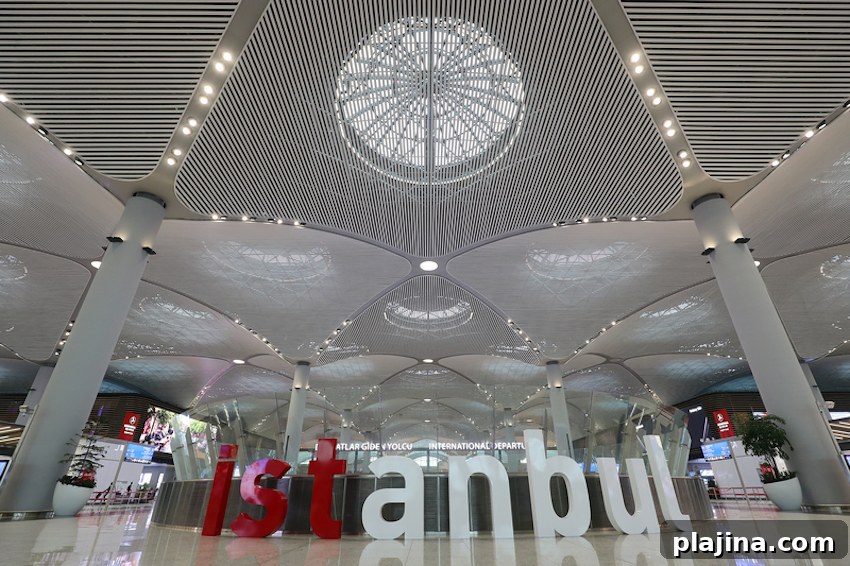
With the official closure of İstanbul’s Atatürk International Airport on April 6, attention shifted to the construction and expansion of the city’s new airport. The first phase of İstanbul Airport opened in late October 2018, and since then it has continued to grow and develop into a major international hub.
Located roughly 22 miles north of central İstanbul, İstanbul Airport is now the primary base for Turkish Airlines. Designed to handle an initial capacity of about 90 million passengers per year, the airport is planned to expand in multiple phases. When all four phases are complete, including six runways and extensive terminal space, the facility is expected to accommodate up to 200 million passengers annually. That final build-out is targeted for completion around 2027. At full scale the project represents an investment of approximately $12 billion and will cover some 29.5 square miles, a footprint larger than Manhattan.
The airport’s master plan blends modern aviation infrastructure with design elements inspired by Turkish architecture. Architects and planners have incorporated references to traditional forms such as domed mosques and historical bathhouse layouts to create public spaces that feel both contemporary and rooted in local heritage. These design choices aim to make the terminals visually distinctive while offering travelers a comfortable environment.
Passenger amenities focus on convenience for international travelers and long-haul transit passengers. For example, those facing extended layovers can reserve sleeping accommodations at on-site facilities like the guest pods operated by Yotel. A network of lounges, retail outlets, food and beverage options, and transportation services supports the airport’s role as a global connection point.
From an operations perspective, the airport has been planned to improve passenger flows, security processing, and baggage handling compared with many older terminals. Concourse layouts, signage, and circulation routes are organized to reduce transfer times and simplify connections between flights. The runways, taxiways, and apron areas are sized to support heavy traffic and a wide range of aircraft types, allowing airlines to scale up service as demand grows.
Ground transportation links tie the airport to İstanbul and the surrounding region. Road improvements, parking facilities, and shuttle services serve passengers traveling to and from the city, while longer-term plans foresee expanded rail and mass-transit connections to integrate the airport into the metropolitan network. These connectivity projects are intended to improve accessibility and reduce road congestion as passenger volumes increase.
Environmental and community considerations are part of the airport’s ongoing development. Planners have addressed issues such as noise mitigation, land use, and energy efficiency through landscaping, building systems, and operational strategies. As the airport grows, continued monitoring and community engagement remain important to balance expansion with regional impacts.
İstanbul Airport’s role as a major aviation hub reflects Türkiye’s strategic position between Europe and Asia. By concentrating resources into a large, modern facility, the country aims to strengthen Istanbul’s role in international travel and logistics, support tourism and trade, and provide a gateway that meets contemporary expectations for efficiency and passenger experience.
As construction progresses toward the final phases, travelers and industry observers can expect further additions to terminals, services, and transport links. The airport’s evolution is likely to continue shaping regional mobility and contributing to İstanbul’s economic and cultural connectivity with the world.