
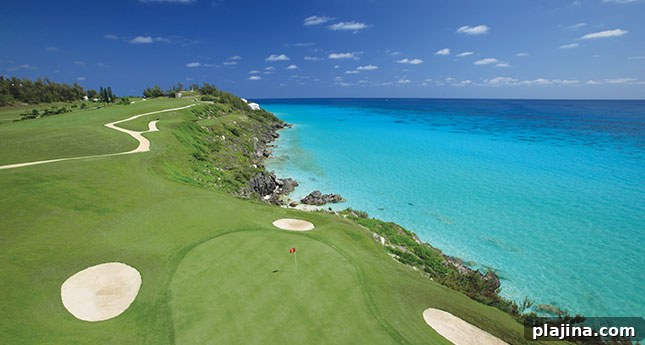
Bermuda’s Port Royal Golf Course — a course I played about 15 years ago — now has a refreshed, modern look. A recent $14.5 million renovation prepared the layout to host the PGA Grand Slam, Bermuda’s premier golf event, in October. Port Royal is scheduled to host the event again in 2010.
Andrew Brooks, director of golf, describes the work as a reshape rather than a redesign. Original architect Robert Trent Jones, Sr. never intended the shoreline views to be blocked by overgrowth. To restore those dramatic ocean vistas, Roger Rulewich — who worked with the original design team in 1970 — cleared many aging Bermuda cedar trees, added thoughtful plantings and opened sightlines while preserving the course’s classic character.
The yardage was extended by nearly 300 yards to 6,842 yards to reflect modern equipment and the way today’s players hit the ball. While the overall routing and feel remain true to the original design, holes 12 and 13 were swapped and now play as a par 4 and a par 3 respectively. The work balances modern playability with the course’s timeless seaside charm.
The nearby Cambridge Beaches Resort & Spa is the closest accommodation and offers a European package that includes breakfast, lunch and dinner. Dining on the restaurant patio is a relaxed highlight, and there are several casual lunch options on property. The spa provides a full menu of treatments and massages; while I played golf, my daughter enjoyed a manicure and facial, making it an ideal stay-and-play escape.
Hole 1 (438 yards, par 4)
The opening dogleg right teaches the positional golf required at Port Royal. Aim center-right off the tee to set up the approach; a right-side drive minimizes the influence of the pond guarding the left side of the green. The green is subtly undulating with a diagonal hump from back to front, so plan your approach and putts accordingly.
Hole 4 (458 yards, par 4)
This gentle dogleg right features two fairway bunkers on the right and out-of-bounds with dense brush to the left. Favor a landing zone just left of the bunkers to leave a mid-iron into an elevated green protected by bunkers on both sides. Take enough club to reach the pin on the uphill approach.
Hole 7 (517 yards, par 5)
The dogleg left requires a tee shot to the center-right to open a clean second shot up the rising fairway. Left-side misses can be recovered but often demand clearing traps and several small palms. A well-positioned second shot leaves a short iron to an elevated green; a lone tree on the right can block errant approach shots and a bunker guards the right of the green. The reward for reaching the green is exceptional: sweeping views of beaches and turquoise water form a stunning backdrop to your putt.
Hole 8 (213 yards, par 3)
You backtrack to this tee from Hole 7, but the ocean view makes it worthwhile. The hole plays slightly less than the stated yardage because the green sits below the tee. A sand trap protects the right, while a narrow throat on the fairway funnels many shots onto the green. Shots long threaten thick vegetation and the cliff edge above the Atlantic, so club selection is important. Pause to admire the water and the activity below at the nearby Pompano Beach Club.
Hole 15 (412 yards, par 4)
This picturesque hole sits beside an old fortification, the Whale Bay Battery, which once guarded the Royal Naval Dockyards from the Hog Fish Cut Channel entrance. Take a moment to view the historic barracks and shell magazines before you play. Accuracy off the tee is crucial; balls left can roll down to vegetation on the slope toward Hole 16, and fairway bunkers may not stop a poorly placed drive. The green is straightforward, so avoid the surrounding bunkers and depressions to secure par.
Hole 16 (235 yards, par 3)
Play this hole from the back tee for the full drama — the green appears to reach out into the ocean. Wind is often a factor on this exposed hole and everything slopes left toward the sea, including the approach fairway for short shots. Many balls find the thick vegetation or the beach below, so commit to your line and club choice.
Hole 17 (507 yards, par 5)
As you turn back toward the clubhouse, the course tightens with a large pond left of the dogleg right coming into play. Favor the center-right of the fairway off the tee to avoid a sequence of fairway bunkers. The second shot is typically a lay-up; avoid the left side where the pond follows the rising ground toward the green. The third shot plays to a highly elevated putting surface protected by two bunkers on the right. This hole demands precision at every stage.
Hole 18 (410 yards, par 4)
The finishing hole features an elevated tee with a drive to the fairway below. The large pond again affects shots that are left or short. Longer tee shots set up an uphill approach to the green, which generally requires extra club. A final look beyond the putting surface reveals the clubhouse and offers a memorable finishing view.
Port Royal Golf Course
P.O. Box 189
Southampton, SN BX, Bermuda
tel 441 234 0974