
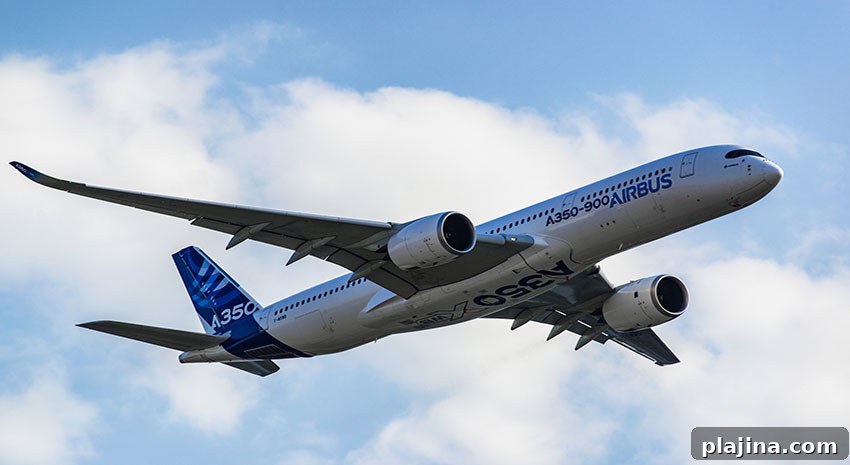
Turkish Airlines has signed a memorandum of understanding to acquire at least 20 Airbus A350-900 aircraft.
“As the airline that serves more destinations than any other carrier worldwide, we look forward to deploying the new A350 XWB to expand our major international routes from Turkey,” said M. İlker Aycı, chairman of the board and executive committee of Turkish Airlines. “This agreement expresses our commitment to proceed with and finalize the acquisition with Airbus. It represents a meaningful step toward improving the flight experience for our passengers and supporting growth in the years ahead. We also expect Airbus’s increased activity to benefit local Turkish suppliers and the wider aerospace sector.”
The memorandum was signed in Paris during Turkish President Recep Tayyip Erdoğan’s visit to France. Turkish Airlines has a long-standing relationship with Airbus, and the A350 XWB joins a succession of Airbus models already serving the airline.
Designed with advanced technology and an efficient airframe, the A350 XWB is equipped with new Rolls-Royce engines that deliver significant fuel savings and lower emissions. Airbus estimates the model can achieve around a 25 percent reduction in fuel burn and emissions compared with previous-generation widebodies, while also reducing maintenance costs. Passenger comfort is a focus as well: the Airspace cabin offers a roomy, modern interior that enhances the onboard experience through improved lighting, larger overhead bins, and quieter operation.
For Turkish Airlines, the A350 XWB aligns with strategic goals to grow international capacity, improve operational efficiency, and elevate customer service. Introducing the A350 into the fleet is expected to support longer-range routes, increase payload flexibility, and contribute to more sustainable operations by lowering per-seat fuel consumption and emissions. The aircraft’s range and efficiency make it suitable for both high-demand long-haul routes and thinner long-range services that benefit from modern widebody economics.
Beyond operational and passenger benefits, the agreement underscores broader economic impacts. Procurement of new widebody aircraft typically stimulates demand for local suppliers involved in components, maintenance, and ground services. Turkish Airlines highlighted that increased collaboration with Airbus and associated supply chains could create opportunities for Turkish businesses in aerospace and related industries.
The adoption of the A350 XWB also reflects industry trends toward more fuel-efficient, lower-emission aircraft as airlines modernize fleets to meet environmental targets and passenger expectations. Features such as improved aerodynamics, advanced materials, and quieter, more efficient engines help carriers reduce their carbon footprint while offering a more comfortable cabin environment.
As Turkish Airlines works to finalize the acquisition, the introduction of at least 20 A350-900s would be a major addition to its long-haul fleet, supporting its position as a global hub carrier and enhancing connectivity between Turkey and destinations across Europe, Asia, the Americas, and Africa.