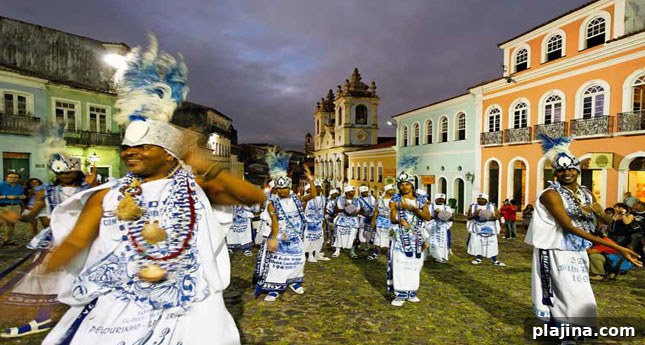
Experience the Brazilian city of Salvador wherever you are right now. If you own Paul Simon’s 1990 album The Rhythm of the Saints, play the track “The Obvious Child.” If not, queue it on a streaming service. Close your eyes and listen.
Hear that opening burst of percussion and imagine Pelourinho Square, where the recording was captured. The brisk rhythm seems to bounce off the cobblestones and reverberate against the Portuguese colonial facades that frame the plaza.
You may notice another layer in those cascading rhythms: an unmistakable echo of Africa.
The Pelourinho — affectionately called Pelô — is Salvador’s oldest quarter. Perched on a cliff overlooking Baía de Todos os Santos (Bay of All Saints), it was here that Portuguese settlers established Brazil’s first colonial capital in 1549.
To build their tropical economy so distant from Europe, they cultivated sugarcane and imported enslaved people from Africa to labor on the plantations and in the port.
Today’s Pelourinho Square, a narrow, sloping strip of cobbles at the heart of the district, still bears the marks of that early history. Pastel-painted buildings recall Lisbon. From beneath the shade of the Church of Our Lady of the Rosary, you can pick out several other centuries-old Catholic churches clustered on the hill, their towers rising above red-tiled roofs.
Despite the European architecture, most people in the square are of African descent. Souvenir stalls sell African drums in many sizes, and the Nigeria Cultural House displays a green-and-white national flag from its wrought-iron balcony.
Brazilian cities typically reflect a blend of European, African and indigenous influences. In the Amazon, indigenous culture is more prominent; farther south, European traits are stronger. In Salvador, however, roughly 80 percent of the 3.5 million residents have African ancestry, making it the largest African-descended city outside the continent.
Some African threads are immediately visible. When the drummers of Olodum — the group that played on Paul Simon’s “The Obvious Child” and on Michael Jackson’s “They Don’t Care About Us” — rehearse in Pelô, their percussion produces a primal pulse that traces back across the Atlantic to Africa.
The same heartbeat supports another public spectacle: capoeira. On many corners you’ll see young men engaged in what appears to be a slow-motion duel. They spin, kick, flip and feint with astonishing agility, delivering blows that nearly miss. Capoeira evolved from dances and combat techniques brought by African slaves in the 16th century. In Salvador, street capoeira favors agility and style over aggression, performed to steady drums and chanting crowds in a hypnotic display.
Africa also shapes the food. Bahian cuisine relies on ingredients like palm oil, cassava, coconut milk, cashews, lime and dried shrimp to create intensely flavored dishes. Although Bahian specialties are enjoyed across Brazil, Salvador remains their epicenter and draws food lovers from throughout the country.
Of all African influences, the most profound is often the most concealed: Candomblé.
Candomblé, a syncretic blend of Catholicism and African spiritual traditions, is the dominant faith in Salvador. It survived centuries of repression and only began to gain official acceptance in recent decades. Even today, its ceremonies are sometimes conducted discreetly in churches or private houses, accompanied by drums and ritual chants.
On the Bonfim peninsula to the north of downtown, Catholic devotion and Afro-Brazilian belief coexist in remarkable ways. Nosso Senhor do Bonfim, the city’s best-known church, exemplifies this mingling of practices.
Ribbons tied as ex-votos in front of Nosso Senhor do Bonfim church © Jibmeyer | Dreamstime.com
Approaching from a shaded square, you notice thousands of tiny colored ribbons tied to the fence, fluttering in the bay breeze. Each ribbon represents a petition for a miracle; local lore says that when a ribbon decays, the wish it represents has been granted.
Inside the church, the Room of Miracles displays wax effigies of body parts — legs, arms, heads, hearts, and more — each intended as a testament to answered prayers. During centuries when Candomblé was suppressed, worshippers outwardly honored Catholic saints while privately linking them to Candomblé deities. Nosso Senhor do Bonfim is associated with Oxalá, one of the faith’s principal orixás.
Pure Candomblé rites take place in terreiros, sacred compounds where devotees gather for ceremonies. Once closed to outsiders, some terreiros now welcome small, respectful groups of visitors. If you attend, hire a local guide to navigate neighborhoods and explain rituals. Dress in white or pale colors as a sign of respect, and do not join the dancing unless invited.
Elsewhere and at other times, Salvador encourages celebration. The city is widely regarded as Brazil’s party capital. Most festivities unfold in the streets rather than in flashy nightclubs, with spontaneous music and dance spilling into public spaces.
The largest of these celebrations is Carnival, a six-day street festival that transforms Salvador into a vast, colorful spectacle. Massive sound trucks crawl along set routes while roughly two million revelers follow, dancing to non-stop music and filling the city with energy.
Salvador’s reputation for wild revelry stretches back centuries. In the 17th century the bay earned the jocular nickname “e de quase todos os pecados” — “and nearly all the sins” — reflecting the port’s lively, transgressive character.
In the Lower City, where the marina’s masts punctuate the skyline, crumbling townhouses and old warehouses nod to a past shaped by trade, prostitution and slavery. These buildings stand alongside more modern commercial structures, preserving a sense of the port’s layered history.
Physically, the city is split by a steep cliff separating the Lower and Upper cities. Until the 19th century goods were hauled by hand along the incline. The Plano Inclinado do Pilar funicular eased that burden, and in 1873 the Lacerda Elevator began transporting people and cargo between levels. Both systems still operate; the elevator ride lasts about 20 seconds and costs only a small fare.
At the top, Pelô’s paved square opens to ornate colonial architecture, a reminder of why the district is a UNESCO World Heritage site. Yet Pelourinho — literally “whipping post” — also recalls the brutal punishments enslaved people endured on this very ground.
The neighborhood constantly shifts between African and European influences. The grand churches attest to the wealth extracted by colonizers; the Church of São Francisco is a striking example, its interior lavishly covered in gold leaf.
Gold interior of the Church of São Francisco © Fábio Salles | Dreamstime.com
By contrast, the Museu Afro-Brasileiro, housed in a former 19th-century medical school, exhibits carved artifacts made by enslaved Africans, tribal weapons and early representations of Candomblé deities, preserving and interpreting the African heritage central to Salvador’s identity.
Salvador lost its status as Brazil’s capital to Rio de Janeiro in 1763 and later ceded national prominence to Brasília in 1960. The decline of slavery and the sugar industry precipitated a long period of economic downturn. In the latter half of the 20th century, however, the city rebounded: population growth accelerated, suburbs spread along the coast, and a modern financial district emerged.
Rapid expansion strained infrastructure. Congested rush hours remain a pressing issue as Salvador prepared to host global events such as the FIFA World Cup and the Olympic Games. To address transit challenges, a metro system has been built in stages, with the downtown section operational since 2012 and further extensions planned to link the airport and carry hundreds of thousands of passengers daily.
For residents, escape is simple: the beaches. Salvador offers wide stretches of golden sand and warm Atlantic waters, and on weekends many locals head to the coast to relax. At sunset, crowds gather at Forte de Santo Antonio, the fort and lighthouse at the bay’s entrance, to watch the sun dip over the water — a ritual carried out here for centuries.
Early settlers likely looked across the Atlantic toward distant homelands in Portugal or Africa. Today, Salvador’s community turns west each evening, watching fishing boats return to the bay and witnessing a city that blends history, culture and celebration along a vibrant coastline.
Where to Stay in Salvador
Hotel Casa do Amarelindo This intimate boutique hotel in Pelourinho offers just 10 rooms and a small pool. Located in the pedestrian zone, it requires a short walk on arrival. Rua das Portas do Carmo 6 $$$
Mercure Salvador Boulevard A modern high-rise in the financial district with good views from upper rooms. The historic center and beaches are a short taxi ride away. Rua Eweron Visco 160 $$$
Pestana Convento do Carmo Housed in a restored 1586 convent, this 79-room property is the most luxurious option in historic Pelourinho. Rua do Carmo 1 $$$
Restaurants in Salvador
Amado Restaurante Overlooking the Bay of All Saints, Amado pairs contemporary architecture with modern cuisine, suitable for business meals or special occasions. Av. Lafayete Coutinho 660 $$$$
Mao Dupla Restaurante Charming and unpretentious, this spot serves home-style Bahian dishes and offers seating on the cobbled street. Rua Santa Isabel 10 $$
Restaurant Paraíso Tropical Tucked into a lush neighborhood, this restaurant sources many ingredients from its own garden and rewards those willing to seek it out. Rua Edgar Loureiro 98-B, Cabula $$$
Salvador Info to Go
Deputado Luís Eduardo Magalhães International Airport (SSA) sits about 17 miles northeast of downtown. While some international flights connect directly to Miami and select European cities, many travelers arrive via São Paulo. A fixed-rate taxi from the airport to the city center is commonly available.
Read more about Bahia.