
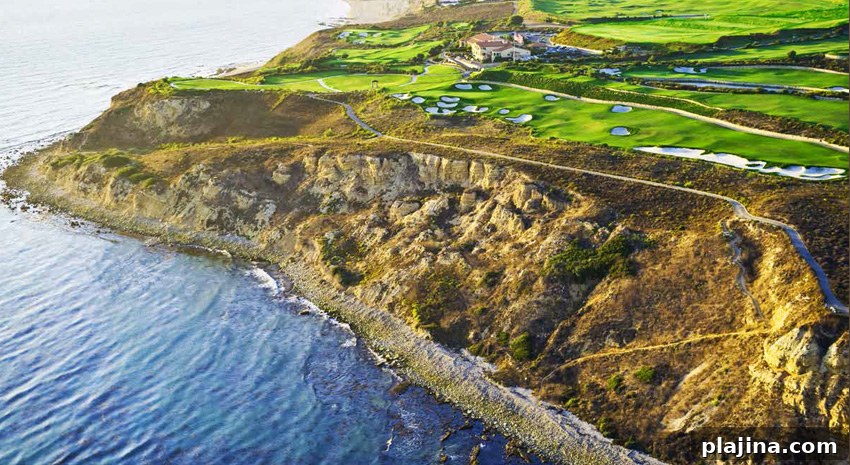
OVER THE COURSE of my career, I have played many rounds at Trump National Golf Club, Los Angeles. The staff there have always been helpful in securing tee times for travelers like me on extended business trips. Special thanks to Lili Amini, general manager, and Joey Lewis, PGA head golf professional, who are always accommodating when I visit.
I have a client who still recalls the time the head of my 7-iron snapped off and sailed into a deep ravine, destined to be part of the course forever. He brings it up every time we play.
One memorable event was an American Airlines “Tee It Up with Tiger” outing, held when Tiger Woods was recovering from a stress fracture. He walked with us on Hole 11, a par 3, and—after watching my tee shot—said, “Hey, that looks like a pretty good shot!”
I recently attended a Chase Inside Access event where Hank Haney, Tiger Woods’s former swing coach, gave each participant a short lesson. Haney’s book, The Big Miss, provides an insightful backstory on Tiger and is worth a read.
The club began as Ocean Trails, a course famously known for losing its 18th hole to the Pacific Ocean in 1999, just weeks before its scheduled opening. A cracked drainage pipe leaked and caused the hole to slough off into the sea. After attempts to keep the course afloat, the previous owner placed it in receivership. The Trump Organization acquired the property, negotiated repairs and insurance, and set about a dramatic overhaul—proof that reading insurance policies pays off.
Donald Trump was reportedly involved in the redesign, which included added waterfalls, extensive sand bunkering and other features. By 2015 the waterfalls were removed—partly, some say, due to the California drought and partly because the features felt artificial and gimmicky. Ahead of a major event, the course was refined: the waterfalls are gone, bunker work improved, and the layout feels more natural and challenging. The result is a refreshed Trump National Golf Club, Los Angeles.
On my most recent round I teed up with E Bae Kim and Bill Noonan from Asiana Airlines and Vladimir Velasco, formerly with Malaysia Airlines.
HOLE 1 | 358 yards, par 3
This opening hole used to feel harsh: an elevated tee dropping to the fairway below, with water features behind the green. Renovations removed the waterfall and added about 30 yards to the left to create a bailout area, turning the hole into a true risk-reward test. The green sits a bit higher now, making approaches more blind unless you are left of center, and the raised fairway changes how the hole plays. The higher green demands better control on approach shots—something that troubled us. We all hit strong drives, including a beautiful one by E Bae, but second shots proved difficult. Vlad played the hole best, managing a bogey.
HOLE 9 | 509 yards, par 4
Hole 9 is the course’s toughest handicap, largely due to length and the fairway’s right-to-left slope. Drives can be pulled into a huge left fairway bunker—about 120 yards long—or they can run toward the lake guarding the green. For many weekend players it plays like a forced par 5. The three-tiered green sits behind water, which makes approaches and scoring tricky. Bill tried a little mind game on me, but I managed to hold par.
HOLE 17 | 240 yards, par 3
The championship tee renovations make this a formidable par 3 for most golfers. This hole, like others that shed their waterfall features, has seen significant bunker work to restore its playability. From the tee you get a striking view of white sand bunkers and the large American flag beyond the green by the clubhouse. I swung aggressively, misfired left into the bramble, and took several shots to recover. Vlad and E Bae chose safer lines right and in front of the green, setting up simple wedge shots and one-putt pars.
HOLE 18 | 512 yards, par 4
The finishing hole offers stunning Pacific Ocean views and cliffs that once swallowed part of the course. As we teed off a cool marine breeze crept in—the Rancho Palos Verdes area is often much cooler than central Los Angeles and can be shrouded in morning fog. On clear days you can see Catalina Island and sometimes whales in the water below.
The fairway at 18 is two-tiered; landing on the lower or upper tier changes how you approach the green. The lower tier forces play over a collection of bunkers guarding the approach—seven on the left alone—while the upper tier opens a chance to reach the green with a clearer line. One golfer on every group seems to cut the left too close and end up in the enormous bunker there; I was that person this day, and escaping left cost me any hope of par. The rest of our group also found the hole challenging. Over the years I’ve enjoyed watching clients scramble up the right side like mountain goats to retrieve errant balls.
Recent work to open sightlines and expand bailout areas improved both playability and ocean views. The clubhouse staff consistently delivers excellent meals and service, and the pro shop completes a satisfying on-course experience.