
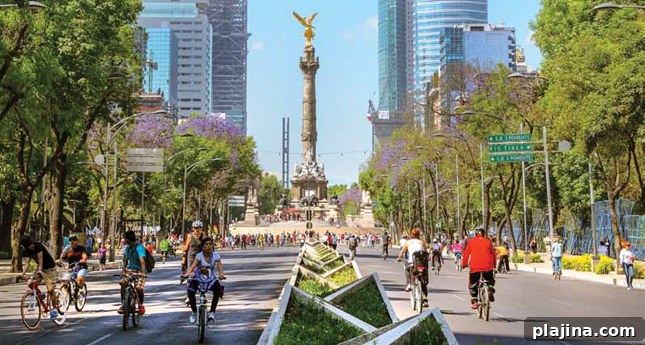
Like a resilient lucha libre wrestler who keeps coming back into the ring, Mexico City — the largest metropolis in North America by population — has repeatedly shaken off crises and grown stronger. When the peso devaluation hit in 1994, the city seemed beaten: crime was high, smog thick, and public sentiment gloomy. Yet over the decades the capital has rebounded, and recent currency fluctuations prompted more of a shrug than alarm.
Economic indicators and tourism figures reflect that resilience. Non-oil exports continue to rise, and 2014 set a record for foreign visitors in Mexico as a whole (29.1 million) and in the capital specifically. The historic center has been restored and enlivened, public transit has expanded with new subway lines and cleaner buses, and visible infrastructure upgrades have boosted daily life. These improvements have even led to cleaner air in parts of Mexico City compared with some departure airports — a striking reversal that illustrates the city’s recovery and renewed vitality.
As the first Spanish capital in the New World, Mexico City now lays claim to many cultural crowns. Its museum scene is unrivaled — more than 170 institutions showcase art, history and anthropology — and the city is widely regarded as Latin America’s premier food capital. While Lima and Buenos Aires attract international acclaim, Mexico City’s culinary range and sophistication are hard to match. From Oaxacan mole and street tacos al pastor to alta cocina in world-class restaurants, exceptional dining is accessible across neighborhoods. Mexican chefs regularly appear on global “best of” lists for their creativity and quality.
Mexican tacos al pastor © Kay Ecker | Dreamstime.com
Business in Mexico City often mixes with dining. Meetings frequently begin over a generous breakfast that can carry on for hours before officials return to the office. Reforma 500 at the Four Seasons has long been a favored spot for power breakfasts, where executives and politicians discuss deals over chilaquiles or omelets. El Cardenal offers a legendary yet more relaxed alternative, with its original location in the historic center and another at the Hilton near Alameda Park.
Lunch meetings tend to start in the midafternoon and run long, with socializing preceding formal conversation. “Mexicans tend to be very etiquette-conscious,” notes Jim Johnston, author of Mexico City: An Opinionated Guide for the Curious Traveler. “A heavy dose of social lubrication is usual before diving into business talk.”
Business travelers and buyers often choose restaurants that combine quality food with an appropriate atmosphere. Contramar in Condesa is a popular spot for seafood and productive meetings; Pujol remains one of the country’s most celebrated dining experiences and requires reservations well in advance. Dulce Patria, led by Chef Martha Ortiz, presents inventive dishes and elegant plating inspired by regional crafts and traditions.
Fountain of Diana the Huntress and The St. Regis Mexico City Hotel © Jose Antonio Nicoli | Dreamstime.com
Visitors often find Mexico City easier to navigate than expected. Most of the 4- and 5-star hotels cluster along a corridor less than ten miles long that runs from Alameda Park through wide Paseo de la Reforma and alongside Chapultepec Park to the upscale Polanco neighborhood. This corridor hosts many top hotels, including the Four Seasons, The St. Regis and the JW Marriott, making travel between business and leisure destinations convenient.
While Paseo de la Reforma is a business hub, other districts host corporate offices and client meetings. The Santa Fe district, located farther from the historic center, resembles an American suburban office park and has attracted national and international company headquarters since the mid-2000s. Firms such as Ford, Sony, Microsoft and PepsiCo maintain significant operations there. Santa Fe’s daytime energy comes with numerous hotel conference facilities and international-chain properties like JW Marriott and Westin, and boutique design-focused options such as Distrito Capital cater to creative travelers.
Heavy traffic has led to a practical local adaptation: many professionals limit travel across the city, so each neighborhood has cultivated standout restaurants and services. For business dining in Santa Fe, hotels like the JW Marriott and the InterContinental offer reliable venues suited to client meetings.
Mexico City sits in a high valley, not on a tropical coast, so much of the year brings cool weather that often calls for a jacket. Professional dress remains common, with suits frequently worn by both men and many women in corporate and government roles. Social norms around courtesy and gender roles persist in everyday business etiquette; for example, it remains typical for one person, usually male, to pick up the check after a meal. Although most quality restaurants accept credit cards, occasional card machine problems make it wise to carry some local cash as a backup.
Mexico City is increasingly important as a convention and conference destination, with three major convention centers and numerous hotel meeting spaces attracting international events. Airport capacity has been a bottleneck, but major expansion plans promise significant relief: a large-scale airport development will add terminals, gates and runways, increasing annual passenger capacity substantially once completed.
Overall, Mexico City presents a blend of historical richness, cultural abundance and modern amenities. Its restaurant scene, museums and improving infrastructure make it a compelling destination for business travelers and tourists alike, offering both tradition and innovation in a dynamic urban setting.