
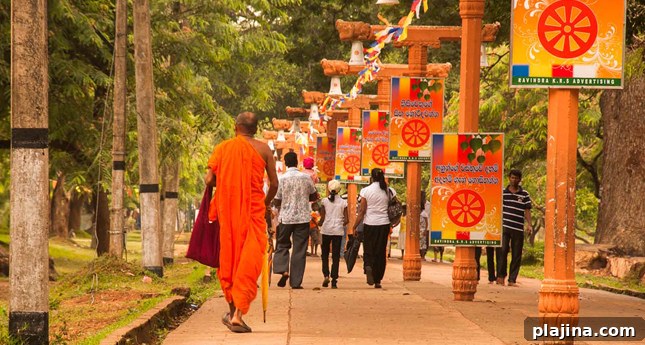
If you’re seeking a destination that packs a remarkable variety of experiences into a compact area, Sri Lanka delivers. Though small in size, this island in the Indian Ocean offers a rich blend of natural beauty, cultural heritage and modern comforts. Often called the “Pearl of the Indian Ocean,” Sri Lanka presents striking ancient sites alongside white-sand beaches, bustling cities, national parks, tea estates and unique wildlife such as the Sri Lanka leopard.
Known as Ceylon until 1972, Sri Lanka lies off the southeast coast of the Indian subcontinent. Its documented history extends more than 3,000 years, and archaeological finds point to human activity reaching far into prehistory. The country emerged from a 30-year civil war in 2009 and today functions as a republic governed by a presidential system. Major national products include tea, coffee, gemstones, coconuts, rubber and cinnamon.
My trip to Sri Lanka with a few photographer friends was a perfect complement to a business visit to nearby India. We met in Colombo, the capital, and stayed at the historic Galle Face Hotel. This grand, colonial-era property—whose original section dates to 1864—sits on manicured lawns that slope down to the sea.
A festooned elephant at the Kandy Esala Perahera festival © Ellen Clark
After a city tour and a good night’s rest, we left Colombo for the island’s interior and the Cultural Triangle, an area with a dense concentration of Sri Lanka’s most revered historic and sacred sites.
Our first stop was Anuradhapura, one of the island’s ancient capitals and among the oldest continuously inhabited cities in the world. As a center of Theravada Buddhism for centuries, the UNESCO World Heritage site includes one of Buddhism’s holiest places and the 2,200-year-old Sri Maha Bodhi tree, grown from a cutting of the fig tree beneath which the Buddha attained enlightenment.
Beyond its religious importance, Anuradhapura was home to one of the ancient world’s most sophisticated irrigation systems; many of its large reservoir tanks remain today.
I was particularly struck by Ruwanwelisaya, an imposing stupa enclosed by a wall adorned with nearly 1,900 large black elephant statues. Inside the enclosure we joined worshipers in circumambulation—walking clockwise around the stupa in meditation, a traditional expression of reverence that keeps the Buddha’s teachings at the center of life.
By dusk we reached Cinnamon Lodge Habarana, a resort with cottages nestled among 27 acres of green grounds where playful monkeys are frequent visitors. A refreshing swim and an alfresco dinner on a tree-shaded patio were an ideal end to a full day.
The next morning, in light drizzle, we visited Sigiriya, another UNESCO World Heritage site dominated by a towering rock column nearly 660 feet high. In the fifth century King Kasyapa built his palace on the summit and decorated the rock face with frescoes. Although most of the original paintings are gone, about 22 of the estimated 500 survive midway up the climb.
After a vigorous ascent we reached the platform where a giant brick lion once stood. The original approach to the summit passed between the lion’s paws and through its mouth; today only the paws remain, and the final climb follows a narrow zigzag stairway affixed to the rock—no place for the unfit or acrophobic. Those who make it to the top are rewarded with palace ruins and sweeping views of the surrounding landscape.
Dambulla Buddhas © Ellen Clark
After lunch we drove to Dambulla, a sacred site since the second century B.C. and home to Sri Lanka’s largest and best-preserved cave temple complex. A 20-minute climb up moderately steep steps brought us to five caves filled with paintings and statues depicting Buddha and scenes from his life.
Although those ancient monuments were captivating, we shifted gears for the cultural energy of Kandy.
Kandy’s Esala Perahera is one of Sri Lanka’s oldest and grandest Buddhist festivals, honoring the Sacred Tooth Relic housed in the Temple of the Tooth. Spanning ten days, the festival blends deep religious observance with spectacular public pageantry; its nighttime parades are often described as among the world’s largest cultural processions.
Attending a nighttime Perahera parade was a highlight of the trip, but it also attracts huge crowds and strict security. Booking assigned seating in temporary bleachers along the route proved essential. With a guide and prearranged seats we settled in two hours before the start, watching the crowd swell around us.
A dancer at the Kandy Esala Perahera festival © Ellen Clark
While waiting we even managed to eat; an entrepreneurial local Pizza Hut took orders from the stands and delivered pizzas and soft drinks to spectators. The mix of traditional spectacle and modern convenience—pepperoni pizza in hand while watching a cultural procession—felt wonderfully surreal.
When the cannon signaled the parade’s start, the show unfolded in a continuous stream of color and sound. Dancers cracked whips and twirled flaming torches, musicians played flutes and drums, stilt-walkers and flag-bearers marched, and dozens of elephants, richly adorned and lit with twinkling lights, moved along the route. The crowning moment for devotees came when the elephant bearing the relic casket—more elaborately decorated than the rest—passed by, draped in garlands and carrying the symbolic casket of the Tooth Relic.
By the end of the night we had sat for more than six hours, but none of us regretted staying for such a memorable and moving event.
We later left the busy lowlands for the cool, misty hills of Nuwara Eliya. The Grand Hotel, an elegant example of Elizabethan-era architecture, felt like a step back in time to the days of British colonial rule and provided comfortable rest before our hike through Horton Plains National Park.
We were on the trail early the next morning. Horton Plains covers more than 12 square miles of montane grassland and cloud forest and supports many endemic species. We enjoyed a few leisurely hours hiking a well-marked trail through a peaceful landscape—a pleasant contrast to the festival crowds.
Our journey through Sri Lanka was full of contrasts: sacred sites and lively celebrations, rugged nature and carefully tended tea estates, British-era hotels and modern eateries. It was a trip that engaged the senses and revealed the island’s rich cultural tapestry.
Sri Lanka Info to Go
Bandaranaike International Airport, located about 22 miles north of Colombo, is Sri Lanka’s primary international gateway. An airport taxi service operated by Airport and Aviation Services maintains a counter in the arrivals lobby with a large fleet, and independent taxis are available outside. A ride to downtown Colombo is typically around $15. A shuttle bus runs frequently to the nearby main bus station, where intercity buses provide access to the city.
Read more about Sri Lankan history.