
What a difference a name can make. Just over a decade ago, the more than 80-mile stretch of pristine beaches and lush jungle along Mexico’s Yucatán Peninsula east coast was commonly called the Cancún–Tulum Corridor. The name described its endpoints on Highway 307—Cancún in the north and Tulum in the south—but it lacked character.
By the late 1990s, Cancún had long been an established tourism hub, and Tulum was drawing more day-trippers eager to see its well-preserved Maya ruins. Few travelers, however, paused to experience the unspoiled coastline and authentic fishing villages between those endpoints. Miguel Ramón Martín Azueta, then-mayor of Solidaridad (the municipality that stretches from Playa del Carmen to Tulum and inland to the Yucatán border), led an effort to rebrand the region as the Riviera Maya.
In retrospect, many consider Azueta a marketing visionary. Others might disagree with his methods, but his initiative reshaped not only the name but the identity of the area. Planners and developers have worked to avoid the high-rise stampede that characterized much of Cancún’s growth, aiming instead for a more measured approach. That balance has been difficult to achieve—developers and environmental advocates have clashed repeatedly—but the region shows signs of more sustainable development patterns.
Community Tours Sian Ka’an is a strong example of collaboration between conservation and tourism. The group is an alliance of local tour operators committed to sharing the Sian Ka’an Biosphere Reserve in an ecologically responsible way. Sian Ka’an—Maya for “where the sky is born”—covers about 1.3 million acres of tropical ecosystems, including lowland forest, flooded savannas, mangrove swamps and part of the Mesoamerican Barrier Reef, the world’s second-largest coral reef system. The reserve hosts roughly 800 plant species and provides habitat for some 350 bird species, as well as jaguar, puma, ocelot, spider and howler monkeys, crocodiles and several turtle species. It also contains nearly two dozen pre-Columbian archaeological sites.
Established in January 1986 and declared a UNESCO World Heritage site in 1987, Sian Ka’an is also part of UNESCO’s Man and the Biosphere program, a global initiative that designates protected areas to study and monitor biodiversity. As a Man and the Biosphere site, Sian Ka’an faces the challenge of integrating human activity without compromising the ecosystems within its boundaries. Community Tours Sian Ka’an meets that challenge by promoting responsible, community-driven tourism.
I joined a guided Community Tours outing led by Alberto Cen Caamal, a naturalist who speaks Maya, English and Spanish. Quiet and knowledgeable, Alberto escorted us along forest paths and boardwalks, past Maya ruins and through wetland habitats, pointing out notable plants and wildlife. When asked about the group’s purpose, he explained the social and economic motivations behind their work.
Before organized tourism arrived in the Riviera Maya, most residents around Tulum worked in low-paying agriculture, often performing backbreaking labor for little reward. Many spoke only Maya, limiting opportunities in nearby towns. Today tourism in Sian Ka’an provides the primary income for an estimated 80 percent of the local population. This industry allows communities to protect their ancestral lands while earning a living—an outcome residents take seriously.
Community Tours emphasizes environmental awareness. Their messaging stresses that both locals and visitors must understand the potential for irreversible damage to wildlife and ecosystems such as coral reefs. To reduce impact, the company encourages group transportation instead of individual cars, plants a tree for every 5,000 miles their vehicles travel and employs guides trained to minimize environmental disturbance on excursions.
On the tour we emerged from the forest onto a riverbank where boats awaited to carry us across open water into a maze of marsh channels. We briefly donned lifejackets—Alberto suggested wearing them backward for a more comfortable float in shallow water—and then drifted down a slow-moving river like a flotilla of ducklings following their mother. After about an hour, our support boats met us and returned us to shore, where a meal prepared in a local kitchen awaited.
The tour felt worlds away from the busy, beachside commerce of Cancún, just 80 miles to the north. As the saying goes, “so near and yet so far”—a fitting description for how close the comforts of mainstream tourism can be yet how different the experience in the Riviera Maya remains.
Transportation Update
Earlier this year, Mexican authorities launched the bidding process for construction and management of a new airport near Tulum. If it proceeds, the airport is expected to open in 2012 and could handle up to 700,000 visitors in its first year. The proposal has stirred debate, pitting development interests against environmental advocates. Ideally, stakeholders will find a compromise that brings economic benefits while safeguarding the region’s environmental integrity.
Info To Go
Cancún International Airport (CUN) is the primary gateway to the Riviera Maya. Located about 16 miles southwest of Cancún and roughly 31 miles north of Playa del Carmen, the airport hosts most major car rental companies. Taxis are available but can be costly. Highway 307 links Cancún with the Riviera Maya and is a modern, four-lane divided road through Calica, six miles south of Playa del Carmen; it continues as a two-lane highway from Calica to Tulum. Check your hotel for airport shuttle options.
Diversions
Playa del Carmen
Playa del Carmen is often considered the unofficial capital of the Riviera Maya. Once a fishing village, the town retains a relaxed beach vibe while offering dining options that appeal to discerning food lovers. Stroll pedestrian-only Fifth Avenue to browse menus and shop for everything from souvenirs to high-end jewelry. When buying silver, look for .925, .950 or .970 stamps to ensure sterling quality.
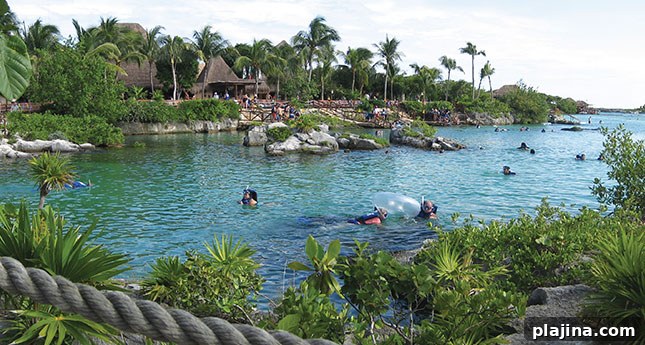
Xel-Há, about 30 miles south of Playa del Carmen, is a “natural aquarium” where visitors can swim among many colorful fish species. Farther south are the Dos Ojos cenotes—two adjacent circular sinkholes—popular with scuba divers and snorkelers. El Eden, about 15 miles south of Playa del Carmen, offers a more tranquil swimming experience.
The Riviera Maya is also a notable golf destination. Home to the annual PGA Mayakoba Golf Classic, the region features courses designed by Jack Nicklaus, Greg Norman, P.B. Dye, Nick Price and Robert Trent Jones Jr.
Lodging
Banyan Tree Mayakoba
A graceful fusion of Thai-inspired design and Mexican hospitality defines this exclusive beachfront resort and spa. Carretera Cancún–Tulum, Playa del Carmen, tel 52 984 877 3688.
Grand Velas All-Suites and Spa Resort
This all-suite, all-inclusive property offers family-friendly and adults-only accommodations with dining that exceeds typical all-inclusive expectations. Carretera Cancún–Tulum Km. 62, Playa del Carmen, tel 52 984 877 4400.
Zoëtry Paraiso de la Bonita Riviera Maya
An intimate luxury resort with 90 suites on 14 acres, including a private beach. Carretera Chetumal 328, Puerto Morelos, tel 52 998 872 8300.
Dining
Blue Parrot Beach Club
A casual beachfront spot perfect for sand-in-your-toes relaxation. Calle 12 Norte, Playa del Carmen, tel 52 984 206 3350.
Di Vino
Contemporary Italian-Mediterranean cuisine in a prime people-watching location. Calle 12 and 5th Avenue, Playa del Carmen, tel 52 984 803 1270.
John Gray’s Kitchen
Chef-owner John Gray, a former Ritz-Carlton chef, focuses on local produce and fresh seafood to create a memorable menu. Av. Niños Héroes, Lote 6, Puerto Morelos, tel 52 998 871 0665.