
“You must drink at least five before it begins to taste good, and you must drink it with Handkäs mit Musik.” My German friend was talking about Frankfurt’s famous apple wine, Ebbelwei, a regional specialty traditionally enjoyed with small pickled cheeses and thinly sliced onions.
The Sachsenhausen district on the south bank of the Main is where you’ll find the coziest taverns and cider pubs. Ebbelwei is commonly served from gray stoneware pitchers and is known for its low alcohol content and sharp, tart flavor. Locals claim it benefits circulation and calms the nerves, and it’s certainly an authentic taste of the city.
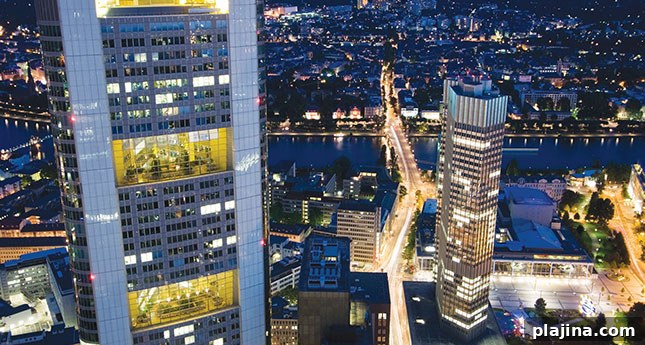
No visit to Frankfurt, Germany’s financial center, feels complete without wandering through this historic neighborhood and sampling Ebbelwei. From Sachsenhausen you get a striking view across the river of the skyline: a dramatic cluster of modern skyscrapers that have earned Frankfurt the nickname “Mainhattan.” The contrast between old and new is one of the city’s defining sights.
Many travelers first encounter Frankfurt as a transit hub. Its airport is the largest in continental Europe, and the Hauptbahnhof (central station) is among Germany’s busiest. The city is also a major motorway junction, so for many it remains a place they pass through rather than explore. That would be a missed opportunity.
Frankfurt was heavily damaged during World War II, yet much of its historic character has been carefully restored. The Römerberg square evokes the city’s medieval roots: a collection of half-timbered houses clustered around an open plaza, dominated by the Römer. This complex of three former merchant houses became the city hall after the city purchased them in 1405. The three-gabled Gothic façade remains an emblem of Frankfurt and still functions as the town hall.
The city’s most famous native son is Johann Wolfgang von Goethe, born here in 1749. Goethe spent his childhood and early youth in Frankfurt, even if he later described aspects of the city with critical affection. His birth house, the Goethe House at Grosser Hirschgraben 23–25, is a restored four-story residence furnished with period antiques, paintings and porcelain that help bring his early environment to life. Adjacent to the house, the Goethe Museum presents a broad collection of art, manuscripts and historical documents related to his life and the cultural context of his time.
Art lovers will appreciate the Museum of Modern Art, an unconventional building whose angular silhouette has a playful, slice-of-cake appearance. Designed by Viennese architect Hans Hollein, the museum offers an engaging layout of oddly shaped rooms and surprising corners—an inviting place to explore works from pop art through contemporary experiments.
Frankfurt’s cultural offerings extend along the Museumsufer, the Museum Embankment that lines the Main River. This stretch hosts a wide variety of institutions: museums dedicated to architecture, regional and European painting, communication, applied arts, film and more. The riverside setting makes it easy to plan an afternoon of museum-hopping with scenic pauses by the water.
For families and nature enthusiasts, the Frankfurt Zoological Garden is a highlight. Renowned among European zoos, it features well-designed habitats and a notable nocturnal animal house. Plant lovers should not miss the Palmengarten, a peaceful botanical garden with spacious greenhouses that shelter an extensive range of tropical and subtropical species. It’s a peaceful contrast to the urban energy of the city center.
Whether you arrive by plane, train or car, Frankfurt rewards visitors who pause and look beyond the transport hubs. From the cellar bars of Sachsenhausen where Ebbelwei is poured, to the historic charm of the Römerberg and the literary legacy of Goethe, to the modern pulse of skyscrapers and innovative museums, the city offers a rich mix of traditions and contemporary life that invites exploration and discovery.