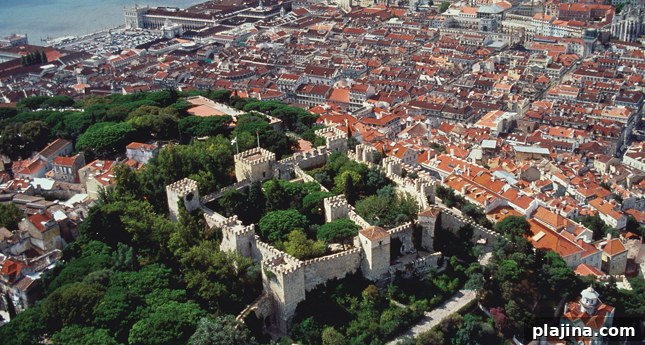
Lisbon reveals itself in a tangle of layered colors and textures. Cool creams, warm golden yellows and russet reds mingle across façades as streets radiate inward and outward from grand plazas and intimate squares. Up close, the city rewards attention with colorful azulejo tiles framing doorways and windows, ornamental fountains, leafy parks and an architectural patchwork spanning centuries.
My maternal grandfather’s family came from this city, and I’ve been fortunate to return several times. This visit I’m with my husband, James, who had expected to spend hours in museums and historic sites. He’s mildly puzzled when I steer him away from the riverfront monuments in Belém and down a small lane toward one of my favorite bakeries. I’m eager to share Lisbon’s celebrated addresses, but for now I’m on a mission for Portuguese pastry.
One of my enduring obsessions is Lisbon’s pastéis de Belém — delicate custard tarts best enjoyed warm with a dusting of cinnamon. Tied to the city’s history, the tarts trace back to monks who sold them after the social and political upheavals of the early 19th century. While many cafés sell similar pastries, Antiga Confeitaria de Belém remains a standout. Since 1937 it has produced the tarts using a still-secret recipe, turning out thousands daily.
The shop is crowded with locals and tourists on day trips from cruise ships, but James follows me to a tiled room in the back and lets me order for both of us. I shake cinnamon over the puckered custard tops and watch his expression change as he takes his first bite — an unmistakable moment of comprehension. I tell him that this is history at its most delicious.
Content, we set out to explore. Near the Praça do Império and beside the National Archaeological Museum stands the Monastery of Jerónimos, a UNESCO World Heritage site along with the nearby Tower of Belém. Built in an ornate, marine-influenced late-Gothic style known as Manueline, construction began in 1501 and took a century to complete. King Manuel I selected the monks who lived here to pray for his soul and those of Portugal’s navigators. The monastery honors Vasco da Gama, who spent his last night here before sailing to India and whose tomb lies by the entrance.
We enter through the richly carved south portal, wander along cloisters rimmed with delicate arches and then cross the riverside promenade beside the Tagus. Atop the mosaic compass near the Monument to the Discoveries, we pause on the broad paved walkway. The colossal stone sculpture of a caravel and figures such as King Manuel I, Vasco da Gama and Magellan projects toward the river, commemorating Portugal’s Age of Exploration and honoring Prince Henry the Navigator.
Leaving the river, we head inland. The tram looks tempting, but we prefer to walk in the sunshine, following paths that climb along uneven stairways and irregular pavements — reminders of the earthquakes that have reshaped the city. We slip into the Lisbon Cathedral, one of the oldest buildings in town, and see the quiet resting place of the city’s patron, St. Vincent, in the sacristy.
Our destination, St. George’s Castle, appears above the red-tiled roofs. We move among the ruins and reach the crumbling outer wall to take in the view. Below lies Alfama, Lisbon’s oldest neighborhood: a maze of tiered alleys that open suddenly into charming plazas. Elevated viewpoints called miradouros are scattered around this area, offering spaces to relax and admire vistas. At the Miradouro das Portas do Sol we pause by the statue of St. Vincent, who holds a ship and two ravens — symbols tied to a legend about ravens guarding the saint’s body until it could be properly buried.
For the return trip we ride a clanking tram down to Baixa, the city’s commercial and cultural heart. Neoclassical buildings line these streets; we pass Café Nicola, once a gathering place for literary figures, and the statue of Dom Pedro IV in Rossio Square. We sit on a marble bench by one of the fountains, watching water arc into the pool and run along the smooth stone forms of lounging nymphs. The plaza’s black-and-white pavement creates an undulating pattern like waves radiating from the fountain.
Traffic circles the square in a blur of horns and brakes, so we head down Rua Augusta, a wide pedestrian avenue lined with shops and cafés. James wants to see MUDE, the museum of design and fashion near the triumphal arch between Rua Augusta and Comércio Square. After exploring exhibits that examine design’s relationship with society, we do some shopping, picking up local goods: a set of glazed ceramic tiles for our house number and a supple cork belt that feels like leather.
We then ride the Santa Justa Elevator — also called the Elevator of Carmo — which links Baixa to Bairro Alto. Designed by Raoul de Mesnier du Ponsard, a former apprentice of Gustave Eiffel, the iron structure echoes the style of that Parisian landmark and is one of the city’s notable sights.
Near midnight we take a taxi to Senhor Vinho, a fado house. No famous names perform tonight, but the intimate setting and a lone guitarist create the right mood. A fado singer fills the candlelit room with songs of heartbreak and the sea; her voice seems to carry the whole city in its notes.
Every city has its own energy — a signature of scents, sights and sounds shaped by history. Lisbon’s energy is the Tagus and the sea, the azulejo tiles, winding streets and memory of bold sailors. The fado singer’s rising and falling voice captures that mix, and James looks at me and, even without understanding the Portuguese words, understands the feeling — and, in that moment, the city itself.
Info to Go
Lisbon International Airport (LIS) lies less than five miles north of the city, making for quick access by taxi or bus. Expect a surcharge for taxi service on weekends and holidays and overnight. The city’s metro and tram network is excellent though there is no direct metro link to the airport. Carris city buses serve the airport on several routes but only accept passengers with hand luggage and small carry-ons; passengers with larger luggage should use the Aerobus, which runs between the airport and central locations at frequent intervals.
Lodging
Altis Belém Hotel & Spa
Set along the riverside promenade, this luxury boutique hotel features an outstanding spa and refined dining. Doca do Bom Sucesso $$$–$$$$
Bairro Alto Hotel
A striking boutique property in a prime walking location between Bairro Alto and Chiado, named for Portugal’s beloved soldier-poet. Praça Luís de Camões 2 $$$–$$$$
Corinthia Hotel Lisbon
An elegant hotel overlooking a large nature park in the financial district, offering graceful rooms, a tea lounge, spa and solarium. Av. Columbano Bordalo Pinheiro 105 $$$$
Dining
Boca
Chef Alexandre Silva highlights fresh, local ingredients at this stylish spot. Open for dinner; reservations recommended. Rua Rodrigo da Fonseca 87-D $$$
Feitoria
Chef José Cordeiro explores flavors linked to Portugal’s former colonies in this Michelin-starred dining room. Reservations recommended. Altis Belém Hotel & Spa, Doca do Bom Sucesso $$$$
Tavares
Reputed to be the city’s oldest restaurant, this Michelin-starred venue serves traditional Portuguese cuisine beneath a gilded, wood-carved ceiling and chandeliers. Reservations recommended. Rua da Misericórdia 37 $$$$
Weblinks
Altis Belém Hotel & Spa
Bairro Alto Hotel
Boca
Corinthia Hotel Lisbon
Feitoria
Lisbon Visitors & Convention Bureau
MUDE Design and Fashion Museum
Monastery of Jerónimos
Senhor Vinho