
Isabu Dokdo Museum, located in Samcheok-si, Gangwon-do, South Korea, is a thoughtful architectural reinterpretation of the region’s history and geography. Positioned near Samcheok Port—approximately a four-hour train ride from Seoul—the museum links contemporary design with the story of a sixth-century military expedition.
In A.D. 512, Silla general Isabu launched a naval campaign from the area now occupied by the museum to subdue Usanguk (present-day Ulleungdo) and Dokdo Island. The museum presents Isabu’s voyage and life, while also offering context about Korea in the sixth century.
© Simplex Architecture
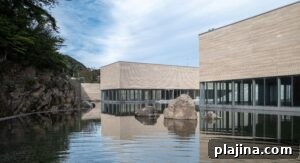
Archaeological traces of the site’s earlier topography inspired the creation of Yukhyangji Pond. By lowering parts of the ground and introducing water, the pond symbolizes the former island setting, recalling General Isabu’s maritime route to Ulleungdo and Dokdo.
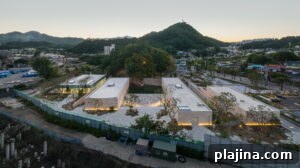
Yukhyangsan Mountain, at the heart of the site, was once surrounded by ocean in Isabu’s time but has since become inland high ground. Beneath the reclaimed land lie the lower slopes of Yukhyangsan that once formed an island.
© Simplex Architecture
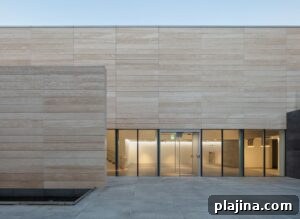
The museum complex is organized into four primary buildings: the Tourist Information Center, the Territorial Defense Memorial Hall, the Dokdo Experience Space, and a Complex Recreation Space. Each structure fulfills distinct functions while contributing to a cohesive visitor experience. Transitional outdoor areas are designed to foster interaction with the surrounding landscape and to connect interior and exterior zones.
The Tourist Information Center serves as the starting point for visitors. It houses a café on the upper level and an information lobby below. From this entry point, visitors descend to the exhibition areas along a stairway with views of Samcheok Port, an area known for its seafood restaurants. A pathway linking the information center to the Territorial Defense Memorial Hall incorporates masonry walls and walkways that reference the nearby Samcheok Pojinseong Fortress, with outdoor steps leading to viewpoints over the historic site.
© Simplex Architecture
High ceilings and strategically placed skylights bathe the interior in natural light, producing a calm and dignified atmosphere. The main lobby functions as a flexible, multifunctional space, while the rock yard offers framed views of Yukhyangji Pond and Yukhyangsan Mountain.
The complex can operate as a single, unified exhibition hall while accommodating independent, temporary exhibitions as needed. This flexibility allows curators to present permanent displays alongside rotating programs.
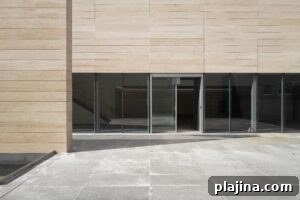
Accessing the Dokdo Experience Space requires passing through a stone plaza into a lobby where visitors can view the lower rock formations of Yukhyangsan through a large window. The surrounding slope wraps around the Dokdo Experience Space and guides visitors toward upper levels, reinforcing the sense of moving through a historic landscape.
© Simplex Architecture
A bridge on the south side of the Dokdo Experience Space connects the museum to a multipurpose community area that supports resident facilities, a book café, lectures, and events. This adjacency encourages community engagement and expands the museum’s role beyond exhibitions.
Outdoor spaces are carefully planned so that architecture and landscape harmonize, allowing the museum to blend naturally into its coastal surroundings. The result is a museum that interprets history through site-sensitive design, landscape integration, and flexible exhibition spaces that invite both reflection and community use.