
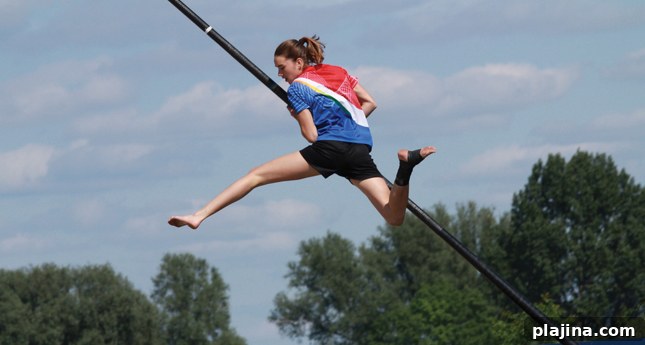
In times of budget cuts and fiscal restraint, planners and politicians should ask a simple question: why build an expensive bridge when a pole will do? Traditionally, the bridge-versus-pole choice was limited to one low-lying corner of Europe, but elsewhere the standard responses to a water barrier have rarely included poles.
The Netherlands, however, has never been limited by conventional thinking. A nation that carved land out of the sea, the country has relied on sea walls, dikes, pumping stations and canals to reclaim roughly a quarter of its territory from below sea level.
Even away from the coastline, water is never far. The reclaimed flatlands are threaded with an extensive network of drainage channels. Thousands of miles of manmade waterways make boating practical, but for farmers and residents who need to cross those channels quickly, bridges are not always feasible.
Medieval Dutch farmers lacked the wood and resources to span every ditch with bridges, so they found a practical alternative: long, strategically placed poles that allowed them to vault from one strip of land to the next. This resourceful approach turned a problem into a simple, low-cost solution.
Over time, that pragmatic practice evolved into a modern sport with specialized equipment, rules and annual competitions. Known locally as fierljeppen, polsstokverspringen or bongelwuppen, it’s commonly called canal jumping. For beginners it’s more challenging than it appears.
Poles originally made of wood are now typically aluminum and can reach lengths of up to 15 feet. They stand upright at the end of a canalside jetty. A jumper sprints along the jetty, grabs the pole, and sends it leaning toward the far bank.
At first contact the jumper is only partway up the pole, which is not enough to cross most canals. As the pole begins to tip, the jumper must climb upward quickly — some even strap bicycle tires to their shoes for extra grip. Gravity is already in motion, so speed and timing are crucial.
Within seconds the jumper must prepare to land on a soft, sandy landing on the opposite bank. Without the correct position on the pole or sufficient forward momentum, the jumper will end up in the water. For onlookers and casual participants, the possibility of splashing down is part of the appeal.
During summer months, several Dutch venues offer canal jumping lessons to the public. What began as a practical crossing method has become a popular activity for stag parties and student groups, often with loud, boisterous fun accompanying the attempts.
At the same time, a dedicated community of athletes has pushed the limits. Elite competitors have achieved jumps exceeding 60 feet, while recreational jumpers commonly clear more than 30 feet. The skill and athleticism involved are considerable.
Given its practicality and low cost, canal jumping deserves a fresh look as an economical alternative for local governments facing tight budgets. Rather than investing in costly bridge construction for every small waterway, municipalities could provide long poles at strategic crossings for public use. Framed not as a sport but as practical infrastructure, these poles offer a resourceful, historically grounded way to keep communities connected while saving money.