
Seoul’s rapid march into modernity began in the 1960s. Emerging from the devastation of the Korean War and pushing aside long-standing traditions, the city reshaped its downtown with highways and high-rise developments. Urban planners paid little attention to historic fabric or natural features; entire neighborhoods were cleared and streams were routed into concrete channels.
One notable casualty was Cheonggyecheon, a stream that had flowed through Seoul since the city’s founding. The waterway was covered over and an elevated highway was built along its course, erasing a long-standing natural feature of the urban core.
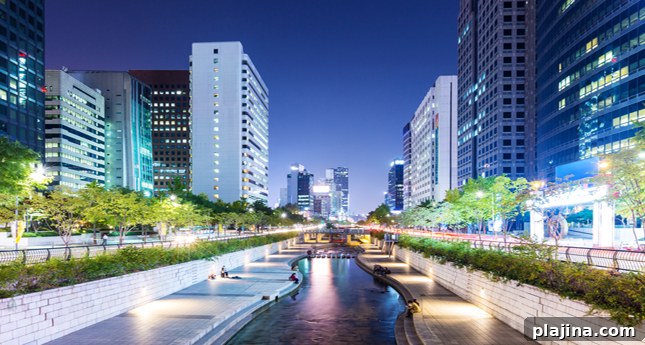
When the highway was removed in 2003, Seoul embarked on an ambitious restoration of the stream. The project provoked debate because of its cost — ultimately totaling $281 million — but after the restored Cheonggyecheon reopened in 2005 it quickly became a beloved public space. Over the following decade the revived waterway matured into a tranquil, seven-mile-long ribbon of water lined with pedestrian paths, green spaces and public art.
Today Cheonggyecheon functions as more than a restored stream; it serves as a social and ecological focal point for the city. The project reintroduced daylighted water, improved urban biodiversity, and created a popular recreational corridor where residents and visitors can walk, rest and escape the city’s bustle. The stream’s banks feature seating, landscaped areas and art installations that invite leisure and contemplation amid the surrounding metropolitan density.
The restoration also contributed to tangible environmental benefits. By replacing an elevated highway with a planted, flowing channel, the project helped lower local temperatures, improve air quality along the corridor and provide habitat for plants and urban wildlife. It established a model for balancing urban development with ecological restoration within a dense city center.
Beyond environmental gains, Cheonggyecheon has become a cultural and civic landmark. Seasonal programming, festivals and community events make use of the corridor, while the accessible pathways connect neighborhoods and commercial districts. The stream’s transformation demonstrates how strategic urban design can revive neglected infrastructure into a multifunctional public asset that enhances both quality of life and urban resilience.
Seoul’s experience with Cheonggyecheon has inspired other cities to consider similar approaches to restoring buried waterways and reclaiming space for pedestrians and nature. The project stands as an example of how a bold, costly intervention can yield long-term social, environmental and cultural returns when it reconnects people with their city’s natural elements.