
Thick, black thunderclouds rolled across the sky as my husband and I left the metro station in Shanghai’s French Concession. Our leisurely summer walk turned brisk as wind rattled the trees along the narrow streets and fat raindrops began to patter on the sidewalk. When the downpour intensified, we ducked into one of the faded mansions that once housed wealthy Chinese and Russian traders in this enclave of French culture.
Clotheslines crisscrossed the dim foyer where an elderly man watched television. He nodded as if he had been expecting us and pointed wordlessly up a flight of worn stone stairs. Not ready to return to the rain, we climbed to the second floor and found, at the end of a dingy corridor, a small sign that read “140 sqm Gallery.” Behind the door, an immaculate contemporary space greeted us: bright white walls and a provocative exhibit titled “Naked.”
Although Shanghai enjoys a relative degree of artistic freedom as China’s cultural capital, avant-garde work is often tucked away inside rickety apartment buildings rather than displayed in grand museums. That hidden quality adds to the city’s allure: get lost among side streets and alleys and you’ll discover shops, galleries and cafés that don’t appear on tourist maps.
Streets of Shanghai © Giancarlo Liguori | Dreamstime.com
During a warm week in June, after our business meetings, my husband and I wandered the city without relying on GPS — which, when I did take it out, attracted a curious crowd of local retirees. Afternoon thunderstorms frequently sent us ducking into establishments we might have missed otherwise, such as the wood-lined 1931 Cafe Pub, a speakeasy that channels the era when Shanghai earned the nickname “Paris of the East.”
I had come hoping to have clothes tailored, so early in the week we visited the South Bund Fabric Market. The three-floor market houses hundreds of stalls, each specializing in a particular fabric—cashmere, denim, leather, silk—and the most experienced (and expensive) tailors tend to be on the lower levels. Tailors work quickly, but allow several days for fittings and alterations. Bargaining by calculator is part of the ritual; I eventually bought a cashmere coat, a leather jacket and two silk shirts for under $200.
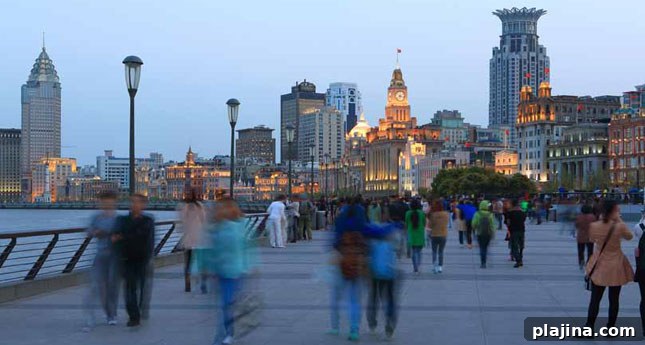
If tailoring isn’t on your agenda, ready-made luxury shops line the Bund, an avenue of Art Deco and Neoclassical buildings along the eastern bank of the Huangpu River that once served as a foreign banking district. One memorable boutique I found on the embankment sold hand-embroidered silk slippers, heels and purses decorated with playful motifs like goldfish and bok choy.
When Shanghai first became a boomtown for American, European and Japanese traders, the Bund gained a reputation for opulence—and for vice—hosting gambling dens and an opium trade amid its monumental façades. Walking the waterfront from north to south, we passed the Peace Hotel, where playwright Noel Coward once stayed; the Customs House, topped by a clock tower reminiscent of Big Ben; and the former Hong Kong and Shanghai Bank, which at one time was among the world’s largest bank buildings.
Most of Shanghai’s contemporary energy is now across the river in Pudong. In the 1990s, farmland here was rapidly transformed into a financial district where skyscrapers rise seemingly overnight. Compared with the Bund’s stately architecture, Pudong’s skyline feels futuristic: neon-lit towers, a pearl-like observation tower and the soaring Shanghai World Financial Center dominate the view.
To soak up local flavors after our meetings, we wandered south from the Bund to Yunnan Lu food street, where savory aromas drifted from sizzling wok stands. The market doesn’t have the shock value of Beijing’s night bazaars, but it’s lively and fun: stalls sell everything from wok-fried noodles to more adventurous fare. We ordered hearty bowls of thick-cut noodles stir-fried with onions and greens and ate standing at a communal counter.
Fortified by simple Suzhou-style comfort food, we continued on to Dongtai Lu Antique Market in the Old Town. Tucked among narrow lanes and historic temples, the market ranges from kitschy souvenirs to genuine antiques: furniture, carved pieces, porcelain, jewelry and, as is common in China, memorabilia from the Mao era. Collectors and curious travelers alike can find everything from decorative items to copies of the “Little Red Book.”
Antique Chinese calligraphy or painting brushes in Dongtai Lu Antique Market © Monainshanghai | Dreamstime.com
Before 1949, Shanghai’s walled Old Town functioned largely as a separate city for Chinese residents, governed by traditional laws and centered around Yu Yuan, a Ming dynasty garden spanning several acres of ponds, rockeries, bridges and pavilions. Though the gardens have been altered and rebuilt over the centuries, the winding paths and teahouses still suggest scenes from an earlier era.
As evening fell, we returned to People’s Square, a civic heart that has hosted everything from colonial race days to modern spectacles. The square is flanked by important cultural buildings—the municipal government, the city museum, the concert hall and the grand theatre—but it can also draw opportunistic hustles aimed at tourists, so it pays to be cautious.
To avoid crowds and touts, we slipped into Jiangyin Lu, a narrow alley east of the square. The street was quiet except for cricket chirps and a family out for an evening walk. Tiny shops between crumbling facades had closed for the night, and behind glass panes hundreds of wooden cages held lucky crickets. As we walked on, their trilling chorus swelled, filling the lane with a soft, natural music as the day dimmed into night.
Shanghai Info to Go
Shanghai Pudong International Airport lies about 19 miles east of the city center and handles most international flights. The high-speed Maglev train speeds passengers from Pudong Airport to the Longyang Road Metro Station in roughly eight minutes. Airport buses, taxis and the regular metro connect both Pudong and Shanghai Hongqiao International Airport—the latter located about eight miles west of downtown and serving chiefly domestic routes—to the city center.
Where to Stay in Shanghai
Cachet Boutique Shanghai A boldly designed boutique hotel in a preserved 1920s building, centrally located with apartment-style amenities such as kitchenettes. 931 Nanjing West Road, Jing’an District $$$
Grand Hyatt Shanghai Occupying upper floors of the Jin Mao Tower, the hotel pairs contemporary interiors with dizzying floor-to-ceiling views. Jin Mao Tower, 88 Century Ave., Pudong District $$$$
The Langham, Xintiandi, Shanghai Located in the Xintiandi shopping and dining district, The Langham is known for attentive service and classic-inspired rooms. 99 Madang Road, Huangpu District $$$$
Restaurants in Shanghai
Jade on 36 An elegant but understated restaurant offering contemporary cuisine and expansive views in Pudong. Pudong Shangri-La, 33 Fu Cheng Road, 36th Floor, Pudong District $$$$$
Jean-Georges Light French dishes from renowned chef Jean-Georges Vongerichten served in a dining room overlooking the Bund. Three on the Bund, 3 Zhongshan Dong Yi Road, Huangpu District $$$$$
Vegetarian Lifestyle One of Shanghai’s original vegetarian restaurants, known for creative dishes made from lotus root, soy and mushrooms, including dumplings and Wuxi-style “spareribs.” 258 Fengxian Road, Jing’an District $$
Read more about Shanghai’s French Concession.