
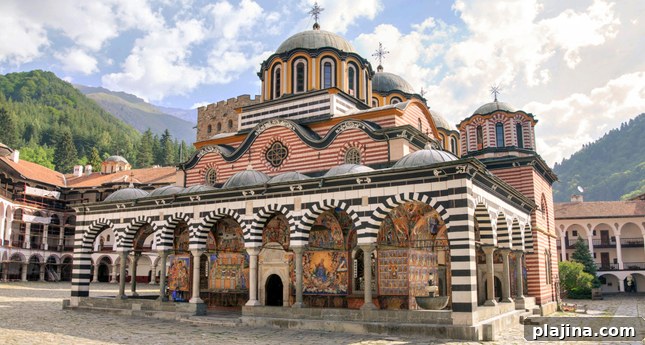
Two hours south of Sofia stands Bulgaria’s most celebrated spiritual and cultural landmark: the Monastery of Saint Ivan of Rila, commonly known as the Rila Monastery. For centuries it has served as the heart of Bulgarian religious life, education and national identity. As my companion Panos observed when we arrived, it ranks among the most important Orthodox monasteries outside Mount Athos in Greece.
Nestled within the Rila Mountains, the monastery traces its origins to the first half of the 10th century, when the hermit Ivan Rilski—later canonized as St. John of Rila and declared Bulgaria’s patron saint—founded a hermitage at the site. During the Ottoman period the monastery, a stronghold of Bulgarian culture and faith, suffered destruction in the 15th century. Much of the complex visible today, however, dates from the 18th and 19th centuries, reflecting the artistic and architectural renewal of Bulgaria’s National Revival era.
As we approached the Rila Massif, a thin veil of mist clung to the surrounding peaks, enhancing the sense of seclusion and calm. Visiting on a crisp autumn day with few other travelers allowed us to move slowly through the grounds, take in the details, and reflect in near silence.
Hrelio’s Tower, the oldest surviving structure within the monastic enclosure, dates from the 14th century and originally served as the monastery’s defensive stronghold. From its heights you can look out over the distinctive five domes of the main church, the Church of the Nativity of the Virgin. The church interior is covered in richly colored frescoes, some executed by well-known regional masters from Bansko and Samokov. The altar’s gold-plated iconostasis is an intricate woodcarving that took five years to complete and remains a standout example of craftsmanship.
The monastery’s library preserves roughly 250 manuscripts alongside many printed works, documenting centuries of spiritual and scholarly activity. The museum displays exceptional artifacts, including a wooden cross carved by the monk Rafail, a work that occupied him for 12 years before he lost his sight.
The residential complex, arranged in four wings, contains more than 300 monk cells, many of which are adorned with paintings and detailed woodcarving. The monastery also offers more than 30 guest rooms for overnight visitors, combining historical ambiance with basic hospitality. Although we explored the site by car over the course of a day, convenient bus connections from Sofia make Rila accessible to travelers without private transport.