
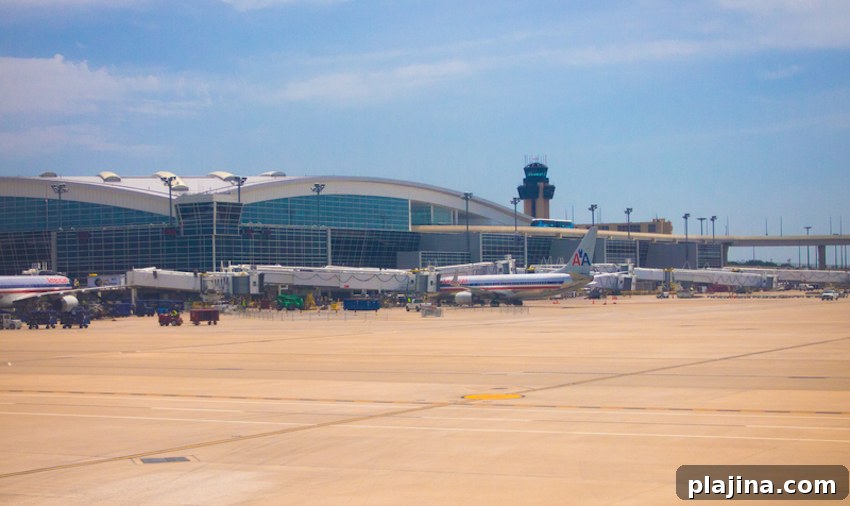
Dallas/Fort Worth International Airport, one of the nation’s busiest airports, is evaluating an expansion to better manage its high passenger volumes. Airport officials have begun talks with American Airlines about adding a sixth terminal to the campus.
Currently served by five terminals, the airport is exploring plans for a new Terminal F. Unlike the existing semicircular terminals that support extensive parking and curbside operations, the proposed Terminal F would be a linear, pier-style facility located south of Terminal D, near the South Express parking area.
Designers are considering a configuration that prioritizes passenger connections rather than additional parking. “Sixty percent of our customers at this airport are here to connect, and the half-moon is not a terrific design for connecting customers,” said Sean Donohue, CEO of Dallas/Fort Worth International Airport. The shift to a linear layout is intended to shorten transfer times and improve flow for connecting travelers.
A pier-like terminal footprint allows gates to be arranged efficiently so more aircraft can be accommodated within a smaller footprint. That flexibility would enable Terminal F to handle both domestic and international services, with aircraft positions and gate facilities optimized for quick turnarounds and simpler connections between flights.
At this stage the addition remains a proposal. Airport planners are evaluating how Terminal F could fit into a broader capital improvement program estimated at $3–4 billion. That larger project would also include upgrades to Terminal C, currently the busiest terminal at DFW, focusing on passenger amenities, gate capacity, and operational efficiency.
If approved, the new terminal could relieve congestion in the existing terminals, improve connection times for the majority of travelers, and provide capacity for future growth without replicating the large parking footprint of the semicircular terminals. Airport authorities continue to work through design options, cost projections, and stakeholder input, including discussions with airline partners, before moving forward with any firm commitments.