
Just before the plane’s cabin door opens, a flight attendant on my reassuringly named Calm Air flight advises passengers to bundle up. Seconds later, a gust of wind-driven air that feels like 40 below — whether Celsius or Fahrenheit hardly matters — blasts through the cabin. Icy pellets sting my face as I cross the tarmac, and I briefly question the wisdom of visiting northern Manitoba in winter.
Most visitors come to Churchill to see polar bears; some arrive to kayak or snorkel with beluga whales. I’m here to witness the northern lights, which are at their most spectacular from January through March. Over four days immersed in the fierce beauty of winter in this Hudson Bay outpost near the Arctic Circle, I watch nature’s own light show and experience a range of local life: the Hudson Bay Quest dog sled race, an unfamiliar taste of barbecued whale meat (not one of my favorites), and a breakfast conversation with a man who believes he communicates with beings from space. Most movingly, I listen to an Inuit father tell how his 15-year-old son became separated from a hunting party, was stranded on an ice floe during a storm and survived by pretending to be a dead seal so a polar bear would ignore him. My trip with Frontiers North becomes more than an aurora tour; it’s a cultural immersion.
Frontiers North has specialized in authentic small-group adventures in Canada’s North since 1986. It is the only northern lights outfitter based in Churchill and the only company using purpose-built vehicles to cross the frozen Churchill River and travel into the surrounding tundra. My tour, which begins in Winnipeg, blends science (the physics behind auroral displays) with regional arts and traditions, practical photography guidance for shooting the lights, and hands-on experiences like a dogsledding lesson from a local musher.
Churchill sits where tundra meets timber and the Churchill River meets Hudson Bay. Life here has always been challenging; even with permanent houses replacing igloos and snowmobiles largely supplanting dog teams, survival is demanding. No roads connect the town to the rest of Canada — access is by plane or train only — and the extreme cold, persistent winds, isolation and the presence of polar bears have driven some assigned health workers to leave soon after arrival.
Despite hardship, Churchill lies directly beneath the Northern Hemisphere’s Auroral Oval, an area where auroral activity occurs on more than 300 nights each year, making it an excellent location to view the aurora borealis — a term Galileo Galilei coined that means “northern dawn.” Since auroral displays generally peak late at night, daytime hours lend themselves to other explorations.
After landing, our group takes a van for a quick orientation of Churchill. Once home to a Cold War-era military base, Fort Churchill later tested cold-weather equipment and, for a time, served as a rocket research range. Today, Greater Churchill is a small community of roughly 800 residents living alongside about 1,000 polar bears and 3,000 beluga whales.
Our guide, Rhonda Reid, points out the town’s notable sights: the polar bear jail, the wreck of the C-46 cargo plane nicknamed “Miss Piggy,” the Eskimo Museum and the Town Centre Complex. The complex spans two blocks and houses a pool, ice arena, curling rink, theater, library, health center, full-size gym, bowling lanes, café and indoor playground. “If you enter at one end and exit at the other, it’s possible to cross town while staying warm,” Reid observes.
The town’s isolation, military legacy and aboriginal heritage have created a diverse and colorful population made up of Inuit, Dene and Métis people alongside outdoor enthusiasts, subsistence hunters, dog mushers and others drawn to northern life. Over breakfast at the Gypsy Bakery, a chat with a local confirms Churchill’s reputation for eccentricity: our conversation casually drifts into the man’s conviction that he communicates with aliens. A waiter later sums it up wryly: “The odds are good, but the goods are odd.”
After breakfast we board a Frontiers North Tundra Buggy, a purpose-built vehicle that looks like a doublewide bus on enormous wheels and is outfitted with comfy couches and a stove. John Gunter, a Frontiers North partner, drives us across hummocks and ice ridges to meet snowshoe guide Mike Macri at his remote cabin. We strap on snowshoes and follow Mike, who carries a powerful rifle for protection, on a trek across the landscape. We spot tracks from snowshoes, Arctic hare, red fox and even polar bear before returning to the cabin for warming chili.
That afternoon I visit the Eskimo Museum, a focal point of Churchill’s arts heritage operated by the local Roman Catholic mission. For centuries, indigenous peoples have used locally sourced materials — stone, ivory, bone and fur — to create functional and spiritual artworks. Oblate missionaries who lived among the native communities beginning in 1912 collected carvings and artifacts that document daily life, belief systems and ingenuity born of necessity.
“The collection tells the story of ingenuity in the face of harsh living conditions,” says curator Lorraine Brandson. “Missionaries encouraged people to explain their way of life by making carvings and bringing them to the mission as a way to open conversation.”
The museum is not large or high-tech, but Brandson describes it as a “treasure house.” Glass cases display tools and carvings crafted from whalebone, antler, ivory, basalt, soapstone and walrus tusk. “The Inuit have an intimate knowledge of the land and its resources,” she notes. “They had to, or they wouldn’t survive. That keen observation is reflected in their art.”
On the walk back to the Tundra Inn, I duck into the Town Complex to escape the biting wind. As I browse a wall of historical photos, a gentle Inuit man from Nunavut helps identify faces and recounts youthful stories. He then tells the account of his son’s near-tragic hunting mishap: separated from his grandfather during a storm, the boy floated on an ice floe until searchers reached him. “Rescue teams asked if my son could survive,” the father recalls. “I said he’s trained in Inuit ways; he’ll survive — we just had to find him.” They located him after he fired a shot to scare off a bear, which also alerted searchers to his location.
A dogsled © Frontiers North
On another day, a chorus of eager yips greets us at Gerald Azure’s Bluesky Expeditions dogsledding camp. We watch Gerald expertly harness the dogs and then double up to mush a scenic loop through snowy fields and woods, switching drivers midway. That hands-on experience makes watching the start and finish of the Hudson Bay Quest dog sled race even more engaging. While warming by a campfire during the event, I sample a piece of barbecued whale meat — an atypical taste of local cuisine.
Churchill charms by day, but the night sky is the true jewel. Each evening after dinner we rest for a few hours and then layer up for the cold. Around 10 p.m. the Tundra Buggy carries us across the frozen Churchill River estuary and into the tundra. Town lights shrink to a distant glow and then vanish entirely.
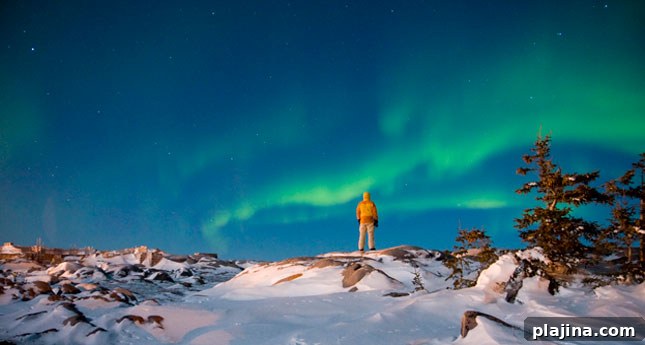
Fortune favors our group with three clear, if frigid, nights. The first evening I trudge across the tundra in search of a quiet spot to watch the sky. At these temperatures, the world seems to hum: snow squeaks, distant tree branches groan and ice groans underfoot. I grit my teeth against the cold and suddenly see a shimmer of green race overhead, followed by slashes of white and pale rose. I am entranced as colors unfurl and dance across the sky in ethereal waves.
Each appearance feels like a new movement in a choreographed performance. Between displays I warm up in the buggy with hot chocolate or wine, and every time I think the show has ended, an encore begins. I swivel to catch each new twist and whirl as the aurora shimmers, waltzes and folds across the heavens. At 2 a.m., lying on the tundra and staring upward, I am oblivious to the cold. What began as a journey I questioned on arrival becomes a place I already plan to return to.
INFO TO GO
Flights from the United States arrive at Winnipeg’s James Armstrong Richardson International Airport (YWG). Frontiers North offers a Northern Lights & Winter Nights in Churchill package that typically includes three nights in Winnipeg, four nights in Churchill, all meals, four Tundra Buggy excursions, round-trip Winnipeg–Churchill air transport and experienced guides.