
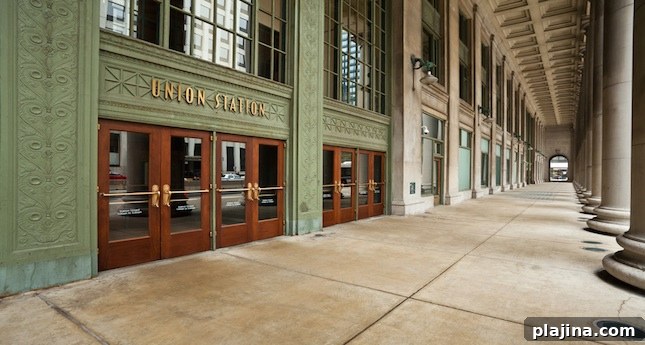
Amtrak announced last month that plans to restore Chicago Union Station have advanced to the next phase, which includes planning, historic review and preliminary engineering. The global engineering firm Arup has been selected to lead the renovation effort. Amtrak and the City of Chicago are jointly funding the improvements to address passenger capacity, service efficiency, safety, accessibility and circulation in and around the historic station.
Under the contract, Arup will design expanded concourses and entrances, widen platforms, and tackle ADA compliance, pedestrian passageways and ventilation improvements. This initial stage, labeled Phase 1A, is expected to last approximately 18 months and will establish the foundation for later construction and upgrades.
“Chicago Union Station is an enormous asset to Amtrak as well as the City of Chicago,” said Stephen Gardner, executive vice president of Amtrak. “We are excited to begin this first phase of efforts to improve this vibrant transportation hub in collaboration with our partners. These efforts, combined with related work to advance new customer amenities and spur development of Amtrak’s historic Station Headhouse and other assets, could restore Union Station’s role as a central anchor of the West Loop neighborhood.”
Mayor Rahm Emanuel emphasized the station’s economic and transportation importance. “We are making Union Station a true transit hub and economic engine by focusing on transportation investments that create jobs and transform neighborhoods,” he said. “Union Station provides an essential link to economic, cultural and recreational opportunities for Chicago’s residents, visitors and businesses. Modernizing Union Station is one way we are working together to build 21st‑century infrastructure to power Chicago’s 21st‑century economy.”
The Phase 1A work will concentrate on design and engineering tasks that reduce bottlenecks and improve passenger flow while preserving the station’s historic character. Key priorities include safer, more accessible routes between concourses and platforms; clearer entrance and wayfinding improvements; upgraded ventilation and mechanical systems; and measures to support future increases in ridership.
By addressing both operational needs and regulatory requirements, the project aims to balance preservation with modern standards for safety and accessibility. The collaborative funding and planning approach between Amtrak and the city is intended to streamline decision-making and align the station’s upgrades with broader neighborhood development goals.
Once Phase 1A is complete, the project team will be better positioned to advance detailed construction plans for platform expansion, concourse improvements and any necessary structural work. These subsequent phases will be scheduled based on findings from the preliminary engineering, historic reviews and stakeholder input gathered during this initial stage.
Restoration efforts are expected to produce tangible benefits for commuters, regional travelers and the West Loop community by improving capacity, reducing congestion and enabling a more comfortable, accessible station experience. The work also supports the long‑term goal of integrating Union Station more fully into Chicago’s multimodal transportation network and surrounding economic development.