
You don’t have to search far to find remarkable archaeological sites in Turkey. Adding a side trip from İstanbul to explore ancient ruins is straightforward. Below are three excursions, each within roughly a 1.5-hour flight from İstanbul, with distinct appeals: Ephesus for classical ruins, Cappadocia for a surreal volcanic landscape with rock-cut churches and underground cities, and Dalaman for a relaxing coastal escape with views of dramatic Lycian tombs.
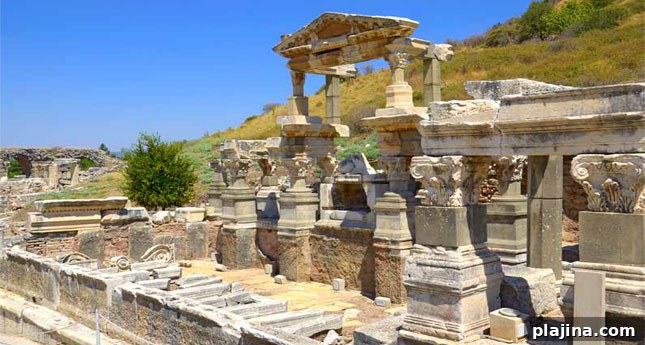
Fountain of Trajan, Ephesus © Anton Starikov | Dreamstime.com
FOR TOTAL IMMERSION in a site that reflects centuries of Greek, Persian, Roman, Byzantine and Ottoman influence, visit Ephesus. It is one of the best-preserved classical cities on the Mediterranean and offers an evocative glimpse into ancient urban life.
The towering columns of the Library of Celsus—the signature image of Ephesus—are only the beginning. Stroll through the Terrace Houses, once home to the city’s wealthiest inhabitants, where you can still see intricate mosaic floors and fragments of frescoed walls. Sit on the stone tiers of the Great Theatre and picture an audience of up to 24,000 watching events on the three-story stage. Walk the Street of the Curates past workshops, offices and monuments and imagine daily life under successive rulers.
Ancient Ephesus has roots stretching back millennia. The original settlement, which dates to around 6000 B.C., was once a coastal port. Greek settlers arrived circa 1050 B.C., and in 560 B.C. the city was relocated near the Temple of Artemis—one of the original Seven Wonders. The ruins visible today mostly reflect the Hellenistic and Roman phases of the city established around 300 B.C.
You can explore Ephesus independently, but a guide adds historical context and brings details to life. Day trips from İstanbul are possible but often feel rushed: tight schedules mean limited time at the site and brief stops at nearby attractions such as the House of the Virgin Mary. For a more relaxed experience, spend two or three days in the region. Fly late to İzmir and overnight there, or stay in Kuşadası to enjoy a full day at the ruins. A private guide can collect you at your hotel and tailor the itinerary so you can linger at Ephesus, visit the House of the Virgin Mary, and see smaller nearby sites.
Make time to visit Şirince, a hillside village with a Turkish Orthodox heritage. It’s a pleasant spot for tasting local wines on terraces with views over narrow streets lined with stalls selling handcrafted goods, olive oil and regional wine.
Hot air balloons float over Cappadocia © Nikolai Sorokin | Dreamstime.com
FLOATING IN A BALLOON OVER Cappadocia’s fairy chimneys is an unforgettable experience. From above the volcanic tuff formations, the landscape appears almost lunar. On the ground, the scenery reveals layers of volcanic activity, erosion and centuries of human occupation.
Cappadocia’s otherworldly terrain formed from ash deposits that consolidated into soft tuff. Wind and water erosion sculpted the tuff into pillars, cones, mushroom shapes and towering chimneys—some exceeding 100 feet. These formations, combined with a long history of habitation, make Cappadocia a UNESCO World Heritage site with striking natural and cultural features.
Conflict and shifting populations led inhabitants to carve underground refuges. Exploring the multilevel Derinkuyu Underground City—parts of which are open to visitors—conveys the claustrophobic conditions people endured when sheltering beneath the surface. Early Christians also used the region for refuge from persecution, carving chapels into rock and decorating interiors with frescoes. Many of these frescoes remain visible today in cave churches around Göreme.
The Göreme Open Air Museum summarizes much of the area’s Christian heritage. Its rock-cut churches, most dating from the 10th to the 12th centuries, display painted scenes from the lives of Christ and the saints. The Dark Church, reached through a narrow passage, contains particularly vivid and well-preserved red, ochre and blue frescoes.
Allow two nights to see Cappadocia properly: tour the Göreme museums, visit an underground city, take a balloon ride (book for the first available morning in case of weather delays), and hike through Pigeon Valley to inspect centuries-old dovecotes carved into the cliffs. Consider staying in a restored cave hotel or a traditional house for an immersive experience.
IF YOU WANT TO ESCAPE to a seaside setting with archaeological interest, fly to Dalaman and join a day cruise on the Dalyan River. The river route provides excellent views of Lycian rock-cut tombs carved into cliffs, along with reed-lined channels and habitats for loggerhead sea turtles.
On the Dalyan cruise you’ll usually stop at Kaunos, an ancient Carian city that was once a bustling port but is now several miles inland due to river silting. The Lycian tomb façades—hewn into the cliff faces in the second to fourth centuries—served as royal burial chambers. While visitors can no longer climb into the tombs, the ornate entrances hint at the wealth once interred within.
Kaunos is quieter than the major archaeological sites and can feel like a private discovery. Excavations have exposed sections of city walls, an acropolis, an amphitheatre, Roman baths and a basilica, offering a sense of urban layout even if the site is smaller than Ephesus. Local operators run group cruises past the tombs and to Kaunos, but private boat arrangements are available for a more tranquil visit. Many tours include stops at thermal mud baths downstream, a pleasant way to round out the day.
Dalaman’s marinas are lively, with luxury yachts and sailing craft available for hire by the hour or for multi-day coastal cruises along Turkey’s Turquoise Coast. Across Turkey, successive civilizations have left traces—from İstanbul to the farthest reaches of the country—and visiting these ruins provides insight into long-ago worlds.
Turkey Info to Go
Direct flights from İstanbul’s Atatürk Airport (IST) reach Erkilet Airport (ASR) in Kayseri (gateway to Cappadocia), İzmir Adnan Menderes Airport (ADB) for Ephesus, and Dalaman International Airport (DLM). Regional tour operators can arrange transfers, guided day tours and multi-day itineraries to help you make the most of short trips from İstanbul.