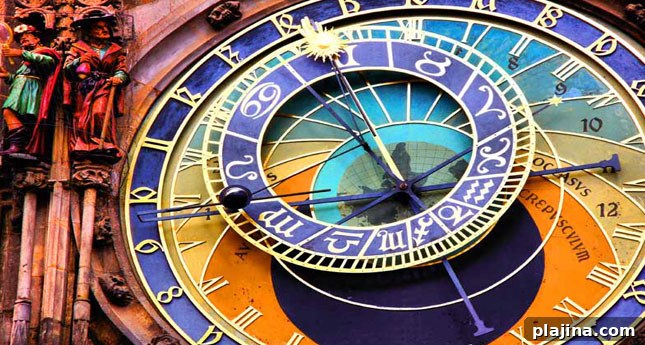
I’m out of breath, weaving through the crowds as gracefully as speed allows, trying not to twist an ankle on the cobbled Prague streets. My husband James is close behind; just ahead I spot the arm of our guide, Milos Cuřik, waving above a group of tourists in matching hats. He shouts something—perhaps “I’m over here,” or maybe a teasing remark about my shoes—but the message is clear: I have only seconds before I miss the performance of the world’s oldest functioning astronomical clock.
We duck under the awning of a small streetside café facing the Old Town Hall Tower with eight seconds to spare. The clock, often called the Orloj, is magnificent and quietly magical. Its layered faces of gold, blue and cream, the movable ring of zodiac signs and the many hands and symbols look as if they sprang from a storybook. Milos explains that the astrolabe dial and the core mechanics date to 1410, the calendar dial was added about fifty years later, and the moving figures of Christ, the Apostles and Death were fitted afterward. On the hour the figures parade through the open windows, and the grim skeleton of Death marks the time by striking the hour.
When the skeleton retreats, a tiny golden rooster leans forward to announce the end of the show. I insist on wine. No one argues, and we settle into our seats while the parade of tourists, shoppers and commuters streams past.
Soon we’re back in the maze of Old Town streets with Milos leading us toward the historic Charles Bridge. We pause to pass the Old-New Synagogue, said to be the final resting place of the Golem’s remains—a clay protector from Prague lore.
Charles Bridge © Cristiaciobanu | Dreamstime.com
The city appears peaceful now, but Milos reminds us it wasn’t always so. A native Prague resident, he lived through the communist era and received unwanted attention from the Secret Police because of his outspoken views and his association with the Velvet Underground. He shifts the conversation toward existentialism as we turn a corner and find ourselves in the Prague that shaped Franz Kafka—streets where Kafka worked and brooded. I close my eyes and imagine what sounds might have filled his world. James and Milos call me back to reality and point upward: a partly embedded cannonball protrudes from the wall, a surreal remnant of an old attack that glints in the afternoon sun.
Prague is full of such contrasts—an intense blend of architectural styles, natural beauty and layered history that stretches from royal courts and castles to the peaceful Velvet Revolution that changed the country in the 1980s.
We cross Charles Bridge, considered by locals the city’s heart, and part at the entrance to the Golden Well, a small luxury hotel set in a 16th-century château within the Prague Castle grounds. The building’s history fascinates us: it was once home to Bohemian ruler Rudolf II, served as a residence for a Roman emperor and sheltered the Danish astronomer Tycho Brahe—an eccentric who kept a pet elk that reportedly fell down an interior stairway after drinking beer.
James and I toast the memory of the elk while dining on the rooftop terrace, enjoying panoramic views and local specialties. Later we retire to our modern room a few floors below. The next morning Milos finds us at breakfast, where we fuel up on freshly squeezed pear and peach juices and a rich hotel-made yogurt mixed with ripe forest berries. He glances at my shoes, nods approvingly, and we set off for Wallenstein Palace, now home to the Czech Republic’s Senate.
The palace offers grand halls like the Mythological and Astronomical corridors and an elaborate Baroque façade that frames distant views of Prague Castle. Sculpted gardens extend in all directions. An albino peacock wanders by, indifferent to our curiosity. We explore a grotto formed by a manmade dripstone wall, twisted into faces and figures that suggest a secret landscape of doors leading nowhere yet hinting at enchanted possibilities. The effect—an indulgent mix of Mannerist and Baroque invention—feels like a collaboration between daring artists and dreamers.
I ask to see the Lennon Wall, and Milos leads us there. The wall’s art changes constantly, but John Lennon’s likenesses and messages of peace and love usually remain. What began as clandestine graffiti protesting the government became a powerful symbol of dissent during the 1980s, often whitewashed by authorities and quickly repainted by locals.
The Lennon Wall © Igor Stevanovic | Dreamstime.com
On our final day we ride the funicular up to the castle to visit St. Vitus Cathedral. The Rose Window and rows of stained glass are worth the climb; Alfons Mucha contributed designs to the newer north nave. We walk among tombs where Holy Roman emperors and Bohemian kings rest and peer into the ornate St. Wenceslas Chapel, glittering with more than 1,300 gemstones. Though the chapel itself is closed—officially to protect saintly relics—Milos tells us the practical reason is a small, heavily bolted door that leads to the Crown Chamber, where the Czech crown jewels are kept.
We descend along a tree-lined path and later board a private boat for a late-afternoon cruise on the Vltava River. Offered chilled Czech beer and ice cream as we wait, we choose both. Punting gently between the banks, guided by a smiling boatman in a white sailor’s suit, we watch spires, arches and colorful roofs ripple in the river. The air is cool and pleasant, and the soft sound of a violin practicing from an open window drifts across the water. James reaches for my hand; the music—live, imperfect and real—makes the moment even better.
Prague Info to Go
Václav Havel Airport Prague (PRG) lies about six miles from the city center. There is no direct metro or train link, but a regular Airport Express shuttle connects the airport with Prague’s main railway station for onward metro travel. Bus stops are located at Terminal 1 and Terminal 2 outside Arrivals; tickets are available in the terminals, on board and from ticket machines. Official taxis display roof signs such as AAA Radio Taxi or Fix Airport Cars. The CEDAZ shuttle runs between the airport and city center every 30 minutes. Car rentals from major companies are also available.
Where to Stay in Prague
Aria Hotel A theater complex converted into a five-star boutique hotel in the historic center, minutes from Charles Bridge, with private access to the lush Vrtbovska Gardens. Tržiště 9 $$$
Golden Well Hotel Romantic accommodations in several 16th-century buildings once associated with Emperor Rudolf II and Tycho Brahe. U Zlaté Studně 166/4 $$$
Mandarin Oriental, Prague Elegant rooms, attentive service and a spa in a building that once housed an ancient chapel. Nebovidská 459/1, Malá Strana $$$$
Restaurants in Prague
Céleste Restaurant French-inspired cuisine with international views from the upper floors of Dancing House—try the rabbit trio as city lights shimmer on the water. Rašínovo nábřeží 1981/80 $$$
Nebozízek Restaurant Czech and Bohemian specialties, including steamed fruit dumplings, served on a glassed terrace with sweeping views of Old Prague; located at the Petřín funicular middle station. Petřínské sady 411, Malá Strana $$
Restaurant Terasa U Zlaté Studně Located atop the Golden Well Hotel, the kitchen offers international classics and Czech specialties such as confit duck prepared sous vide. Golden Well Hotel, U Zlaté Studně 166/4 $$$
Read more about the arts in the Czech Republic.