
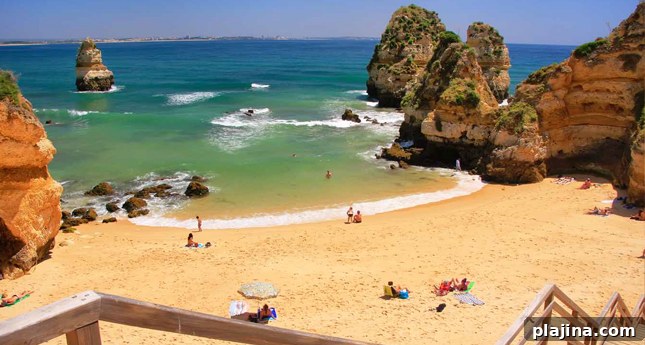
Sun and sand have attracted winter-weary Europeans to Portugal’s southern coast for more than a century. This region, known as the Algarve, delivers both in abundance — about 300 days of sunshine each year and over 100 miles of golden-sand beaches.
Some stretches have been transformed by high-rise hotels and apartment blocks catering to package-tour crowds, but the coastline is long enough that much remains unspoiled. Secluded coves hide intimate beaches backed by soaring cliffs, while long dune-backed strands offer plenty of space for towels and tranquil solitude.
The western Algarve is the quietest and most dramatic. Small fishing villages tuck into picturesque coves while resorts blend into a landscape of alternating beaches and wind-sculpted cliffs carved into fantastic shapes and grottoes. After rounding Cape St. Vincent — Europe’s most southwesterly point — the shoreline swings north and brings a third attraction: surf. The western beaches feel the full force of the Atlantic, with long lines of breakers that rank among the best surfing spots on this side of the ocean. World-class competitions are held here, and spectators enjoy natural amphitheaters formed by steep coastal slopes.
Lighthouse at Cape St. Vincent © Ernest Winnik | Dreamstime.com
Not into big-wave surfing? The western Algarve is a great place to learn. It uniquely offers two coasts: the gentler southern waters and the wild Atlantic-break western shores, so learners can build skills without confronting massive waves and still enjoy comfortable resort amenities.
Perched where the two coasts meet at Sagres, the region’s only five-star resort occupies a sheltered cove. Martinhal Beach Resort & Hotel was designed to harmonize with the landscape: small detached beach rooms and villas nestle on a sloping shore amid native trees and grasses above a half-mile crescent of golden sand.
The beach’s gradual slope makes it popular with families and ideal for windsurfing, paddleboarding and other water sports. Kayak tours explore offshore islands, sea caves and clear shallows where fish play between rocks. The resort’s full-service Finisterra Spa, swimming pools, sports facilities, children’s programs, beach bars and three restaurants create a well-rounded retreat for those seeking secluded luxury away from business routines.
Martinhal’s broad cove is sheltered by the headlands of Cape St. Vincent, where in the 1400s Prince Henry the Navigator gathered Europe’s top mapmakers, sailors and geographers to plan voyages that launched Portugal’s era of exploration. The riches brought back by those voyages helped fund the region’s Baroque churches, and Sagres remains an excellent base for exploring both the southern and western Algarve.
North of Cape St. Vincent the coastline grows even more dramatic, with high cliffs plunging into the sea and narrow beaches tucked into coves. These secluded sands are beloved by local surfers and swimmers and often escape heavy tourist traffic. From Vale do Bispo, just north of Sagres, follow signs to Praia do Castelejo and pause to view Torre de Aspa, a rock formation rising about 500 feet above the waves. Further north, the astonishing beaches and cliffs at Amado and Bordeira reward exploration. A long-distance path tracks the coast; if you are comfortable with heights, sections of the trail run along cliff tops with breathtaking vistas.
A protected park preserves much of this western landscape, and the south-facing shore that marks the western Algarve’s transition remains largely low-rise, with resorts that integrate into small fishing villages and craggy cliffs. Praia da Luz retains its fishing-village character and uncrowded beaches, while Alvor sees relatively few visitors. Between them lies Lagos, livelier and more visited but still convivial; development has been kept back from its beaches. Encircled by 15th-century walls, Lagos features an attractive harbor and two churches whose interiors still gleam with New World gilding.
Beach villas on the cliffs at Carvoeiro © Sergioua | Dreamstime.com
East of Carvoeiro, before the central Algarve’s busier beaches begin, the coastline reveals some of the region’s most dramatic cliffs and rock formations, including a large sinkhole created when porous rock collapsed into the sea. Trails run from a lighthouse along the cliff tops and down to the coves. Small fishing boats operating from Carvoeiro offer sea views of eroded cliffs and sea caves and access to hidden beaches. For diving, book with a PADI-certified dive center operating in the area.
Although golfing opportunities exist near Sagres, many serious golfers head to luxury enclaves farther east along a stretch of the coast known for some of the Algarve’s finest and busiest courses. At Vale do Lobo, expansive greens and fairways perch atop red cliffs that fall toward miles of white sand. The resort’s Yellow Course crosses dramatic ravines and provides memorable holes.
Vale do Lobo and Quinta do Lago are part of a cluster of ultra-luxury facilities that include some of Europe’s most prestigious courses. Quinta do Lago’s courses feature lakes, challenging bunkers and standout fairways framed by umbrella pines, cork oaks and citrus trees. The 27-hole championship Pinheiros Altos offers three distinct nine-hole loops, while the demanding Corks Course is famed for a notoriously difficult eighth hole. San Lorenzo’s manicured Bermuda grass fairways are often reserved for guests of nearby luxury hotels.
With such scenery, golfers can easily be distracted from play. Other activities abound: expert instruction in sailing and windsurfing, equestrian centers offering rides along coastal trails, and tennis academies with multiple courts. Vilamoura, nearby, hosts the Algarve’s largest marina, berthing more than 1,000 yachts. Well-equipped charter boats and fishing vessels operate out of the area, offering deep-sea fishing for marlin, tuna and other species. Upscale shopping, further scuba diving, sailing and scenic cliff cruises draw an international clientele to this part of the coast.
Statue at Palace of Estoi © Carlos Neto | Dreamstime.com
Tavira offers a very different, more relaxed atmosphere. Here you’ll feel closer to traditional Portuguese life, while beautiful long beaches lie a short boat ride away. A mini-train also runs into the large Ria Formosa Natural Park — 42,000 acres of beaches, lagoons and islands that attract migrating birds and the birdwatchers who come to see them.
Tavira does not feel like a mass-tourism center. Elegant 18th-century houses climb the hillsides and line the riverbanks, crossed by a bridge built on Roman foundations. A riverside garden frames views of colorful fishing boats, and a small hilltop castle offers atmospheric viewpoints across red-tiled roofs.
Near the castle a former convent was transformed into a Pousada, one of Portugal’s historic properties converted to luxury accommodation. A few miles away in Estoi, a grand 19th-century palace adorned with neo-Baroque decoration overlooks formal gardens; the Palace of the Visconde de Estoi now houses a pousada’s public rooms, with contemporary guestrooms in an adjacent wing.
The Pousada de Estoi sits close to the excavated Roman villa of Milreu, where well-preserved mosaics provide a reminder that the Algarve’s heritage extends well beyond beaches and resorts. In addition to Milreu and Prince Henry’s site at Sagres, the region offers hilltop castles at Castro Marim and Paderna and the large fortress at Silves, where Moorish influences remain evident. The Moors also introduced almond cultivation, creating the “Algarve snow” of blooming trees that turns the hillsides pale in February.
Algarve Info to Go
Faro Airport (FAO), serving the Algarve capital, provides frequent connections to Lisbon and many international flights from across Europe. Travelers who stop in Lisbon can reach the Algarve by car in about three hours via the well-marked E1 highway or by following the scenic western coastal route.