
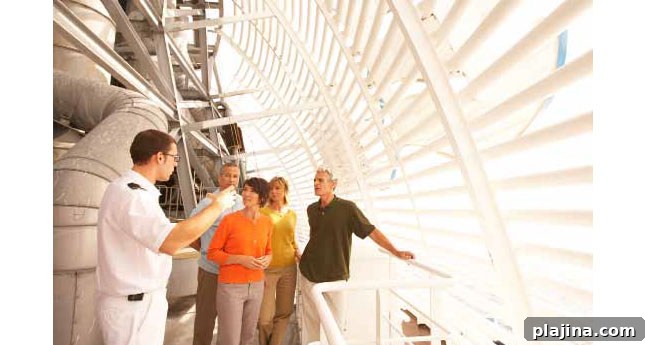
One of the greatest pleasures of a cruise is exploring a new port, but passengers can also enjoy a different kind of discovery without ever leaving the ship: a behind-the-scenes tour of the lower decks. When offered, these limited excursions give a small number of guests access to areas normally off-limits, revealing how the ship operates from galley to engine room.
Our first such tour took place aboard Holland America Line’s ms Rotterdam. This 1,404-passenger vessel offered an extensive look beneath the passenger decks, beginning in its busy 24-hour galley — a succession of stainless-steel workstations, grills and ovens arranged for high-volume production. Executive Chef Thomas Schumann described the kitchen’s “well-organized chaos” as being like a beehive, where roughly 69 chefs and 21 assistant staff work in constant motion. The galley consumes significant supplies: the crew moves about 10 pallets of food ashore each day and uses large quantities of staples, including about 100 pounds of butter and over 150 pounds of sugar daily. Chef Schumann emphasized two essentials the kitchens cannot run out of: coffee (brewed in large filters) and rice, which totals around 300 pounds a day to feed a crew largely from Indonesia and the Philippines. “Without coffee, we can’t stay awake,” he said. “Without rice, the crew will sit down and work no more.”
The tour continued to the ship’s waste-management center, where an environmental officer explained how the vessel handles roughly 40 tons of sewage and about four tons of ground food waste each day. Staff sort and process the solid waste generated by passengers and crew so it can be managed responsibly at sea and in port.
We then passed rows of storage rooms stocked for a two-week voyage: more than 200 pallets of produce, dairy, flour, pasta, rice, beers and cases of wine and Champagne. After a quick stop at the engine control room, the group retraced its route to the laundry complex, a vast operation with stacks of towels and sheets, heavy-duty folding machines and washers and dryers the size of vaults — all essential to turning over cabins quickly and keeping the ship running smoothly.
Three unexpected areas stood out on the ms Rotterdam. First, a compact but fully equipped wood shop staffed by three carpenters and two upholsterers who repair and rebuild furniture and fittings. Second, a tailor shop where three tailors mend, alter and even produce uniforms. Third, a small morgue capable of holding up to three bodies at cold temperatures — a mandated, discreet part of ship operations that few passengers realize exists.
Holland America’s larger ships, such as ms Eurodam and ms Westerdam, offer comparable behind-the-scenes experiences. Their “Behind the Scenes Tour” (typically priced at about $150 per person) mixes factual briefings and photo opportunities with complimentary Champagne, hors d’oeuvres and small souvenirs.
Not every line provides public access to these areas, often citing security and insurance concerns, and some vessels reserve such tours for high-tier guests. Still, several lines do offer widely available behind-the-scenes programs. Princess Cruises runs an “Ultimate Ship Tour” (around $150) on sea days; the three-hour tour usually begins with a backstage theater visit that lets guests meet cast and production staff, continues into the galley where the executive chef presents Champagne and canapés, and moves through the engine control room and incinerator complex. Guests also visit the print shop, digital photo lab, medical center and the nonstop laundry — which can process tens of thousands of towels daily — and leave with a souvenir bathrobe and a photo with the captain.
Carnival Cruise Lines offers a “Behind the Fun Tour” (about $95) that highlights its galley, laundry and bridge, plus crew dining areas, the training center and gym. Limited to small groups, the tour lasts roughly three and a half hours and typically includes a gift and a photo with the captain.
The galley on Cunard Line’s Queen Mary 2 © Cunard
Cunard Line’s behind-the-scenes experience (around $120) often starts in the theater costume shop, which stores thousands of costumes, then proceeds through the galley, butcher shop, food stores and mooring deck, where anchors and winches are handled. On ships such as Queen Mary 2, Queen Elizabeth and Queen Victoria, Cunard limits these tours to small groups and typically runs them once per voyage for about three and a half hours.
Other major lines provide similar programs. Celebrity Cruises’ “Inside Access” tour (about $150) moves from galley to bridge and includes visits to crew areas and a wine-paired meal in the dining room. Royal Caribbean’s “All Access Tour” (approx. $150) also explores many below-deck spaces and concludes on the bridge. Norwegian Cruise Line offers a standard “Behind the Scenes” tour as well as an extended seven-hour option (around $150) that can include sake tastings, sushi demonstrations and dinner at a specialty restaurant.
These behind-the-scenes tours give passengers an uncommon look at the hidden decks where crew live and work, where food is prepared for thousands, and where laundry and maintenance keep public spaces and cabins ready for guests. They reveal the complex operations that support life on board and help make a cruise comfortable, safe and well supplied.