

With travel demand rising rapidly, airports worldwide face pressure to improve both efficiency and safety across security checkpoints, boarding processes, terminals and runways. Recent years have seen numerous runway projects ranging from routine resurfacing to major expansions. Below is an overview of notable runway upgrades and expansions that have shaped airport operations and traveler experiences.
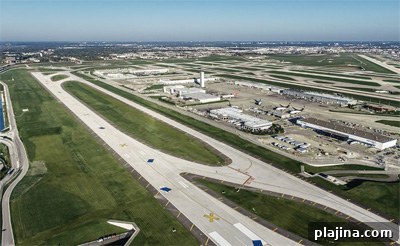
Chicago O’Hare runway © CHICAGO DEPARTMENT OF AVIATION
Chicago O’Hare has been the focus of some of the most significant recent work. A multi-year program included building two new runways to reduce delays and mitigate jet noise for nearby communities. Construction began in August 2016 on runway 9C/27C, an east-west runway that will become O’Hare’s sixth parallel runway. At 11,245 feet long and 220 feet wide, it is designed to accommodate the airport’s largest aircraft and to relieve congestion. That project represents roughly half of a $1.3 billion infrastructure initiative announced in 2016 and was scheduled to open in 2020.
In 2016 O’Hare also completed runway 10R/28L, a 7,500-foot by 150-foot runway that increased operational flexibility by enabling two simultaneous arrivals and a dedicated departure runway on the south airfield. That project earned the Construction Management Association of America’s Project of the Year and the Project Achievement Award for infrastructure valued over $150 million.
After decades of debate, the British government approved the expansion of London Heathrow, one of the world’s busiest airports. The plan—valued at roughly $18 billion—includes a third runway as well as new terminal facilities, car parks, roads and rail connections. Heathrow has long operated near capacity, and supporters argue the new northwest runway will reduce congestion and deliver economic and employment benefits across the United Kingdom. This will be the first new runway at Heathrow since World War II, making it a landmark development for European aviation.
Dublin Airport embarked on its first full modernization of the main runway in 27 years. Runway 10/28, which handles about 95 percent of flights at the busy Irish airport, is being fully resurfaced and fitted with a new LED ground lighting system. The LED upgrades are expected to improve safety while cutting energy use by roughly two-thirds. The modernization is projected to create about 150 jobs and was planned for completion by May 2018. During overnight work on the main runway, operations have shifted to the secondary runway (16/34) to maintain service.
John Glenn Columbus International Airport in Ohio reopened its north runway following a seven-month, $17.3 million rehabilitation. The project repaved the surface, upgraded lighting to LED, refreshed signage and relocated taxiway connectors. Funded in part by the Federal Aviation Administration, which covered about two-thirds of the cost, the work finished on time and on budget. Columbus now operates two runways and supports roughly 140 daily nonstop flights to 34 destinations, linking the region to major U.S. airline hubs.
In Zimbabwe, the upgraded Victoria Falls International Airport was commissioned by President Robert Mugabe after an expansion that began in February 2013. The roughly $150 million program included a 2.48-mile runway, a new air traffic control tower and revamped domestic and international terminals. The expanded runway increases aircraft handling capability and is intended to boost tourism and support Zimbabwe’s ambitions to develop as a regional aviation hub.
Nigeria temporarily closed Nnamdi Azikiwe International Airport in Abuja to rehabilitate a deteriorated runway, in a project costing around N1 billion (approximately $3 million). During the closure, flights were redirected to Kaduna International Airport while crews completed the repairs to restore safe, reliable operations at the nation’s second-busiest airport.
Norfolk International Airport in Virginia is pursuing approval from the Federal Aviation Administration for a second runway. The airport had closed a smaller secondary runway because it no longer met updated FAA length and crash-zone requirements, leaving the facility to operate on a single primary runway. Officials have indicated a second runway will be necessary to support growth and to avoid capacity constraints as the airport expands its role among U.S. small-hub airports.
The Lehigh-Northampton Airport Authority planned a major $57 million airfield renewal that includes full replacement of Runway 06/24 at Lehigh Valley International Airport. The 7,599-foot runway showed extensive cracking and surface deterioration. The airport’s improvement program also encompasses a new transportation center outside the main terminal, a bulk hangar and other infrastructure upgrades. Airlines serving the airport include American, Delta, United and Allegiant, and runway work was expected to cost an estimated $15–20 million of the total project.

Estonia’s Tallinn Airport overview © TALLINN AIRPORT
Tallinn Airport in Estonia recently completed a major reconstruction phase, producing a 3,480-foot runway that ranks as the longest civilian runway in the Baltic states. The project included resurfacing, a modern ground lighting system, an expanded de-icing area, an engine-test apron and additional aircraft parking stands. The upgrades support airlines such as Lufthansa, Finnair, Ryanair and Turkish Airlines and are part of a long-term improvement program budgeted at roughly €127.4 million through 2022, with the reconstruction phase costing about €40.8 million.
Across these projects, common goals emerge: improving safety and reliability, reducing delays and environmental impact, and expanding capacity to support future passenger growth. Runway investments are essential to modern airport operations, delivering immediate operational benefits while enabling long-term economic development for the regions they serve.