Stuffing another bite of Alaskan king crab that tasted like it had been minutes from the sea, I found myself silently grateful for the 1960s experiment that introduced this delicious crustacean to the Barents Sea. Only three days into my Scandinavian trip, I was already enamored — not just with the food, but with the art, culture, heritage and style of Norway.
Over 10 days I tapped into my inner Viking, fed my art-loving soul and satisfied my curious streak by placing a six-day southbound Hurtigruten cruise between stays in Oslo and Bergen. I traveled in February to chase the northern lights, but nearly everything I experienced is available year-round, so the same itinerary works for summer’s midnight sun as well.
Clean, green Oslo impressed me with an urban-cool yet artsy vibe, especially on Tjuvholmen — the former red-light district that has become a hotbed of contemporary architecture and design. This islet, framed by the Oslofjord and canals, is packed with galleries, restaurants, boutiques and the chic Thief hotel.
Staying at The Thief comes with free admission to the adjacent Astrup Fearnley Museum of Modern Art, a boundary-pushing collection housed in a striking building. The museum’s sculpture park offers a time-travel view across the fjord to the late-13th-century Akershus Fortress. From here I walked briskly along the waterfront to downtown Oslo, determined to squeeze in as many sights as possible in one day.
City Hall drew me in with its carved wooden panels depicting Norse mythology and rooms filled with Norway-focused artwork. The Great Hall, where the Nobel Peace Prize ceremony has been held since 1990, and the adjacent spaces display paintings, frescoes and murals by Norwegian masters like Edvard Munch, Per Krohg and Henrik Sørensen. A nearby wall of photos featuring Nobel ceremonies led naturally to the Nobel Peace Center, a museum that explores Alfred Nobel’s life and the work of prize laureates.
The Munch Museum, a short tram ride from the center, houses works the artist left to Oslo, including The Scream and his studies. The museum also offers interactive displays where visitors can leaf through Munch’s sketchbooks on tablets. A larger, newly designed museum was planned to expand exhibition space and visibility for the collection.
Crab safari, Kirkenes © Hilary Nangle
From Oslo I flew to Kirkenes, located about 250 miles above the Arctic Circle and only a few miles from the Russian border. In winter the fjord is a field of snow and ice, and our crab safari sent us out on a snowmobile-pulled sleigh. Bundled up, we watched guides cut holes in the ice, haul up netted traps and pull king crabs — some weighing up to 33 pounds with leg spans of six feet — onto the surface. I held a crab for a photo, learned how guides humanely dispatched and prepared the catch, and minutes later sat in a remote cabin enjoying an all-you-can-eat crab feast.
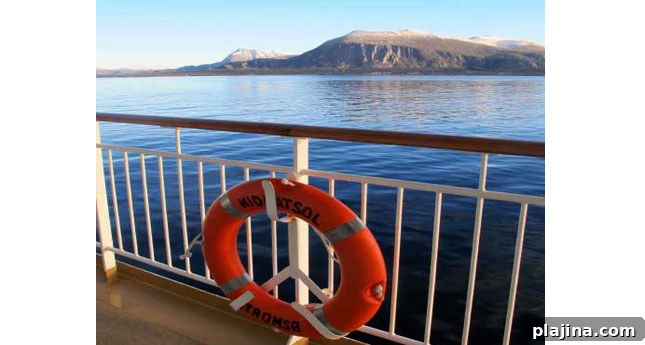
The fjord where we fished is only one indentation in Norway’s vast, jagged coastline. Although the country stretches roughly 1,100 miles, its intricate shoreline totals tens of thousands of miles, threaded with nearly 1,200 named fjords and bays and hundreds of thousands of islands. Excited to trace this coastline by sea, I boarded Hurtigruten’s MS Midnatsol to travel south toward Bergen, watching for northern lights and soaking in luminous winter twilights.
Hurtigruten blends expedition-style cruising with regional ferry service. Since 1893 the company has connected coastal communities, and today its ships call at dozens of ports along the route. The rhythm of the voyage is part of the attraction: frequent stops, chances to step ashore and a steady unfolding of Norway’s coastal scenery.
Aboard ship I settled into a comfortable routine. I walked the decks, lingered in lounges, admired the onboard art, read in the library and spent long minutes on the outdoor decks, breathing crisp air while the ship threaded its way through glacier-sculpted mountains, cliffs, fjords and remote fishing villages. I also ate heartily: buffet breakfasts and lunches and plated dinners showcased Norwegian flavors — from many varieties of herring to reindeer pâté with aquavit-marinated cranberries and wild cod with smoked peas.
Ice Palace in Svolvær © Hilary Nangle
Each port brought its own surprises. Highlights ranged from a dip in near-freezing Arctic waters and a midnight concert at Tromsø’s Arctic Cathedral to exploring the Hurtigruten Museum and the historic M/S Finnmarken in Stokmarknes. In Svolvær I visited the year-round Ice Palace and tasted Arctic crowberry wine served in a glass that began to melt in the warmth of my hand — a reminder to drink quickly.
We arrived in Vardø during the blue hour, when pre-sunset light casts a magical glow. The Steilneset Memorial, also known as the Witches Monument, honors the 91 people executed here in the 17th century; its candlelike lights against the dark sea made for a haunting, beautiful scene.
In Hammerfest, the world’s northernmost town, a guide pointed out landmarks and historical notes: the town’s early use of hydropower for street lighting, a church shaped like traditional fish-drying racks, an Ice Age monolith, the port handling liquefied natural gas from the Snøhvit field, a Sámi hut where seasonal dishes are served, and the Struve Geodetic Arc, a UNESCO site commemorating the first accurate measurement of Earth’s circumference.
The Vesterålen Islands offered gentler scenery: remote villages, rustic fishing shacks, pasturelands and dramatic peaks. Trondenes Church, a fortress-like 12th-century stone building with six-foot-thick walls, hints at a richly ornamented past and anchors a regional historical center that traces Stone Age, Viking and medieval life.
Further south the Lofoten Islands and the Raftsundet Passage delivered sharper, more rugged beauty. Trollfjord, a narrow channel framed by towering cliffs, felt like a natural cathedral; the stillness of land, sky and sea reflected in the water remains one of my most vivid memories.
Trondheim blended Viking history with a lively modern presence. Nidaros Cathedral, built over the grave of Norway’s patron saint, sits alongside the Norwegian University of Science and Technology and Rockheim, the national museum of pop and rock. I crossed the Old Town Bridge into a neighborhood of well-preserved wooden houses and treated myself to waffles and luxurious hot chocolate at Baklandet Skydsstation, a cozy café dating back to 1791. The hot chocolate was poured over pieces of chocolate and topped with whipped cream and shavings; the waffles came with jam, sour cream and Norwegian brown cheese — pure comfort.
On the final day at sea we sailed the Strait of Steinsundet, a thousand-island passage, before arriving in Bergen. With just one full day to explore, I moved quickly through Bryggen’s UNESCO-protected wharf area, a colorful maze of 62 gabled wooden buildings dating from the Hanseatic trading era. I rode the Mount Fløyen funicular for sweeping city views, savored an unforgettable fish soup at the Fish Market and squeezed in visits to Kode, the Hanseatic Museum and Bryggens museums.
For a farewell that blended tradition with innovation, I dined at Lysverket, where chef Christopher Haatuft champions contemporary Norwegian cuisine he playfully calls “neofjordic.” The set menu highlights seafood prepared with local, natural and organic ingredients, some gathered on foraging expeditions led by the chef. It was a fitting final taste of Norway — fresh, creative and deeply rooted in place.
Scandinavia Info to Go
Major airlines serve Oslo Airport (Gardermoen), about 30 miles northeast of the city, and Bergen Airport (Flesland), roughly 12 miles southwest of Bergen. The Flytoget Airport Express Train runs between Oslo Airport and Oslo Central Station every 10 minutes for a 19-minute trip; the Flybussen Airport Express Coach runs about every 20 minutes and takes roughly 40 minutes to reach city hotels. From Bergen Airport the Flybussen Airport Express operates every 15–20 minutes to major hotels, with a 25-minute journey time depending on traffic. Taxis are available at both airports.
Read more about Kirkenes.