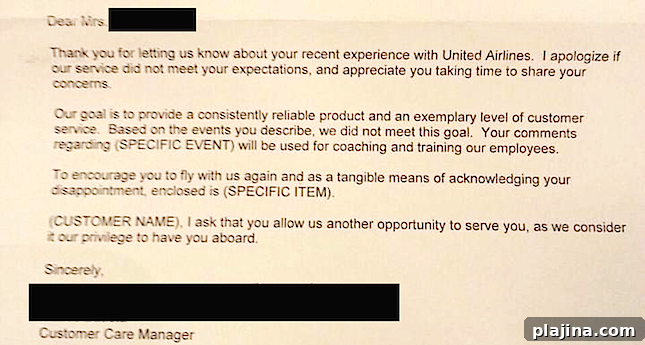
A form letter posted on Reddit, a popular social media bulletin board, has sparked discussion about how airlines respond to customer complaints. What drew attention was that the United Airlines customer care manager who replied to the passenger failed to replace the placeholder text in the template.
The response read in part: “Our goal is to provide a consistently reliable product and an exemplary level of customer service. Based on the events you describe, we did not meet this goal. Your comments regarding (SPECIFIC EVENT) will be used for coaching and training our employees.”
It’s an understandable slip — likely the result of a busy employee handling multiple cases and relying on a standard template. Yet the incident also highlights how impersonal automated or templated replies can feel, and raises questions about how well airlines personalize responses and acknowledge individual passenger experiences.
Airlines often use form letters to ensure consistent messaging and to process large volumes of feedback efficiently. When done carefully, templates can help resolve issues quickly and direct complaints to the appropriate department for follow-up. When placeholders are left in place or messages come across as generic, however, customers can feel dismissed or undervalued.
Some best practices for customer service communications include tailoring replies to the specific incident, referencing relevant dates or flight numbers, and offering concrete next steps or remedies when appropriate. Even a brief personal sentence from the agent — acknowledging the passenger’s frustration and outlining what will happen next — can make a form response feel more genuine.
Ultimately, the Reddit post served as a reminder that small errors in customer communications are visible in the age of social media and can quickly become talking points. For passengers, it underscores the importance of documenting issues clearly and following up if an initial response is vague or fails to address the matter. For airlines, it’s a nudge to strike a better balance between operational efficiency and thoughtful, personalized service.
For further reading on how to handle poor service and craft effective complaints, see the September 2014 issue of Global Traveler.