
In a region known for some of the Caribbean’s finest beaches, pristine parklands and well-preserved colonial towns, one of the U.S. Virgin Islands’ most memorable attractions is an unlikely one: a 40-year-old shack tucked into the rainforest at the northwestern tip of St. Croix.
The Mt. Pellier Hut Domino Club draws visitors for its enormous “everything” burgers, the warm hospitality of proprietor Norma George and her signature “Mama Wanna,” a home-brewed elixir of dark island rum infused with honey, herbs and roots. Yet these treats are almost incidental to the real spectacle: beer-drinking pigs named Gem, Vic, Grunt and Hurricane Roger, who guzzle cans of near-beer with astonishing gusto.
That surreal scene began over 20 years ago when Buster, a family pet, grabbed a can of Heineken and proceeded to drink it down. Buster later was laid to rest on the premises, and the tradition continued with nonalcoholic O’Doul’s. The pigs stand on their hind legs, snatch cans, crunch through the aluminum and chug foam with the same exuberant energy you might expect at a college party—followed by loud, satisfied burps. It’s a quirky, unforgettable slice of island life.
If anthropomorphic swine aren’t your idea of local culture, don’t worry. The U.S. Virgin Islands offer a wide range of experiences: diverse landscapes, deep history and three distinct islands—St. Thomas, St. John and St. Croix—each with its own personality. For U.S. citizens, travel is especially convenient since no passport is required for entry or departure.
The islands’ history runs deep. Indigenous Taino and Carib peoples first settled the area. Christopher Columbus landed on St. Croix during his second voyage in 1493, and over the centuries the islands were controlled at various times by Spain, Britain, the Netherlands, France and the Knights of Malta. Denmark later colonized the islands, converting much of the arable land to sugar production; remnants of that era, like stone windmills, still dot the landscape. The United States purchased the islands in 1917 to protect shipping lanes for the Panama Canal and to keep them out of German hands during World War I.
With the rise of jet travel in the 1950s, the Virgin Islands became an accessible escape from the U.S. mainland, ushering in decades of tourism. Notable visitors included author Herman Wouk, who ran a hotel on St. Thomas and drew inspiration for his island novel Don’t Stop the Carnival; actress Helen Hayes, a regular on St. Croix; and philanthropist Laurance S. Rockefeller, who purchased more than 4,600 acres on St. John and donated the land in 1956 to establish Virgin Islands National Park.
St. Thomas is the primary gateway to the territory. Cyril E. King International Airport offers nonstop flights from multiple East Coast and Midwest cities, and the harbor at Charlotte Amalie welcomes several cruise ships daily during peak seasons. The island’s long history as a free port translates into attractive duty-free shopping—allowances here can be up to $1,600 per person, higher than many neighboring islands—making jewelry, watches, perfume and liquor popular buys.
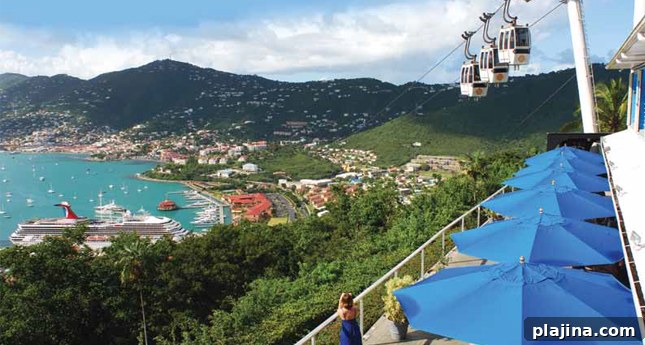
For sweeping views, ride the Paradise Point St. Thomas Skyride up to Flagg Hill’s 700-foot summit. Shops and a bar make it an ideal spot for sundowners with vistas reaching to Puerto Rico. Drake’s Seat and Magens Bay provide additional picture-postcard panoramas: Magens Bay’s mile-long, sand-bottomed beach ranks among the Caribbean’s favorites, while quieter Hull Bay, two miles west, is beloved by locals and surfers.
Golfers will find Mahogany Run’s challenging course with its notorious “Devil’s Triangle” holes, while Coki Point Beach and nearby Coral World Ocean Park serve families and snorkelers with amenities, rentals and an underwater observatory showcasing one of St. Thomas’s healthiest reefs.
Just three miles east of St. Thomas lies tranquil St. John, where two-thirds of the 19-square-mile island is preserved as Virgin Islands National Park. With no airport, no cruise ship docks and no golf courses, St. John appeals to nature lovers. Over 20 well-marked hiking trails—like the scenic Reef Bay Trail, Ram Head Trail and the historic Annaberg Plantation Trail—lead past colonial ruins, petroglyphs and secluded beaches. The island’s north shore features a string of fine white-sand beaches from remote Waterlemon Bay to family-friendly Trunk Bay, which includes a marked underwater snorkeling trail ideal for beginners.
St. John is also the departure point for day sails and powerboat trips to the British Virgin Islands. Many outfitters run itineraries to highlights such as The Baths at Virgin Gorda and the lively beaches of Jost Van Dyke; remember to carry a passport for British Immigration. Coral Bay, on the island’s east side, offers a relaxed local vibe with waterfront bars, liveaboard sailors and chill spots like Skinny Legs.
St. Croix, the largest of the U.S. Virgin Islands at 84 square miles, lies about 40 miles south of St. Thomas. Its economy is more diversified and less tourism-dependent, housing well-known rum distilleries and an oil refinery. Still, St. Croix offers a rich blend of cultural and natural attractions. Frederiksted on the west side receives cruise visitors and is anchored by Fort Frederik, while Christiansted on the north-central coast preserves an elegant grid of 18th-century neo-classical buildings and historic sites that form the Christiansted National Historic Site.
From Christiansted’s waterfront you can arrange excursions to Buck Island Reef National Monument, a 19,000-acre marine preserve where snorkelers explore a protected lagoon teeming with turtles, reef fish and rays. West of town, Salt River Bay National Historical Park and Ecological Preserve features Columbus’ landing site, a rare early earthwork fort and extensive mangrove habitat that supports diverse birdlife. For divers, St. Croix is a standout shore-diving destination; Cane Bay’s dramatic walls, submarine canyons, shipwrecks and nocturnal dives around Frederiksted Pier reveal seahorses, frogfish and other marine life.
Sandy Point National Wildlife Refuge, on St. Croix’s southwest tip, protects the territory’s longest beach and serves as the Caribbean’s second-most important nesting site for endangered leatherback sea turtles. During the April–August nesting season, U.S. Fish & Wildlife Service rangers lead turtle-watch tours—an intimate, natural wildlife encounter that contrasts with the playful spectacle at Mt. Pellier Hut.
Info To GoSt. Thomas’ Cyril E. King International Airport (STT) sits two miles west of Charlotte Amalie. Ferries connect St. Thomas to St. John from downtown and Red Hook. Henry E. Rohlsen International Airport (STX) serves St. Croix on the island’s south-central side. Frequent daily flights link St. Thomas and St. Croix; the seaplane between Charlotte Amalie and Christiansted is particularly scenic. |
LodgingTHE BUCCANEER HOTEL: The oldest family-run resort in the islands spans 340 acres outside Christiansted, offering golf, tennis, two beaches and seaside villas. 5007 Estate Shoys, Christiansted, St. Croix $$$$ CANEEL BAY, A ROSEWOOD RESORT: Laurance S. Rockefeller founded this luxurious retreat; the 170-acre property features seven beaches and 166 guestrooms with upscale amenities. Route 20, Caneel Bay, St. John $$$$ FRENCHMAN’S REEF & MORNING STAR MARRIOTT BEACH RESORT: Recently renovated, this resort includes infinity pools, swim-up bars, restaurants, a spa and a rum bar. 5 Estate Bakkeroe, Charlotte Amalie, St. Thomas $$$ |
DiningCOCO BLUE RESTAURANT: An east-end eatery known for gourmet Caribbean dishes like guava-glazed pork ribs with habanero. American Yacht Harbor, Red Hook, St. Thomas $$$ EAT @ CANE BAY: Open-air dining overlooking the beach with creative, changing “food shots.” 110C Cane Bay, St. Croix $$ LA TAPA: A friendly 65-seat bistro in a century-old Danish building specializing in tapas-style, market-fresh dishes. Centerline Road, Cruz Bay, St. John $$$ |
Big Beard’s Adventure Tours
The Buccaneer Hotel
Calypso Charters
Cane Bay Dive Shop
Caneel Bay, A Rosewood Resort
Coco Blue Restaurant
Coral World Ocean Park
Eat @ Cane Bay
Frenchman’s Reef & Morning Star Marriott Beach Resort
Mahogany Run Golf Course
National Park Service, U.S.V.I.
Sandy Point National Wildlife Refuge
La Tapa
U.S. Virgin Islands Department of Tourism
Virgin Kayak Tours