
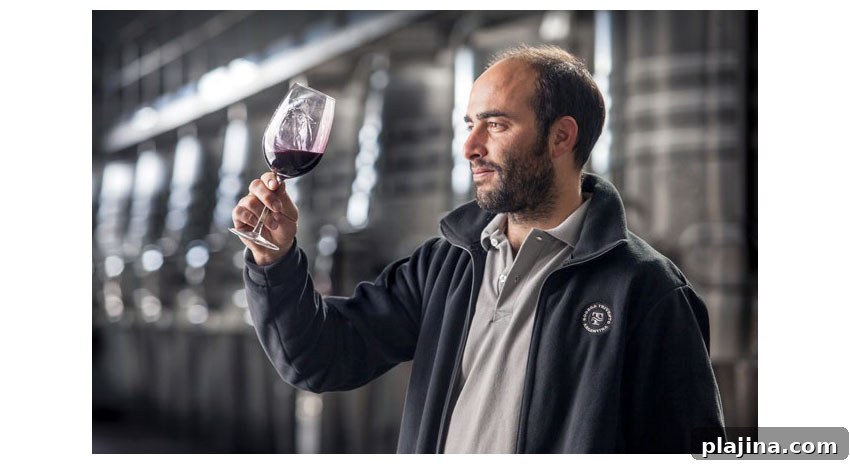
TRIVENTO, in Spanish, means “three winds,” a fitting name for the Argentine winery where three important winds sweep across its Mendoza vineyards: the polar winter wind, the warming Zonda in spring, and the cooling Sudestada in summer. These climatic influences, together with the region’s altitude and alluvial soils, help shape the grapes that winemaker Germán Di Cesare turns into wines such as Chardonnay, Torrontés, Pinot Grigio, Cabernet Sauvignon, Pinot Noir, Syrah and, most notably, Malbec.
Malbec is a red grape that arrived in Argentina from France in the mid-1800s and found an ideal home in Mendoza, in the western foothills of the Andes. There the grape thrives, producing deeply colored wines with medium to full bodies, lively acidity and a silky texture when well made. The combination of sun, cooling mountain air and drainage from the Andes contributes to fruit concentration and balanced ripeness in many of Argentina’s top Malbecs.
At a recent luncheon with Germán Di Cesare, we began the tasting with Trivento White Orchid Reserve 2018 ($11), a refreshing white blend of Torrontés and Pinot Grigio. The wine offers bright aromatics and a crisp palate that pairs well with light starters and seafood.
The tasting progressed through a selection of Malbecs starting with Trivento Reserve Malbec 2017. This entry-level red delivered attractive aromas and satisfying structure at an exceptional value for about $11. Next was Trivento Amado Sur Malbec Blend 2017 ($15), a blend containing 70 percent Malbec; it showed deep color, medium body and notes of berries and plums that make it approachable and food-friendly.
Trivento Golden Reserve Malbec 2016 ($21) presented a fuller body and a well-balanced profile with bolder flavors and coffee-like nuances. Germán referred to it as “a classic Malbec,” reflecting its concentration and depth.
The tasting concluded with Trivento’s flagship Malbec, Eolo 2015 ($79). Named for a wind god, Eolo is produced in limited quantities from a single 10-acre parcel. The wine is smooth yet powerful, exhibiting full body, layered fruit, a touch of spice and toast, and a long, lingering finish. Its complexity and length make it a memorable finale to the tasting.
Germán often says, “The best measure of a wine’s worth is an empty bottle.” On that afternoon the luncheon table, scattered with empty bottles, offered ample proof of Trivento’s consistent quality and value.