
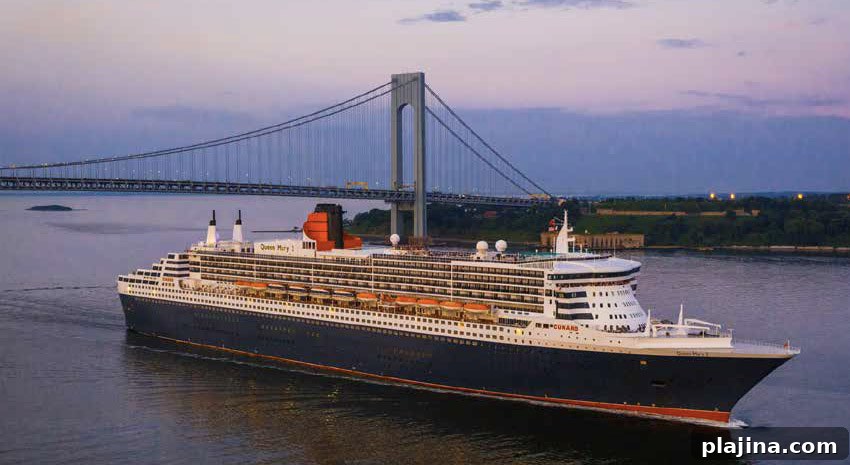
Leaning over the polished deck rail, I watch latitude and longitude dissolve into endless swaths of deep blues and shifting grays. Beneath my feet, the ocean’s depth is measured in fathoms—a vast, mysterious well whose secrets remain hidden beneath a constantly changing surface.
I’m aboard Cunard’s iconic Queen Mary 2, one of the world’s most distinguished ocean liners. Together with my husband, James, I’ve set out on a seven-night transatlantic voyage that began in New York and ends on the English coast. The itinerary’s appeal is immediate: no daily port calls, just the romance of crossing the open ocean and the timeless ritual of life at sea.
We left Brooklyn at dusk and sailed past the Statue of Liberty, watching her silhouette from the balcony of our stateroom as she faded into evening. Passengers gathered along the decks below, waving to the receding landmark. Once in open water, James popped a bottle of chilled Champagne to toast our journey.
By morning, land had vanished from view. We chose breakfast-in-bed room service and relaxed on our veranda with coffee and tea, eyes fixed on the endless horizon. The ship’s motion is gentle, and we soon spotted pods of dolphins arcing through the waves alongside the hull—an effortless reminder of the sea’s wild beauty and of Cunard’s attention to unforgettable moments.
Later we wandered through the ship to admire its elegant Art Deco interiors and carefully restored public spaces. Remastered in 2016, Queen Mary 2 received gleaming new woodwork, a refreshed hull, upgraded carpets and upholstery, newly varnished floors and restored artwork. Dining options expanded with additions such as The Verandah restaurant, and more staterooms were added to the upper decks. Classic features were refreshed as well, including the largest ballroom at sea and a full-service Canyon Ranch SpaClub. On the lower decks, permanent exhibitions trace Cunard’s storied past and the ocean liner’s own illustrious history.
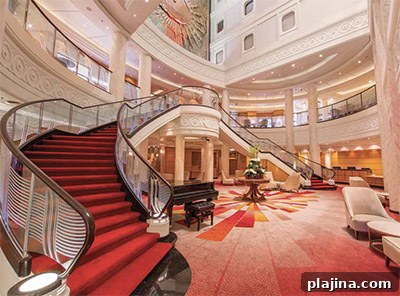
Grand Lobby © CUNARD
Entertainment aboard the ship covers a broad range of interests, from live performances to expert lectures. I began a morning with an Insights Lecture in the elegant Illuminations theater. Maureen Ryan, who once served as a post-war telephonist and Lady Assistant Purser on both Queen Mary 2 and Queen Elizabeth, recounted vivid tales of life at sea in an era when many key roles were male-dominated. She outlined Cunard’s origins in a government contract awarded to Samuel Cunard to carry Her Majesty’s mail between Britain and the Americas—a pioneering achievement that cut crossing times dramatically.
The first formal evening of our voyage was a gala affair. Guests arrived in evening gowns and tuxedos, filling the dining rooms with a sense of occasion. After dinner, we drifted toward the Royal Court Theatre, passing an art gallery before settling in for a musical production and a ball. Our attempts at the waltz quickly showed we had much to learn compared with more practiced passengers.
The next day offered star shows in the Planetarium and a traditional afternoon tea in the Queens Room. White-gloved servers circulated with silver trays of delicate finger sandwiches and pastries, and the room hummed with quiet conversation and the clink of teacups.
Throughout the crossing, the onboard program provided variety and enrichment. James attended a conversational Japanese class while I joined a workshop with New Yorker cartoonist David Sipress. Later, we regrouped in the Champagne Bar to plan our outfits for the Roaring Twenties Ball. Our Charleston steps proved serviceable, and we spent a joyful evening dancing in a setting that felt perfectly attuned to the period.
Before dawn on our final day, the ship’s horns announced our approach to Southampton. Standing once more at the balcony rail, we reflected on tranquil nights and long, unhurried days that allowed time to appreciate the ship itself—the service, the spaces and the slow rhythm of life at sea.
Samuel Cunard might never have imagined that someone from Providence, Rhode Island, would one day cross this ship’s gangplank with such anticipation. Yet here I was: rested, grateful and buoyed by the line’s legendary White Star Service. For those who value the heritage and purpose-built design of an ocean liner, Queen Mary 2 remains distinct from typical cruise ships—a vessel built for the crossing itself.
Queen Mary 2 Info to Go
When booking a transatlantic crossing with Cunard, convenient travel arrangements are available at both ends of the voyage. In New York, the Brooklyn Cruise Terminal is accessible from LaGuardia (LGA), John F. Kennedy International (JFK) and Newark (EWR). In the U.K., Southampton is served by London Heathrow (LHR), Stansted (STN) and Gatwick (LGW). Transfer options include private car, taxi, Cunard shuttle service or train, and travel time from the airports to each port typically ranges from under an hour in New York to under two hours in the London area.