
A new building will soon rise beside Taiwan’s Touqian River: a combined market and food hall with cultural spaces in the northern city of Zhubei. Designed as a stack of open, flexible floors that can adapt to changing needs, the project will act as an urban condenser and represents a contemporary evolution of the traditional shopping market. Reflecting this forward-looking approach, the scheme is named Market Cube. Rotterdam-based architecture firm MVRDV is the lead designer for the project.
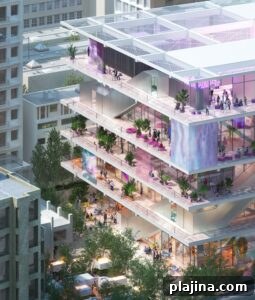
© MVRDV
Zhubei sits roughly 80 kilometers south of Taipei and is among Taiwan’s fastest-growing cities. Its rapid growth is linked to proximity to Hsinchu Science Park, a technology hub that draws young professionals and growing families to the area. Responding to these demographic shifts, Zhubei’s municipal leadership envisioned a market building that would serve both as a daily amenity and a destination for the city’s increasingly affluent population.
Planned for a prominent riverside site where a major bridge connects Zhubei with nearby Hsinchu, the project was initiated under Mayor Zheng Chaofang. MVRDV, together with Taipei-based co-architect EKUO, researched the evolution of market types—from roadside vegetable vendors and open market squares to contemporary supermarkets and food courts. Their study identified a tension and opportunity between the efficiency and convenience of modern retail models and the multifunctional social life that earlier Taiwanese street markets supported.
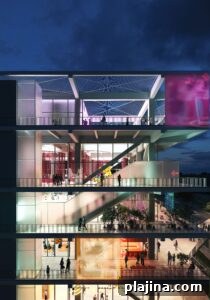
© MVRDV
Market Cube, referred to locally as Riverbank 1, takes a hybrid approach: a modern platform for a traditional market combined with culinary destinations and spaces for social and leisure activities. The concept stacks open-plan floors programmed for markets, food courts, day care and a children’s playground, exhibition and performance spaces, plus a rooftop agricultural showcase and activity pavilions.
To aid circulation and wayfinding, the design uses layered systems of color-coded lighting, clear signage and interactive media. Each level will have a distinct color palette, supported by LED screens and neon elements to improve legibility and atmosphere. Exterior escalators, enclosed with translucent panels, make movement visible and turn circulation into a form of public theater.
Wide exterior terraces will be reached by two sets of escalators that spiral up the building’s façade, enabling each floor to be opened or closed independently. This arrangement encourages a porous relationship between interior and exterior, letting parts of the program spill into terraces and riverside promenades.
Simplicity and flexibility are central to the design strategy, allowing the building to respond to changing social and commercial patterns over decades. By prioritizing adaptable floor plates and modular stall types, the project aims to prolong the building’s usefulness and minimize the need for costly structural alterations in the future.
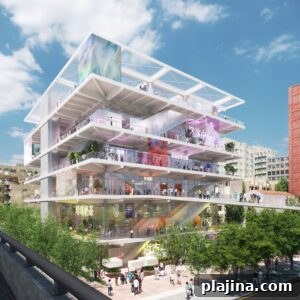
© MVRDV
For the market and food court levels, a catalogue of stall types will be offered, ranging from simple traditional market stalls to kiosks with integrated seating, accommodating diverse vendor formats and culinary experiences. The design also intentionally reaches into its surroundings to attract passersby: a pedestrian bridge from Touqian Riverside Park will provide direct access to the food court on the first floor, while market areas on the ground and lower-ground floors can extend activities into the adjacent street and shaded zones beneath the overpass.