
In the small hours of a moonless night, it appears to be just a road. Lit by sodium lamps, it winds up through darkness, seemingly suspended in the void. We have it almost to ourselves. My cousin is driving, masterfully negotiating a continual sequence of rising bends. I stare beyond the meandering river of light into velvet blackness. I have been told this is one of the world’s greatest roads. At that hour, I cannot see why.
I flew into Jeddah on the sweltering Red Sea coast at midnight. To reach my cousin’s house we must climb one of the northern reaches of the Great Rift Valley, the long geological fissure that runs from Mozambique to Syria. At the top of the escarpment we pass through the hauntingly quiet city of Taif. At 3 a.m. there is no sign that this is the seasonal seat of the Saudi government, which relocates here each summer to escape Riyadh’s furnace-like temperatures.
Two weeks later I return to Jeddah in daylight. By now, I approach any venture onto Saudi roads with heightened anxiety. I have faced sandstorms that reduce visibility to a few feet, endured numerous near misses with local kamikaze drivers, and witnessed the horrific aftermath of several accidents.
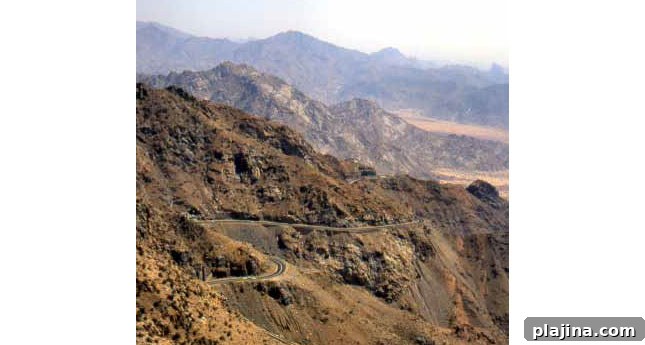
We reach the escarpment’s edge and pull to the side. Daylight transforms the scene. From our high perch we take in a panorama of stark rock plunging sharply to pale, sandy lowlands. The landscape is so alien compared with our green, temperate homeland that it might as well be Mars.
Wild baboons soon surround the car, insistently begging for food. My cousin pretends to pick up a loose stone and the troop bounds away, descending the mountainside and leaping nimbly from rock to rock.
Back in the vehicle, we begin the descent. The two-lane highway improbably carves its way down the sheer contours. The smooth, wide tarmac is a comfort, but the driving standard provides none: hazards are met without concession. Cars flash past at frightening speed and tires squeal on the sharp switchbacks.
I fix my gaze on the sweeping view. It feels like being in an airplane on a tortuous final approach. Slowly, the tiny rooftops below grow in size and clarity. Eventually the road flattens, broadens and straightens, heading west toward the coast.
A significant obstruction stands between us and Jeddah. Signs above the highway announce our approach to it. Three lanes are reserved for Muslims. The remaining two lanes, marked “Obligatory for non-Muslims,” peel off onto the so-called “Christian bypass.” We will not be allowed any closer to Mecca; beyond that point, travelers must show mosque-issued documentation to enter the holy city.
The bypass skirts behind a range of hills south of Mecca, adding some 70 miles to our journey. Close to the road, stretches of blue water and green vegetation briefly interrupt the barren desert — Mecca’s sewage ponds. Once the smell is no longer shocking, the area becomes a fine place for bird-watching. We put our binoculars to use, spotting kingfishers and waders among the reeds.
As we near Jeddah the air becomes humid and traffic thickens. On the city’s outskirts we find ourselves stuck in the first of many jams. I look back, full of nostalgia, at the route we have taken: the same spectacular track used for centuries by nomads, camel trains and pilgrims. It is more than a road. It is a journey.