
Juan Segundo Díaz Dopazo grew up in Argentina’s Patagonia and later moved to Buenos Aires to study architecture. From an early age he knew he would return to Patagonia, drawn by its untouched landscapes. He did not, however, expect to one day design a collection of cabins for his own parents deep within the Arrayanes forest.
© Nacho Ballester
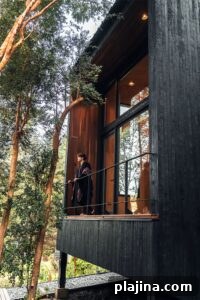
The project, named Casa Gallareta (Luxury Landscape Cabins), is located in Villa la Angostura, Patagonia, Argentina. It is a boutique-scale tourist complex set within a native forest of Coihues and Arrayanes on steep terrain with direct access to the shores of Lake Correntoso. The brief emphasized minimal intervention in the landscape while providing intimate, high-quality accommodation for visitors seeking a deep connection with the forest.
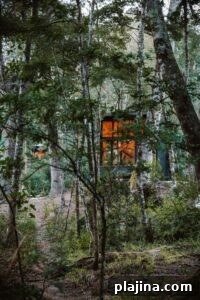
The master plan consists of modular “landscape cabins” intended for two to three guests. Each cabin was conceived as an additional element of the forest, designed to recede visually into its surroundings. While the cabins share a coherent architectural language, subtle differences in orientation, openings and material treatment give each unit its own character, producing a controlled randomness that mimics natural variety.
© Abril Roffo
Placement of the cabins was carefully planned: structures occupy natural clearings so no trees needed to be felled. This respectful siting preserves the forest ecology and creates intimate relationships between each cabin and its canopy. Despite modest footprints, the interior spatial sequences feel generous, intentionally blurring the boundary between inside and outside.
Each unit is arranged as a single open space punctuated by large, strategically placed windows that extend the perceived interior volume into the forest. These glazed openings frame views of the dense myrtle canopy, offering both privacy and immersion in nature. The design leverages orientation and window placement to capture light, views and seasonal changes.
Bathrooms are generous and designed for comfort. The largest cabin includes a freestanding tub positioned to offer panoramic views; in winter guests can relax in a hot bath while watching snowfall through the window. Such moments form part of the cabins’ immersive experience, celebrating seasonal atmospheres.
© Juan Segundo Diaz Dopazo
The cabins’ exteriors respond to the rugged site. Facades are clad in eucalyptus wood treated with the traditional Japanese technique of Shou Sugi Ban, producing a charred surface that enhances texture, water resistance and durability. The darkened cladding sets off the green of the trees and the white of winter snow. Complementary materials include lapacho wood, expansive glazing, black metalwork and exposed concrete, chosen for durability and to reinforce a restrained material palette.
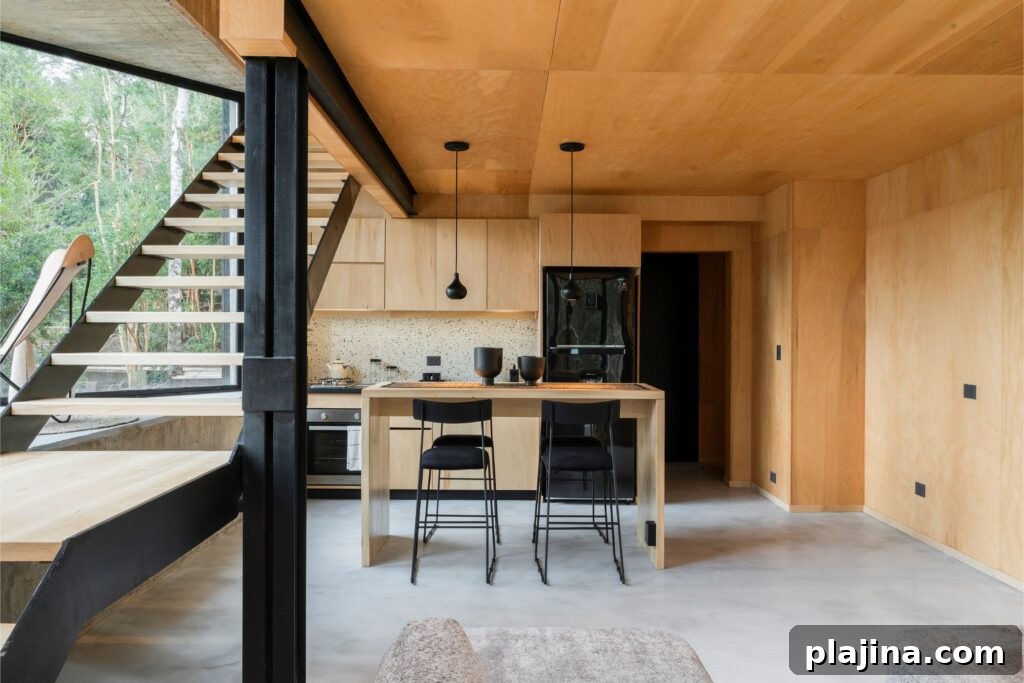
Inside, Guatambú wood predominates. Its light, knot-free appearance contrasts with the dark exterior and amplifies a sense of spaciousness. Large wood panels serve both aesthetic and constructive purposes, simplifying interiors while providing warmth and visual continuity.
Furniture is crafted from the same Guatambú, creating seamless transitions between built elements and fittings. This unified material approach results in clean, contemporary interiors where furniture reads as an extension of the architecture rather than separate objects.
The project was executed by Organic and Joyful Architecture, who describe Casa Gallareta as a labor of care that has resonated with residents and visitors alike. The cabins opened to guests in 2024 and have since received international attention, garnering nominations, awards and features in publications for their sensitive approach to design in a protected landscape.
For reservations, contact Casa Gallareta by email at [email protected] or through the official booking channel provided by the property.