
A relic from Sofia’s Soviet era still commands attention: the nearly 12-foot-high Monument to the Soviet Army. A Red Army soldier stands atop the monument, flanked by a Bulgarian man and woman, while a procession of figures lines the base — Bulgarians greeting the Soviet soldiers who entered the country in 1944.
Erected in 1954 to commemorate the Soviet role in defeating fascism during World War II, the monument stands in the center of Borisova Gradina (Boris’ Garden), one of Sofia’s largest parks. It is also the first stop on our tour of Bulgaria’s capital — a stark reminder of Communist rule from 1946 to 1989.
The park is where my partner, Panos, used to jog every day during the three years he helped rebuild infrastructure in the mid-1990s after the fall of the Iron Curtain. This is the Sofia he remembers, and the Sofia I expect as we pause during a business trip to see how the city has changed.
Reminders of that era remain — weathered facades and Soviet-style apartment blocks on the city’s edges — but modern Sofia has moved on. Over the last decade Bulgaria’s rapid transformation and its integration into the European Union have softened the prominence of the Soviet past.
Today the area around the statue draws young skateboarders, while downtown Sofia buzzes with bars, boutiques, nightclubs, beer pubs, trendy restaurants and sprawling shopping centers.
We leave the statue and stroll through the late 19th-century park, following paths lined with dog walkers, elderly women deep in conversation and university students absorbed in their phones. Many of Sofia’s top sights are within walking distance of the park or are easily reached by tram, metro, bus or trolley.
We pause at the Battenberg Mausoleum, built in 1897, its single copper dome glinting in the sun. This mausoleum is the final resting place of Prince Alexander I, the first head of state of modern Bulgaria.
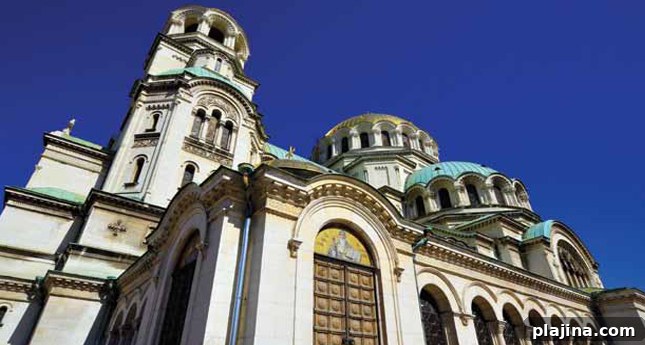
Sofia’s most iconic Orthodox church is the gold-domed St. Alexander Nevsky Cathedral, a city emblem built in the early 20th century to honor the roughly 200,000 Russian, Ukrainian, Belorussian and Bulgarian soldiers who died in the Russo-Turkish War of 1877–1878. It ranks among the largest and most important Eastern Orthodox cathedrals. Underneath the cathedral, a crypt contains the National Art Gallery’s collection of Bulgarian Orthodox art, including many historic icons.
Adjacent to the cathedral sits St. Sophia Church, the church that lent its name to the city. Originally constructed in the sixth century on the site of an ancient Roman theater, the building was briefly converted into a mosque during Ottoman rule.
Behind the cathedral, the National Gallery for Foreign Art, housed in the former Royal Printing Office, displays a varied collection that includes Christian sculpture from far-flung regions such as Goa, among other international works.
Stretching south and west from the cathedral, Sofia’s principal sights are connected by the so-called “Yellow Brick Road,” a pathway paved with Viennese yellow cobblestones that are said to have been a wedding gift to Prince Ferdinand in the late 19th century. Along this route stands the Russian Church (the Church of St. Nicholas the Miracle-Maker), a 1914 revival-style building known for its colorful frescoes and the crypt that holds the remains of the Russian Archbishop Seraphim.
We browse the Antiques Market and sift through odds and ends, from old cameras to lacquered Russian nesting dolls. Nearby streets host vendors selling Communist-era memorabilia alongside other curiosities.
Beyond the Yellow Brick Road, the Central Synagogue — the second-largest Sephardic synagogue in Europe — rivals Sofia’s churches with its grand exterior. Built between 1905 and 1909 and inspired by a Vienna Sephardic synagogue destroyed in World War II, its interior once received a large menorah, brass chandelier and other fittings from Vienna. Though bomb damage in 1944 impaired the synagogue, it has since been restored.
Inside the synagogue complex we visit the Jewish Museum of History-Sofia and learn about the Jewish community’s history. The museum highlights the rescue of approximately 50,000 Bulgarian Jews during World War II, many of whom later emigrated after the founding of Israel in 1947.
Completing the city’s trio of major religious sites, the Banya Bashi Mosque — one of Europe’s oldest mosques, completed in 1576 — stands not far from the synagogue.
We spend daytime hours sightseeing and revisiting Panos’ memories, while evenings are reserved for local friends, food and Sofia’s nightlife.
Shopska salad © Anetkata | Dreamstime.com
Our first night’s meal introduces me to Bulgarian cuisine at Manastirska Magernitsa, a mehana (traditional restaurant) with an extensive menu of local dishes. We begin with shopska salad and other vegetable plates, paired with rakia, the potent traditional spirit typically served with the first course.
After a long, hearty dinner we stop at Bar Up for a fruity cocktail before exploring Sofia’s late-night clubs. The bar sits on the edge of Rakovski Street, Sofia’s theater-lined thoroughfare. One of the city’s popular club scenes centers on chalga — a Bulgarian pop-folk genre with Balkan and Middle Eastern influences. Sin City is a noted chalga venue where young partygoers dance into the early morning hours.
For a more classical cultural experience, we try to visit as many museums and historic sites as time allows. At the Bulgarian Council of Ministers, an underpass reveals archaeological remains from the East Gate of the ancient fortress of Serdica. Sofia’s Roman and Thracian origins are often overlooked amid 20th-century history: the Thracian settlement that later became Serdica dates back to around 2000 B.C.
In the courtyard of the Presidential Palace and the Sofia Hotel Balkan are additional Serdica remains and the restored Roman Rotunda of St. George (Sveti Georgi), which now functions as St. George Church. The arena of a Roman amphitheater is visible at the Arena di Serdica Hotel.
Rotunda of St. George © Ccat82 | Dreamstime.com
Nearby, the National Institute of Archaeology with Museum at the Bulgarian Academy of Sciences, housed in a former Ottoman mosque, presents relics from the Roman period and earlier eras, from Thracian treasures to sarcophagi and tools.
The National Art Gallery occupies the former Royal Palace and is a highlight for its setting as much as its collections. Visitors can explore medieval paintings, modern Bulgarian art and works from the Ottoman era housed in the palace’s grand rooms.
We make a detour to Slaveykov Square, the booksellers’ square named for poets Petko and Pencho Slaveykov. Where once tables sold pirated CDs and software, about 40 stalls now offer a wide range of books, from science fiction to travel guides.
On our final day we visit Boyana Church at the foot of Mount Vitosha, a UNESCO World Heritage site celebrated for its frescoes and icon paintings. The complex has three buildings, the oldest dating to the 10th century, and is regarded as one of the most complete and well-preserved monuments of medieval Eastern European art.
Nearby, the National Museum of History houses more than 650,000 exhibits and ranks among the largest history museums in the Balkans. The museum occupies the former residence of Bulgaria’s last Communist leader, Todor Zhivkov — a fitting final note for a tour of a city that increasingly looks to the future rather than remaining anchored in the past.
Sofia Info to Go
There are no direct flights from the United States to Sofia, but travelers can connect through major European hubs such as London, Rome, Frankfurt or Paris. Bulgaria Air operates from Sofia Airport, the city’s primary international gateway. Public bus lines No. 84 and No. 384 connect the airport to the central city and to metro stations.
Where to Stay in Sofia
Arena di Serdica Hotel The hotel’s 63 rooms and suites sit on the site of a Roman amphitheater, with a section of ruins visible from the lobby. 2-4 Budapeshta St. $$$
Grand Hotel Sofia This refined 105-room hotel attracts international guests and offers a spa solarium and upscale dining at Shades of Red Restaurant. 1 Gurko St. $$$
Suite Hotel Sofia Located in the Student City area, this 122-room contemporary hotel offers free WiFi and panoramic views from its Zest Restaurant. 1A Yordan Yossifov St. $$
Restaurants in Sofia
Hadjidraganovite Kashti Traditional Bulgarian dishes served in restored 19th-century houses, each reflecting the style of different towns. 75 Kozloduy St. $$
Pod Lipite Restaurant One of Sofia’s oldest eateries, known for locally sourced dishes like homemade yogurt, cheese and bread, accompanied by live folk music. 1 Elin Pelin St. $$
Thirsty Dragon Inn A cozy spot offering local cuisine and Czech lager in a homey, wooden-decor setting. Ulitsa 13 Marzo 2 $$