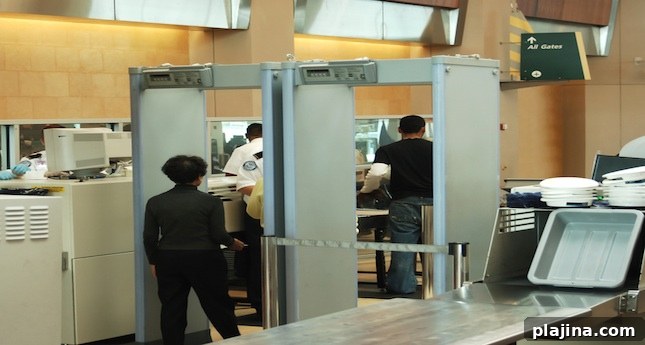
New security scanners at airports promise to reduce wait times in security lines and improve the overall travel experience. These advanced systems can generate three-dimensional images of suitcases and backpacks, offering a clearer and more detailed view of both main compartments and external pockets. As a result, travelers may no longer need to remove laptops and other electronic devices, because the scanners can inspect every inch of a carry-on bag without requiring items to be unpacked.
The familiar plastic bins used at checkpoints are also being redesigned to streamline the screening process. Larger bins will be introduced so passengers spend less time distributing their belongings across multiple trays and then hastily repacking them after passing through the scanner. This change aims to make security lines move more smoothly and reduce stress for travelers juggling personal items.
These new scanners and bin designs are undergoing continued testing at Changi Airport in Singapore, widely regarded as one of the world’s leading and most innovative airports. By trialing these improvements, Changi Airport is helping validate technologies that could enhance security efficiency and passenger comfort at airports globally.
Implementing three-dimensional imaging and improved tray logistics supports both safety and convenience. Enhanced imaging enables security staff to more accurately identify prohibited items while minimizing the need for secondary bag checks. At the same time, larger trays and less frequent unpacking reduce physical handling of personal belongings, lowering the chances of misplaced items and improving the flow through checkpoints.
For travelers, the expected benefits include shorter lines, fewer interruptions to repacking, and a more predictable screening process. For airports, the benefits include faster throughput, more effective detection capabilities, and the potential to reallocate staffing to other priority areas. Together, these advances can make the journey through security less stressful and more efficient for everyone involved.
While the rollout of new equipment requires careful validation and regulatory approval, ongoing trials at a forward-looking facility like Changi demonstrate practical steps toward adoption. Continued evaluation will focus on image clarity, operator ergonomics, throughput rates, and passenger experience to ensure the new systems meet safety standards and user expectations before wider deployment.