
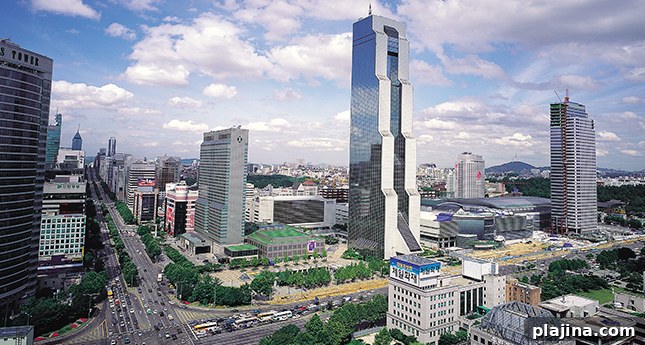
The toughest decision delegates at November’s G-20 summit may face is how to spend a few spare minutes. Seoul’s largest convention complex, the 4-million-square-foot Coex, combines the World Trade Center Seoul, the Seven Luck Casino and the biggest underground shopping center in Asia. Within the Coex, visitors can explore a vast aquarium, learn about Korea’s staple pickled vegetable at the Kimchi Museum, or catch a film in the 808-seat Coex Artium — all without leaving the mall.
That sense of convenience extends across much of Seoul. “The entire city is a market. Everywhere you go, stuff is being sold,” says Chi Nguyen-Rettig, who lived in Seoul for three months on a consulting assignment. “Street vendors are everywhere and shops appear in train and subway stations. You can eat around the clock. It feels a lot like New York — you rarely need to cross town because what you need is within a small radius.”
Free time in Seoul can be scarce. Koreans work more hours than people in any other OECD country: an average of 2,357 hours a year, versus 1,797 hours in the United States (2008 OECD data). That makes proximity to services, hotels and convention centers especially valuable, and helps explain why Seoul is so appealing to meeting planners.
“We’re within walking distance of Lotte World, which includes an amusement park, restaurants, shops and a stadium. Nearby is the historic Namhansanseong Fortress,” says Roberta Spencer, executive director of the System Dynamics Society, whose 2010 conference took place in Seoul.
With 10 million residents packed into 233 square miles (by contrast, New York City has roughly 8 million people in 305 square miles), Seoul’s landscape shifts rapidly from preserved palaces and temples to ultramodern towers. Still, the city is designed for connection — from the AREX high-speed rail that brings travelers from Incheon Airport to downtown in about 45 minutes to the Seoul Metropolitan Subway, handling some 8 million trips a day with routes labeled in both Korean and English. Seoul is also one of the world’s most connected cities online; a Korea Communications Commission plan could raise typical home speeds from 100 megabits to one gigabit per second as part of an ambitious broadband expansion.
Seoul’s focus on design and urban planning is long-standing: Joseon Dynasty kings incorporated planning principles when they built the city’s five grand palaces in the 14th century. In recognition of Seoul’s design achievements, the International Council of Societies of Industrial Design named the city World Design Capital for 2010.
One of the most visible modern transformations is Cheonggyecheon. The 3.6-mile creek had been paved over in the 1950s, but in 2003 then-mayor Lee Myung-bak launched a $384 million restoration that removed concrete, revived the river and replaced an elevated highway with a 3.7-mile public park. Since reopening in 2005, the restored stream has helped cool city temperatures, ease traffic flow and draw roughly 90,000 daily visitors.
About 230,000 of the 7.8 million visitors to South Korea last year attended one of 120 meetings or conventions in Seoul. The government aims to increase that to 300,000 attendees at 150 events, arguing that convention guests generate roughly twice the local employment impact of a typical tourist. To prepare for large events like the G-20 summit, officials even planned major infrastructure projects, including three large artificial islands in the Han River that will host convention facilities and link to downtown Seoul.
Medical tourism is another major draw. Seoul promotes high-quality, competitively priced health care and hopes to attract 52,000 medical visitors in 2010. “Korean medical technology has reached world-class levels, especially in surgical specialties,” says Miae Lew of the Korea Tourism Organization. “Advanced procedures in Korea are available at competitive prices — often a fraction of U.S. costs — and are delivered with caring medical teams.”
The weakened South Korean won has also made Seoul more affordable for international travelers. Many visitors come for history and heritage: Gyeongbokgung Palace, rebuilt after its 1394 origins; Bukchon Village, where traditional hanok houses remain preserved; or the Demilitarized Zone that separates the Koreas. Several cultural sites double as meeting venues: the National Museum of Korea hosts conferences, and Fradia, a floating cultural space on the Hangang River, stages concerts and fashion events.
Planners seeking distinctive team-building activities can arrange a temple stay, where participants spend half a day to several nights at a Buddhist temple under the guidance of resident monks. Taekwondo lessons at Gyeonghuigung Palace offer another engaging option. The National Palace Museum at Gyeonghuigung and the Tteok (Rice Cake) Museum provide group cooking classes and hands-on cultural experiences.
Interest in Korean food has grown alongside the popularity of Korean TV and film across Asia. “From beloved kimchi and bulgogi to delicate rice cakes, authentic Korean cuisine is a must-try,” Lew says. Dining is also integral to Seoul’s business culture: visitors can often expect meals with hosts after a day on the convention floor. “Everything is done over food,” Nguyen-Rettig notes.
Convention Centers
Coex
The Coex complex draws roughly 200,000 visitors daily and offers an extensive range of facilities: 51 meeting rooms, four exhibition halls, three five-star hotels, the Hyundai Department Store, a 16-screen cinema and an aquarium featuring an Undersea Tunnel with 40,000 marine creatures in 2,500 tons of seawater. Coex also includes an 1,800-guest Grand Ballroom and Room 201, equipped with 17 translation booths and designed for major international summits. 159 Samseong-dong, Gangnam-gu, tel 82 02 6000 1125.
Kintex
Opened in 2005, Kintex is Korea’s largest modern exhibition center with 580,982 square feet of meeting space and plans to add another 538,195 square feet upon a scheduled expansion. Convenient to Incheon International Airport, Kintex offers a pillarless floor ideal for large shows like the Seoul Motor Show, plus a 2,000-guest Grand Ballroom and numerous VIP meeting rooms. Daehwa-dong Ilsan-seogu, Goyang-si, Gyeonggi-do, tel 82 31 810 8114.
Seoul Trade Exhibition Centre
SETEC promotes itself as a launchpad for businesses entering global markets. Its 168,240 square feet include two convention halls, a 330-seat international conference hall and a 33,691-square-foot exhibition area accommodating about 170 booths. The center hosts events such as LED Designcon Korea, the International Golf & Resort Fair and Seoul Fashion Week. 514 Daechi-dong, Gangnam-gu, tel 82 02 2222 3811.
Meeting hotels
Lotte Hotel
Don’t confuse Lotte World the mall with the Lotte Hotel. The hotel stands as one of Korea’s grandest properties with 1,486 guestrooms, 17 restaurants and 15 meeting and banquet spaces, conveniently located near the shopping and amusement complex. 1 Sogong-dong, Jung-gu, tel 82 02 317 7211.
Novotel Seoul Ambassador Gangnam
With nine meeting rooms and 332 guestrooms, the Novotel Ambassador Gangnam offers quiet, practical comfort in the heart of Seoul’s business district — an ideal retreat after a long conference day. 130 Bongeunsaro, Gangnam-gu, tel 82 02 567 1101.
Westin Chosun
A Seoul landmark since 1914, the Westin Chosun blends Art Deco charm with modern amenities, including Westin’s signature beds and LCD televisions. The hotel features 453 rooms, eight function rooms and a 5,845-square-foot ballroom seating 500. 87 Sogong-dong, Jung-gu, tel 82 02 771 0500.