
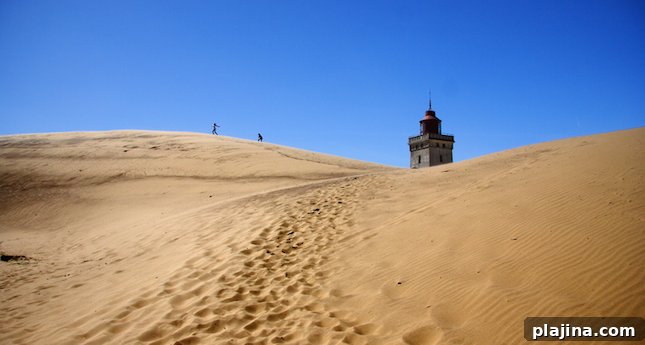
Chances are you already know Denmark for its sweeping landscapes, Hamlet’s drama and Hans Christian Andersen’s fairy tales, but the country offers many hidden stories beneath the obvious attractions. One striking example is Rubjerg Knude, a lighthouse on the coast that has been slowly swallowed by the shifting sands. Once a functioning beacon until 1968, the lighthouse now leans into the dunes and is expected to be entirely buried in the coming years.
Further north, at Denmark’s northernmost point in Skagen, the 14th-century Saint Laurence Church—dedicated to the patron saint of seafarers—stands as another testament to changing coastal forces. Over centuries, sand encroachment has overtaken much of the church; today only the tower remains intact. Historical accounts even note that by the late 18th century parishioners had to dig a path to reach the building for services.
In Helsingør, a different kind of architectural marvel sits near the water’s edge. The Maritime Museum of Denmark, designed by Danish architect Bjarke Ingels, is thoughtfully integrated into the landscape, largely built underground between the historic Kronborg Castle and The Culture Yard. Its design respects the maritime heritage of the region while offering visitors a modern, immersive experience.
These sites illustrate Denmark’s constant dialogue between nature, history and contemporary design. Coastal erosion and moving sands have reshaped the shoreline for centuries, creating dramatic scenes where architecture meets the elements. Rubjerg Knude and Saint Laurence Church are reminders of how quickly landscapes can evolve, while projects like the Maritime Museum demonstrate how modern architecture can respond sensitively to place and history.
When visiting Denmark, take time to explore beyond the iconic landmarks. Seek out places where the natural world has altered human structures and where designers have chosen to blend new buildings into historic settings. Such contrasts—old towers peeking from dunes, a lighthouse succumbing to the beach, and a museum carved into the earth—offer a richer sense of the country’s story than postcard views alone.
Whether you are drawn by literary associations, royal history, or dramatic coastal scenery, Denmark rewards visitors who look for layers of meaning. From medieval towers reduced to single silhouettes against the sky to contemporary museums that recast maritime narratives, the nation balances preservation and change in ways that invite closer attention and reflection.