
Argentina’s economy recorded 7.1 percent growth in 2008—below the impressive 8.8 percent average of the previous four years, but still notable given the global financial slowdown. In Rosario, a thriving city of about one million in Argentina’s agricultural heartland roughly 180 miles northwest of Buenos Aires, developers, entrepreneurs and local government continue to secure funding for commercial projects and urban improvements.
Located on the Paraná River, South America’s second-largest waterway, Rosario grew from its historic role as a major port during the colonial era. Ships and later railways transported grain and soybeans from the agricultural interior through Rosario to population centers near Buenos Aires. As industry and population expanded in northern Argentina, Rosario developed into an important trans-shipment hub, handling goods such as paper pulp, petrochemicals and mined ore through its river port and rail network.
While river and rail transport remain vital, 21st-century industries—electronics, recreation, education, scientific research and cultural tourism—have diversified and strengthened Rosario’s economy, even during downturns. These modern sectors have spurred new real estate projects, including Puerto Norte, a large private redevelopment that is transforming a 247-acre former industrial harbor into a mixed-use neighborhood with residential units, retail space and extensive green areas (about 42 percent of the site). Several historic structures, such as old grain silos and railway stations, will be preserved and incorporated into this environmentally minded district.
Another landmark project is Puerto de la Música, a cultural complex designed by renowned Brazilian architect Oscar Niemeyer—his first work in Argentina. Plans call for a 2,500-seat indoor theater, a music school, exhibition halls, a library and museum, multiple multimedia spaces and an outdoor performance arena for more than 30,000 spectators. When completed, it is expected to become one of South America’s most distinctive cultural sites.
Many historic buildings along Rosario’s lower riverfront promenade, the Costanera, have been restored as art galleries, affordable fish and parrilla (barbecue) restaurants, cafés and shops. Once-derelict warehouses and older rail facilities now host lively evening and weekend attractions thanks to a combination of private investment and municipal commitment to public parks and riverside recreation.
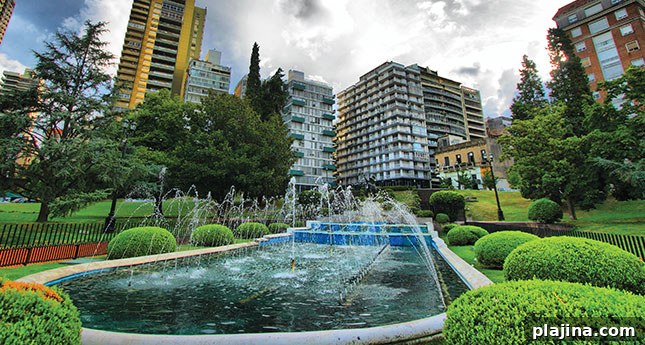
Downtown Rosario features elegant early-20th-century office buildings, several of which are being restored after years of neglect. Although high-rise apartment towers are scattered across the metropolitan area, weekends reveal the city’s more intimate character: parks, river beaches and family-friendly waterfronts give Rosario the feel of a small town despite its urban amenities. It’s common to see families picnicking along the Paraná, couples strolling down the pedestrian-friendly Córdoba, and spontaneous tango gatherings filling tree-lined streets. Bicyclists frequent the Cultural Complex Park of Spain, where Latin American performances run late into the warm summer evenings from November through March.
Rosario’s neighborhood diversity also contributes to its village-like ambiance, with each barrio offering distinct character. Pichincha—once known for 19th-century red-light establishments—now centers around the restored Rosario Norte train station, which houses the Department of Culture and a local history museum, while cafés and bars line its narrow streets. Former outskirts such as Fisherton, Alberdi and Saladillo have become charming residential enclaves featuring mansions, countryside homes and family-run restaurants that reflect a blend of local traditions.
Argentina’s gaming industry dates back to 1939 in Mar del Plata and has since grown to include roughly 135 casinos and gaming rooms with an estimated 45,000 slot machines, generating significant revenue. While many of the larger casinos are near Buenos Aires, Rosario will add a major venue: the Casino de Rosario, planned as a comprehensive entertainment and tourism complex with 80 gaming tables, 2,000 slot machines, a five-star hotel, conference facilities and multiple swimming pools. The complex was scheduled to open in late 2009.
LODGING
HOLIDAY INN ROSARIO
Recently renovated high-rise hotel offering WiFi, meeting rooms and a business center. Complimentary buffet breakfast, valet parking and airport transfers. $$
HOLIDAY INN ROSARIO
Dorrego 450
tel 54 341 410 0000
PRESIDENTE HOTEL
A four-star downtown property with an outdoor pool, solarium, parking garage, property-wide WiFi, meeting rooms and an on-site restaurant. Complimentary buffet breakfast. $$
PRESIDENTE HOTEL
Ave. Corrientes 919
tel 54 341 424 2789
ROS TOWER HOTEL, SPA & CONVENTION CENTER
Deluxe business hotel a block from the Paraná River, featuring in-room WiFi and a rooftop pool and patio. $$
ROS TOWER HOTEL, SPA & CONVENTION CENTER
Mitre 295
tel 54 341 529 9000
DINING
BAJADA ESPAÑA
A riverbank restaurant housed in a historic railway building, known for grilled beef and fish. $
BAJADA ESPAÑA
Calle España and Barrancas del Río Paraná
tel 54 341 449 6801
EL PARRAL
Family-run restaurant serving excellent cuts of Argentine beef. $
EL PARRAL
Sorrento 398
tel 54 341 455 8956
LOVA
Casual dinner-only spot with a tree-shaded patio offering trout, salmon, veal and a potato-mushroom lasagna. $
LOVA
3 de Febrero 2417
tel 54 341 447 2774
DIVERSIONS
The National Flag Memorial (Santa Fe 581, tel 54 341 480 2238) is often the first stop for visitors. This 210-foot tower in Rosario’s historic district stands beside the Paraná and marks the site where the Argentine flag, created by Rosario native Manuel Belgrano, was first raised. The museum spaces under the tower display artifacts, and the view from the top is a highlight worth the modest entrance fee.
Rosario is rich in cultural venues, including the ornate 1904 Teatro El Círculo (Laprida 1223–35, tel 54 341 424 5349) for opera and classical concerts; the Auditorio Fundación (Mitre 754, tel 54 341 448 1150) for music and workshops; and Teatro La Comedia (Mitre and Cortada Ricardone, tel 54 341 480 2597) for comedy and theater productions.
The Museo de Arte Contemporáneo de Rosario (MACRO) (Boulevard Oroño and the Paraná River, tel 54 341 480 4981) occupies colorful former concrete grain silos and houses one of the largest collections of modern Argentine art. A glass exterior elevator offers views toward the river. Nearby, the Museo de Bellas Artes Juan B. Castagnino displays European and Argentine fine art in an elegant 1930s Art Deco building.
Outdoor activities along the Paraná include swimming, boating and fishing. For a scenic drive, cross the Rosario-Victoria Bridge—a complex system of bridges, viaducts and causeways that spans the river and its islands. Without a car, take a short motorboat ride from the city center to Entre Ríos province, where beaches, bars and restaurants provide a pleasant escape.
Ernesto “Che” Guevara was born in Rosario, and although there are few dedicated attractions to his early life, a small plaque near La Plaza de Cooperación marks his birthplace. Locals can often point out the original house, which is occasionally opened to visitors by its current owners.
INFO TO GO
Aeropuerto Internacional Rosario Islas Malvinas (ROS) lies about 30 minutes from downtown by taxi (around $8). Car rentals are available at the airport, and some hotels offer shuttle service. Bus travel from Buenos Aires takes roughly three hours (around $15); the train journey is about six hours (around $10). High-speed rail lines are under construction.