
The Balearic Islands — Mallorca and the smaller islands of Menorca, Ibiza and Formentera, plus about 100 tiny islets — lie scattered across the western Mediterranean as if they’ve slipped off the coast of Spain. Although politically and culturally Spanish, the archipelago feels distinct from the mainland: Palma, Mallorca’s capital, exudes a perpetual holiday atmosphere, with festivals and a relaxed pace that invite visitors to slow down and savor island life.
Begin exploring Palma aboard an open-top sightseeing bus to get an efficient overview of the city. Hop off to wander narrow streets, visit highlights such as the Palau de l’Almudaina (the royal palace) and the circular Castell de Bellver, perched on a wooded hill with panoramic views from its ramparts. The guided audio commentary helps orient new arrivals, and short walks from the bus reveal lively plazas, cafes and historic nooks.
Castell de Bellver was built in the 14th century on a hilltop near Palma de Mallorca. © Harryfn | Dreamstime.com
Palma’s layout still bears traces of its Arab past: rounded arches, rippling fountains and maze-like lanes recall the medieval medina. Dominating the waterfront, the cathedral began construction in the 13th century after the Christian reconquest and later received restoration work influenced by the Modernist Catalan architect Antoni Gaudí. Its Mirador Portal is a fine example of Spanish Gothic sculpture, and the cathedral’s rose window ranks among the largest in Gothic church architecture.
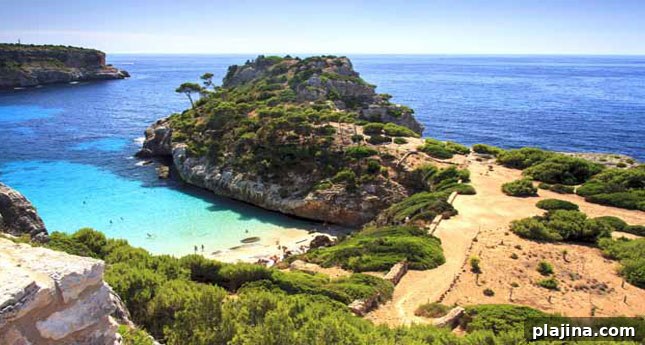
While Palma’s historic center is atmospheric, most visitors come to the Balearics for beaches and resorts. Mallorca alone has more than 200 beaches, from crowded stretches near Palma to secluded coves along its varied coastline. The simplest way to find a favorite beach is to drive the coast and explore until you discover the sand and water that suit you.
Es Trenc, southeast of Palma, is prized for its wide mile of golden sand and remarkably clear water; because it isn’t attached to a resort, it often feels more natural and unspoiled. Cala Barca, also on the southeast coast near Mondragó Park, offers good snorkeling and diving. On the northeast, Cala Agulla sits beneath the pine-clad Llevant Peninsula Natural Park and holds Blue Flag status for environmental and safety standards. Cala Formentor, at the island’s northern tip, is another Blue Flag favorite, while quieter Es Carbó can be reached on foot from Colònia de Sant Jordi for a more solitary stretch of white sand.
Beyond sunbathing, Mallorca offers nature and cultural attractions. Birdwatchers and hikers head to Mondragó Natural Park where rivers meet beaches and oak forests host orchids and more than 70 bird species. Elsewhere, dunes, cliffs and ravines shape dramatic coastal scenery. On the northwest coast, the Costa Nord Cultural Centre in Valldemossa—created by actor Michael Douglas—promotes the Tramuntana Mountains’ landscape and traditions through concerts and exhibitions. La Granja de Esporles, an old manor house, presents local foods, wines, traditional crafts and equestrian demonstrations.
Valldemossa is famous for its Royal Charterhouse, where composer Frédéric Chopin and author George Sand wintered in 1838. Visitors can tour the rooms associated with the couple and attend the annual August Chopin Festival. Nearby gardens at Alfabia reflect the island’s Moorish past and enhance the region’s romantic ambiance.
A vintage train links Palma with the coastal town of Port de Sóller, and a historic tram runs from the town down to the harbor. From Port de Sóller, coastal boat trips depart to explore northern coves, and a scenic road climbs toward a dramatic lighthouse. Close to Palma, the former studio and gardens of Joan Miró house many of his works and preserve the settings that inspired him, left much as he arranged them before his death in 1983. For a striking coastal drive, follow the road from Palmanova through the steep terraces of Banyalbufar to Andratx, pausing at viewpoints.
The island’s most dramatic headland is Cape Formentor at the northeast tip, where sheer cliffs plunge into the Mediterranean. Nearby, the Coves d’Artà reveal limestone caverns high above the surf. Port d’Alcúdia serves both fishing excursions and ferries to Menorca from this region.
For sea-based perspectives, Mallorca has more than 40 marinas and numerous charter companies. Porto Portals, at the eastern end of Portals Nous, is an upscale marina popular with visiting yachts. Golfers will find many courses: the Real Federación Española de Golf lists 18 affiliated clubs on Mallorca and clubs on Menorca and Ibiza as well. Golf Son Gual is among the courses frequently ranked among Europe’s best.
Taulas at Talatí de Dalt, Menorca © Lunamarina | Dreamstime.com
Ibiza, often called La Isla Blanca for its white sands, is widely regarded as one of the most beautiful Balearic islands. Much of Ibiza remains densely wooded with pine forests and dramatic cliffs above hidden coves, and its cultural heritage helped secure UNESCO World Heritage recognition. Archaeological sites such as Sa Caleta and Puig d’es Molins date back to the 8th century B.C., while Menorca’s prehistoric sites, including round dwellings and megalithic monuments like Talatí de Dalt, attest to human presence going back millennia. Museums in Ciutadella display artifacts from these prehistoric settlements.
Despite rich history, Ibiza’s beaches are the principal lure. The island offers more than 50 sandy coves and bays, many of them sheltered and relatively undiscovered. Southeast Ibiza has some of the highest concentrations of beaches; within easy reach of Santa Eulària des Riu, Playa Niu Blau is a family-friendly bay ringed by pine trees, while Cala Pada offers quiet sands and clear water. Cala Boix, set in a pebble bay near rocky headlands, is popular for snorkeling and for surfing the steeper afternoon winds.
Balearic Islands Info to Go
Frequent flights from Madrid and Barcelona connect to Palma (PMI) and Ibiza (IBZ). In Palma, city buses link the airport with the center and with many beach hotels. In Ibiza, airport transfers can be arranged by shuttle services; regular buses also serve main resorts though some routes require connections in Ibiza Town.
Where to Stay in the Balearic Islands
Castillo Hotel Son Vida — A 13th-century castle set in subtropical grounds, located minutes from several of Mallorca’s top golf courses. Carrer Raixa 2, Son Vida, Palma, Mallorca
Gran Hotel Son Net — An elegant boutique hotel housed in a 1672 stone villa at the foot of the Sierra de Tramuntana, offering handcrafted interiors and a refined atmosphere. Carrer Castillo de Sonnet, Puigpunyent, Mallorca
Hotel Mirador de Dalt Vila — A 19th-century townhouse set within historic city walls, featuring a small number of meticulously appointed rooms and personalized service. Plaza de España 4, Ibiza Town, Ibiza
Restaurants in the Balearic Islands
Can Curreu Restaurant — Terrace dining with modern takes on traditional Balearic dishes, set in a rural hotel near Santa Eulalia, Ibiza.
Can Simoneta Restaurant — A hotel restaurant emphasizing fresh ingredients from its gardens, with terrace views over a coastal bay in Capdepera, Mallorca.
Simply Fosh Restaurant — Contemporary Mediterranean cuisine served in a minimalist setting in Palma, Mallorca.
Whether you come for beaches, history, food or outdoor pursuits, the Balearic Islands offer a compact blend of natural beauty, cultural depth and relaxed island living that makes them one of the Mediterranean’s most appealing destinations.