
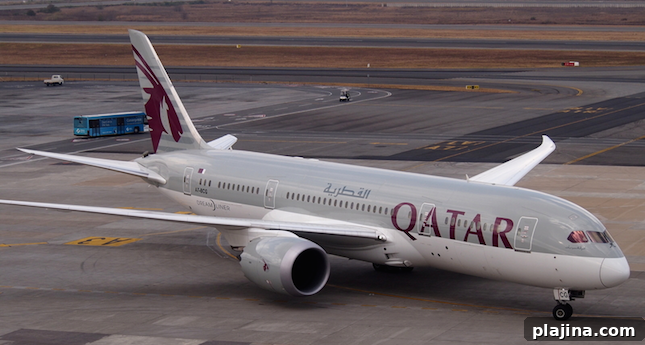
During a press conference in Washington, D.C., Akbar Al Baker, Group Chief Executive of Qatar Airways, dismissed as “baseless” claims by American Airlines, Delta Air Lines and United Airlines that Gulf carriers—including Qatar—unfairly benefit from government subsidies and therefore gain an advantage under Open Skies treaties.
Describing the accusations as “a transparent attempt to block new competition and limit consumer choice,” Al Baker said that U.S. Open Skies agreements are intended to expand options for travelers. “These agreements are about offering choice and the ability to fly with the airline you prefer to regions that are underserved by U.S. carriers,” he said. “The Big Three [American, Delta and United] want to restrict choice. World travelers would suffer if they succeed.”
At the press conference, Al Baker highlighted broader aspects of Open Skies treaties, stressing their role in connecting the United States with parts of the Gulf and the Indian subcontinent that currently lack nonstop service from U.S. carriers. He argued that such links support both cultural exchange and economic ties between regions.
“The Big Three do not compete with us on a single nonstop route,” Al Baker added. “The beneficial exchange of culture and commerce made possible by the U.S.–Qatar Open Skies agreement must not be blocked by the Big Three merely because we have chosen to serve markets they have ignored.”
Al Baker’s remarks emphasized that Open Skies agreements are designed to increase connectivity and consumer choice rather than to favor particular airlines. By opening routes to underserved destinations, the treaties create opportunities for travelers, businesses and communities to benefit from improved access to global markets and cultural exchange.
He also pointed out that competition from international carriers often spurs improvements in service, network reach and pricing, which ultimately benefits passengers. Limiting competition, he warned, could reduce the number of available routes and diminish the quality of options for consumers looking to travel between the U.S., the Gulf and South Asia.
Al Baker’s comments came as part of a broader debate over the role of government support and fair competition in international aviation. While legacy U.S. carriers have raised concerns about state backing of some foreign airlines, Qatar Airways disputes the characterization of its operations as reliant on unfair subsidies. The carrier maintains that its network choices reflect market demand and a strategy to serve routes overlooked by other airlines.
In urging regulators and the traveling public to preserve Open Skies principles, Al Baker framed the issue as one of protecting choice and connectivity rather than as a bilateral dispute between carriers. He reiterated that decisions about route development should be guided by demand and the benefits of increased international travel and trade.
Ultimately, Al Baker warned that efforts to curtail Open Skies access could lead to fewer direct routes, higher fares and diminished service quality for travelers. He called on policymakers to resist pressure from carriers seeking to limit competition and to uphold agreements that enable broader access and stronger ties between nations.