
No roads lead to Churchill. Freight trains deliver grain to ships at the Hudson Bay dock on the edge of town — Canada’s only Arctic seaport — but the highway stops 250 miles south at Thompson. Visitors arrive only by train or plane. Slow, uneven tracks limit locomotive speeds to 15–20 mph, so the VIA Rail journey from Winnipeg, a thousand miles to the south, takes roughly 46 hours. Small regional carriers like Calm Air and Kivillak offer flights from Winnipeg, Calgary and Thompson. Still, for about six weeks each year tourists converge on this remote northern Manitoba outpost because it is one of the few places on Earth where you can reliably observe polar bears in the wild.
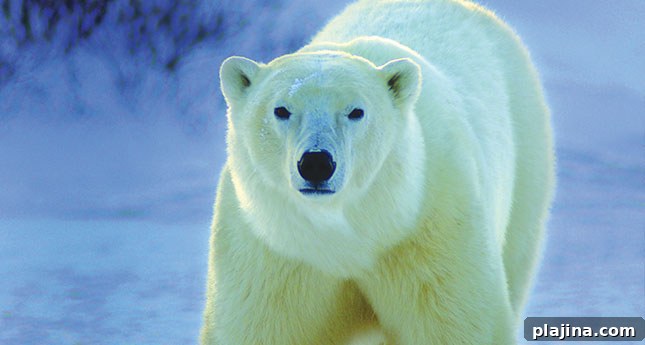
Polar bears, sometimes called “Lords of the Arctic,” do not follow human meal schedules. From November through June they gorge on seal blubber, stalking prey on the sea ice throughout winter. In summer many retreat inland and slow their metabolism, living off fat reserves until they are hungry again in mid-October. At that time they gather at the water’s edge, waiting for the bay to refreeze — a seasonal congregation that has turned Churchill into an internationally recognized wildlife destination.
Churchill’s exceptional bear-watching reputation stems from its geography: the town sits on a promontory where freshwater from nearby lakes and the Churchill River pools as it flows into the bay. Fresh water freezes before salt water, so ice forms there first. Instinct draws the bears to this early hunting ground, and visitors follow. Concerns about long-term population trends have only increased demand, prompting people worldwide to book excursions months — sometimes years — in advance to secure travel, accommodations and seats on the essential tundra buggies.
Invented locally from a mix of gravel truck, snowplow and crop sprayer parts, these rugged boxcars ride 10–12 feet above the ground on oversized all-terrain tires. Built to handle the rocky, rut-filled taiga and tundra, they are purposely crude and highly functional. Only 18 exist, and two companies hold the licenses to operate them, offering daylong safari-style excursions (about $300 per person) to view migrating bears.
Despite advice from travel agents to plan far ahead, we managed a last-minute trip in late September. We flew to Winnipeg and boarded the Northern Express, which winds west into Saskatchewan before heading north to Churchill. The train moves slowly with frequent stops but is comfortable, with sleeper compartments and berths made up with crisp white sheets, a dining car offering three-course meals, and an observation car with bar service and a glass-domed view of the passing landscape.
Two days later, arriving about five hours behind schedule, the train rolled into Churchill’s picturesque Victorian depot. After collecting our bags and visiting the Parks Canada Interpretive Centre at the station to learn about local natural history, we walked a couple of blocks to a modest motel. The Bear Country Inn was clean and practical, with a view that stretched past tank cars toward the bay. Free Wi-Fi in the lobby was helpful since cellular coverage in town is limited.
Churchill bills itself as a quaint little town, but the settlement of roughly a thousand residents is a stark two-by-nine-street grid of prefabricated houses and simple buildings. A handful of stores, restaurants and trading posts line Kelsey — the main street that runs toward the water. Signs warning “Polar Bear Alert” and “Never Approach a Polar Bear” underscore that hungry animals sometimes wander into town. After a series of serious incidents in the 1960s, residents began locking garbage and, when necessary, tranquilizing and holding problematic bears in a “bear jail” near the airport until the ice returns. With Halloween falling in peak bear season, traditional trick-or-treating is largely impractical.
Visitors are advised to leave car doors unlocked in case someone needs to climb inside quickly, and to remember the local emergency line, 657-BEAR. We took a cautious stroll, bought the expected “bear minimum” T-shirts and resisted novelty items ranging from bear-claw salad tongs to bear-themed drinkware. Dinner featured local dishes such as musk-ox sirloin and Arctic char in mushroom sauce, after which we slept to the sound of the howling wind.
At 7:30 the next morning, Lionel from Tundra Buggy Tours picked us up along with about two dozen international sightseers carrying cameras and binoculars. Ten miles outside town we transferred into Tundra Buggy No. 2 and set off across the Cape Churchill Wildlife Management Area on traces of old access routes left when the Canadian Space Agency used the area for rocket testing. Strong winds helped push the buggy as it navigated the uneven terrain.
We had been briefed on bear behavior and knew the day’s weather would limit activity: low-fat bears conserve energy and are often stationary. Our first two bears were curled low on the sheltered south side of sparse willow patches, avoiding the biting north wind. Their fur had a creamy, buttermilk tint rather than brilliant white, blending into the rocky scenery and prompting a few mistaken “bear” sightings at rocks that resembled figures. A thin male later shifted among a pile of kelp, and the fourth bear we encountered treated us to more movement — stretching into a yoga-like pose before lumbering past our buggy to rest in a willow grove.
Because keeping a safe distance is crucial, guides park the buggies in optimal viewing spots and wait. Passengers can gather inside behind fog-resistant windows or step out onto the buggy’s observation deck, safely beyond the bears’ reach, to study behavior. Mostly the bears yawned, stretched, and blinked; as apex predators they have few worries. Lionel reminded us that to the bears we were “meals on wheels,” but their calm, massive presence felt almost endearing — giant animals with small tails and rounded ears adapted to conserve heat.
While watching bear No. 4, Lionel produced a canteen of soup, followed by chicken sandwiches, soda and chocolate chip cookies, each served in sequence to prolong the outing. We clustered around the propane heater at the rear of the buggy, trying to keep warm and grateful we had layered appropriately, though reluctant at the thought of removing layers to use the on-board portable facilities.
Other wildlife dotted the landscape: a bold jaeger, a trio of gulls, and a large Arctic hare nibbling at dry brush. Camouflaged white for the season, the hares have black tips on their folded ears that can appear as a pair of watchful eyes, a natural deterrent to predators approaching from behind. Travelers who visit in calmer conditions often report sightings of snowy owls, Arctic foxes and several bears in a single day.
Given Churchill’s isolation, wildlife is its principal draw year-round. Outside bear season the region attracts visitors for birdwatching, kayaking, hiking, dog sledding, aurora viewing and swimming with beluga whales. But the polar bears are the marquee experience, and we returned home with a deeper appreciation for these formidable animals that command the shores of Hudson Bay.
Info To Go
Although we arranged transport, lodging and our own buggy tour, many travelers prefer packages offered by specialized outfitters. Typical packages that include round-trip air from Winnipeg (YWG), an overnight in Churchill and two days on the tundra buggy start at around $1,990 with established operators. Consider contacting a reputable local outfitter to coordinate logistics and permits for the season.