Alongside the Eiffel Tower, the cancan, fine gastronomy and the city’s timeless charm, Paris also stands out as a major center for business. Already one of the world’s top tourist destinations, attracting some 45 million visitors annually, Paris hosts the headquarters of many multinational corporations, including 37 Fortune 500 firms. In addition to landmarks such as the Arc de Triomphe and the Louvre, the city is home to the headquarters of L’Oréal, Air France, Renault, Vivendi, Total and Coca-Cola Europe, among others.
In the 19th century, the rail network that fueled the Industrial Revolution brought waves of workers into Paris to staff the new light and heavy industries that sprang up across the city. As Paris evolved into an important center of technology, trade and tourism, the Eiffel Tower—erected for the 1889 World’s Fair—became an early emblem of its industrial and engineering ambitions.
The historic center of Paris, a compact area roughly six miles across, still preserves its traditional financial quarter around the former Bourse stock exchange and the Opéra. After World War II, however, much economic activity shifted toward the suburbs, transforming the metropolitan area into the most populous region in Europe and creating one of the continent’s largest urban economies.
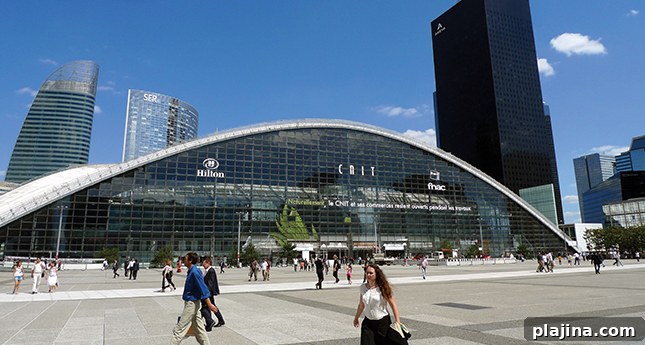
Follow the Champs-Élysées west past the Arc de Triomphe and the Periphérique ring road and you’ll reach La Défense, Europe’s largest purpose-built business district. This modern complex of glass and steel includes dozens of office towers across extensive grounds, offering roughly 38 million square feet of office space along with restaurants, fountains, public art, malls and an elevated esplanade. The district serves some 180,000 workers and about 20,000 residents. Ambitious regeneration plans to expand transport, housing and office space have progressed unevenly amid recent economic slowdowns.
Although Paris is only the 20th-largest urban area globally, the city’s gross domestic product ranks among the world’s highest—fifth overall—behind metropolitan regions such as Tokyo and New York. Manufacturing has declined to about 10 percent of GDP, yet greater Paris remains a major manufacturing center by volume, producing automobiles, construction materials, machine tools and railway equipment. Over time, the economy has diversified into high-tech and services, with strong sectors in construction, publishing, electronics, chemicals and processed foods. As a global fashion capital, Paris also maintains a robust industry in clothing and luxury goods. The city’s role as a venue for trade fairs, fashion weeks, conferences and tourism keeps services and hospitality at the core of its economy.
Since the mid-19th-century transformations under Napoleon III that produced Paris’ grand boulevards, the city has been shaped by large-scale urban planning. Recent initiatives have focused on revitalizing the metropolitan economy and addressing social challenges in suburban areas. The “Grand Paris” plan, promoted to modernize transport networks, stimulate economic growth and create a high-technology hub at Saclay in the southern suburbs, gathers architects and urban planners to design a more sustainable, expanded metropolitan region for the 21st century.
The Chamber of Commerce and Industry of Paris represents roughly 380,000 companies across the metropolitan area, offering training, support and business counseling to help entrepreneurs navigate administrative requirements. French bureaucratic procedures and local customs can be challenging for newcomers: many businesses slow or pause during July and much of August for summer vacations, and formalities often dictate a deliberate pace of work. International entrepreneurs sometimes notice a sharp contrast in setup time and cost compared with other countries.
Business etiquette in France tends to be formal. Visitors should expect polished dress, begin meetings with a courteous greeting in French when possible, and allow time for polite small talk before getting to substantive matters. Emphasizing proper manners and measured conversation helps establish trust and mutual respect.
Despite these peculiarities, Paris remains an attractive business destination. A recent survey ranked the city among the world’s top locations for setting up business, with numerous companies planning expansion there. Under Mayor Bertrand Delanoë, initiatives such as “Paris respire” have sought to improve air quality and reduce traffic, enhancing the city’s livability. Citywide Velib’ bike-sharing stations make short trips easy and affordable, pedestrian-friendly weekends close selected streets to cars, and seasonal events transform parts of the city—like temporary beaches along the Seine—into lively public spaces. Although living costs are high, Paris consistently ranks highly for quality of life, offering remarkable architecture, monuments and vibrant neighborhoods that make it an inspiring place to work and live.
Diversions
Paris is ideal for strolling and sightseeing, and the city’s fitness and public-space initiatives make outdoor activities even more inviting. Public ping-pong tables, basketball hoops and boules courts appear in parks across the city; a fitness trail runs through the Bois de Boulogne; and an elevated linear park, Le Viaduc des Arts, begins near the Bastille and stretches for nearly three-quarters of a mile above Avenue Daumesnil.
Guided tours offer many ways to see Paris—on foot, by riverboat, bicycle, rollerblade or Segway. Local operators organize regular bicycle outings and night rollerblade tours, while river services such as Batobus provide frequent hop-on, hop-off stops along the Seine between landmarks like the Eiffel Tower and the Louvre. Segway tours include an orientation session before exploring central neighborhoods.
After dark, Paris’ nightlife ranges from iconic revues to jazz clubs and cocktail bars. Famous cabarets continue to draw visitors, while jazz venues and classic cocktail bars offer intimate evening experiences. Stylish nightclubs and newer venues around central districts provide options for dining, dancing and late-night entertainment.
Lodging
Hilton Paris La Défense
The 148-room Hilton inside the CNIT convention complex offers convenient metro access to central Paris and views of the Grande Arche. 2 Place de la Défense CNIT, tel 33 1 46 92 10 10
Le Meurice
This recently renovated palace hotel overlooking the Tuileries Gardens features acclaimed restaurants, a Valmont Spa and bespoke guest services. 228 Rue de Rivoli, tel 33 1 44 58 10 10
Radisson Blu Ambassador Hotel, Paris Opéra
Located in the midtown financial district, the Radisson Blu provides comfortable rooms, a fitness center and the popular 16 Haussman restaurant suited for business lunches. 16 Blvd. Haussmann, tel 33 1 44 83 40 40
Dining
Café de La Paix
A classic near the financial district, this Belle Époque brasserie serves refined traditional dishes and offers prime people-watching from its sidewalk tables. 12 Blvd. des Capucines, tel 33 1 40 07 36 36
Le Castiglione
A favorite among fashionable young Parisians, this venue combines a lively brass bar with an elegant dining room in red velvet décor. 235 Rue Saint-Honoré, tel 33 1 42 60 88 22
Ralph’s
Ralph Lauren’s restaurant presents comforting American-style cuisine in a handsome garden courtyard or renovated stable, known for steaks and classic burgers. 173 Blvd. Saint-Germain, tel 33 1 44 77 76 00