Whenever business brought me to Paris, my wife Margaret eagerly came along. Evenings and weekends we explored the city’s best — from the Louvre to the Eiffel Tower — and enjoyed Parisian art, film and fashion. On our most recent visit, however, we followed Margaret’s true passion: the written word. We traced the paths of famous writers who helped make Paris the literary capital of the world, moving from bookstores and cafés to cathedrals and cemeteries — and even into the city’s sewers.
We began with a writer synonymous with Paris: Victor Hugo, a towering figure in world literature. Hugo’s reputation owes much to the modern success of Les Misérables, the stage and screen adaptations of his 1862 novel, which Margaret and I have applauded in London and New York. Hugo died in Paris in 1885, and we paid our respects at his tomb in the Panthéon, an 18th‑century monument that serves as France’s mausoleum for its greatest figures. There we also nodded to Voltaire, Rousseau and Alexandre Dumas, whose The Three Musketeers thrilled me as a boy.
Fans can visit Hugo’s house-museum at 6 Place des Vosges, one of the elegant residences in the 17th‑century square Henry IV built and called Place Royal. But Hugo’s most lasting monument is Notre‑Dame Cathedral, the setting for The Hunchback of Notre‑Dame (originally Notre-Dame de Paris). The novel’s popularity sparked a major restoration of the then-neglected cathedral, which remains at the heart of the city. We climbed the 387 steps to the bell tower again, delighted to see the famous gargoyles up close — the figures that populate the tragic tale of Quasimodo.
Our Victor Hugo pilgrimage continued down from the steeple into the sewers, the dramatic backdrop for a sequence in Les Misérables where Inspector Javert confronts Jean Valjean. Paris’s sewers form one of the world’s most extensive systems — roughly 1,300 miles of pipes — handling more waste daily than most municipal networks. Much of what visitors see in the Paris Sewer Museum reflects the 19th‑century modernization that Hugo described. The self-guided tour follows underground galleries filled with historical equipment: cleaning machines, gas masks, yellow hip waders, hard hats, headlamps and flusher trolleys from a century or more ago.
A faint, unpleasant odor accompanied our quarter-mile walk underground, and the steady thud of rushing waste reinforced Hugo’s grim phrase: “Nothing equaled the horror of this old voiding crypt.” It was a vivid reminder of how closely the city’s physical infrastructure and its literature are intertwined.
Back above ground, we sought more romantic literary corners. Strolling the Left Bank of the Seine, we traced the roots of the early 20th‑century literary scene. Gertrude Stein, James Joyce, Ernest Hemingway, F. Scott Fitzgerald and other writers gravitated there after American expatriate Sylvia Beach opened the Shakespeare and Company shop in 1919 and later published Joyce’s Ulysses in 1922. Though Beach’s original store did not survive World War II, George Whitman revived the spirit when he opened the modern Shakespeare and Company nearby in 1951.
Whitman welcomed a new generation of rebellious writers — Henry Miller and Anaïs Nin, Lawrence Durrell, Richard Wright and figures of the Beat Generation like Jack Kerouac, Allen Ginsberg and William S. Burroughs. On an earlier trip to Paris, Whitman invited us upstairs for a chat and even offered a bed (which we politely declined). After George Whitman’s passing at 98, his daughter Sylvia Beach Whitman continued to run the beloved labyrinth of shelves that remains an essential stop for bibliophiles.
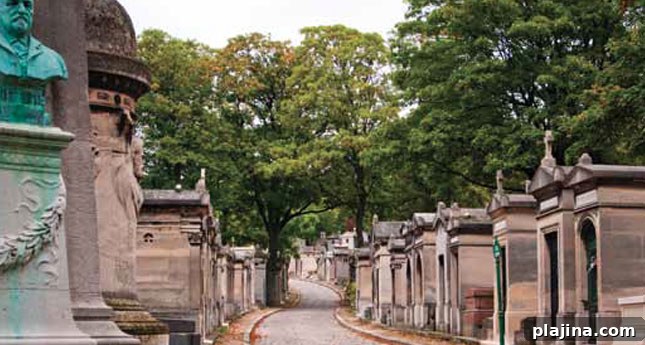
Whitman is buried in Paris, as are many authors who shaped the city’s literary voice, so we visited Père‑Lachaise Cemetery, Paris’s largest and most visited necropolis. Wandering its tree-lined avenues, we found shrines and notable graves: the medieval lovers Héloïse and Abelard, Apollinaire, Molière, Balzac, Colette and Proust. The cemetery also holds several expatriates we particularly wanted to see: the ashes of novelist Richard Wright in the columbarium, the tomb of Gertrude Stein and the elaborate monument of Oscar Wilde, whose visitors left rose petals that morning.
On the Left Bank, Montparnasse Cemetery proved equally rich in literary history. There we found the graves of poet Charles Baudelaire, playwright Eugène Ionesco, and the adjacent tombs of Jean‑Paul Sartre and Simone de Beauvoir, as well as the unexpected resting place of Carlos Fuentes.
We could have chased dozens more literary sites, but café hopping on the Left Bank filled our remaining hours. Saint‑Germain and Montparnasse’s boulevards form an endless buffet of literary atmosphere. We began at Café Les Deux Magots, where writers from Verlaine and Rimbaud to Oscar Wilde, Simone de Beauvoir and Gore Vidal once gathered. Nearby, Café de Flore was Sartre’s habitual morning study, where he wrote daily.
For lunch we chose La Closerie des Lilas, where Hemingway revised The Sun Also Rises, James Joyce celebrated Ulysses and Thomas Wolfe set scenes in Of Time and the River. Today the café honors its literary patrons with brass table markers naming Baudelaire, Verlaine and others. Later we refreshed at La Coupole, an Art Deco brasserie that was once a bohemian hub for Hemingway, Kay Boyle, Henry Miller and Anaïs Nin. The Café du Dôme retains an atmospheric charm and appears in scenes of Hemingway’s The Sun Also Rises and Miller’s Tropic of Cancer. Café de la Mairie, another evocative spot, hosted Hemingway, Beckett and Saul Bellow and witnessed the final split between Sartre and Camus.
Montparnasse Cemetery | Photo: © Wam1975 | Dreamstime.com
Our favorite was Le Select, a largely unchanged 1925 café with generous sidewalk seating. I favored the croque‑monsieur while Margaret enjoyed onion soup and Welsh rarebit. Le Select was Paris’s first 24‑hour café and a longtime haunt for couples and writers alike: Henry Miller and Anaïs Nin, Sartre and de Beauvoir, and in later decades James Baldwin, Norman Mailer, Ray Bradbury and Susan Sontag all dined or debated there. Montparnasse Cemetery, where Sontag is buried, lies nearby.
As a literary time machine, Paris has no equal, and we savored every scene. As Hemingway observed in his memoir, “Paris is a moveable feast,” and our Left Bank rambles left us eager to return and discover more pages of the city’s enduring story.
INFO TO GO
Charles de Gaulle International Airport (CDG) has three terminals connected by the CDGVAL shuttle train. The RER commuter train Line B from Terminal 3 is the fastest way into the city (35–45 minutes). Taxis from the airport run about $90. Within Paris, the 16‑line Metro, which carries millions daily, starts at around $2 per ride; a carnet of 10 tickets reduces the per‑ride cost. Taxis around town have a roughly $7 minimum fare. Much of Paris is easily explored on foot from metro stops.
LODGING
L’HOTEL
Oscar Wilde’s final residence remains a glamorous Left Bank address, with spiral staircases, a Michelin‑starred restaurant and a library bar. 13 Rue des Beaux‑Arts, 6e
LE PAVILLON DES LETTRES
A refined boutique hotel with 26 rooms and suites themed to authors from Hans Christian Andersen to Émile Zola, offering a breakfast salon and library. 12 Rue des Saussaies, 8e
RITZ PARIS
Proust stayed here and the Fitzgeralds lit up the place; although the Hemingway Bar is closed, the Ritz remains a classic haven for book lovers. 15 Place Vendôme, 1er
DINING
CAFÉ LES DEUX MAGOTS
This historic haunt for poets and novelists still attracts readers and writers. 6 Place Saint‑Germain des Prés, 6e
CAFÉ DU DÔME
A Roaring Twenties landmark once frequented by Sinclair Lewis and Samuel Beckett, now known for refined seafood. 108 Blvd. du Montparnasse, 14e
LA COUPOLE
An Art Deco brasserie where Joyce, the Fitzgeralds and Camus once celebrated, notable for its atmosphere and history. 102 Blvd. du Montparnasse, 14e