
We fly over the Central American isthmus and cross the Bridge of the Americas — an iron structure that, from above, looks like a massive clasp joining North and South America across the Panama Canal. It has been eight years since my last visit to Panama City, and from the air I immediately notice how dramatically the skyline has changed. The city has grown skyward, filled with glass-and-mirrored towers; many locals and realtors now liken it to a Manhattan-style skyline.
Sitting in the shade of a jacaranda tree in a handsome plaza in the colonial Casco Viejo quarter, I am reflecting on Panama’s pivotal role in Spanish imperial plans through Central and South America when a loud mobile phone interrupts my thoughts. I look up to see an impeccably dressed North American woman sipping tonic water and surrounded by a stack of office files. She is unmistakably a real estate agent, and by the tone of her conversation, business is booming.
Her call makes clear she is brokering deals for North American buyers. Right there, with an ice-cold Balboa beer in hand and surrounded by recently restored colonial and republican-era buildings, I have encountered a visible segment of the baby-boomer retiree population — primarily North Americans, with some Europeans — purchasing affordable land and luxury apartments throughout the country.
I had not expected the expatriate presence to be so apparent, but Panama City has long been a crossroads of nationalities. The territory was once a department of Colombia before becoming independent and then receiving intense development and international attention as the site of the Panama Canal. That canal remains the country’s defining feature, attracting French engineers and laborers from the Caribbean as well as workers from more distant places such as Albania and China.
When the United States assumed a leading role in the canal’s construction and administration, another group arrived: the Zonians, Americans who lived in suburban neighborhoods along the canal inside the American-run Canal Zone. Historically, Zonians rarely integrated into the wider Panamanian society; they lived adjacent to Panama but in a distinctly separate community. Today’s expatriates, by contrast, often mingle more with local life.
With pensions and savings, many retirees find they can afford a comfortable lifestyle in Panama: buying land, building homes with pools and dining out regularly without worrying about finances. In effect, they function as long-term residential tourists. How the global economic slowdown and Panama’s election cycle will affect incoming retiree numbers remains uncertain. For now, regular conversations among this group revolve around the city’s affordability and its real estate market.
On this visit I benefit from the American influence on modern Panama. Rather than staying in the busy downtown neighborhoods of El Cangrejo or Marbella, I am lodging in Balboa, the heart of the former Canal Zone. Here streets are wide, mornings are cooled by a steady breeze, people maintain their lawns, and there is a greater sense of personal space. A basketball net hangs above a garage door; the scene evokes a version of Americana that contrasts sharply with other parts of the city.
Yet Panama retains its own distinct character. Over breakfast on a terrace, surrounded by birds-of-paradise, I spot a family of coati foraging at the edge of the garden and hear a pair of toucans calling from the canopy above. These small wild encounters make the setting unmistakably tropical.
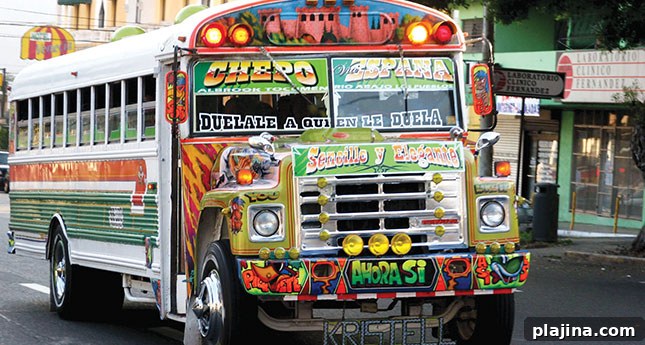
Panama has experienced strong economic growth in recent years, spawning a rising middle class and notable advances, though those changes are less visible in neighborhoods such as Curundu and Chorrillos. Riding a Diablo Rojo — a refurbished U.S. school bus that now serves as local transport for just 25 cents — and chatting with a Panameño often yields a sobering perspective on daily life. Conversations on these buses can be blunt, and one passenger shared pointed criticisms of the ruling party, the Revolutionary Democratic Party (PRD), President Martín Torrijos and presidential hopeful Balbina Herrera, suggesting support for the Opposition. With national elections approaching in May 2009, the PRD appears well positioned, while the Opposition struggles to unify its alliances.
Whatever the political outcome, the city’s social patterns are unlikely to shift dramatically. As in earlier decades when Zonians kept to themselves, many current expatriates appear to remain within their own social circles, while tourists continue to gravitate toward beach resorts, high-rise condominiums and eco-lodges in the national parks. Panama City’s evolving skyline and mix of communities will likely endure alongside these established patterns of life and leisure.