
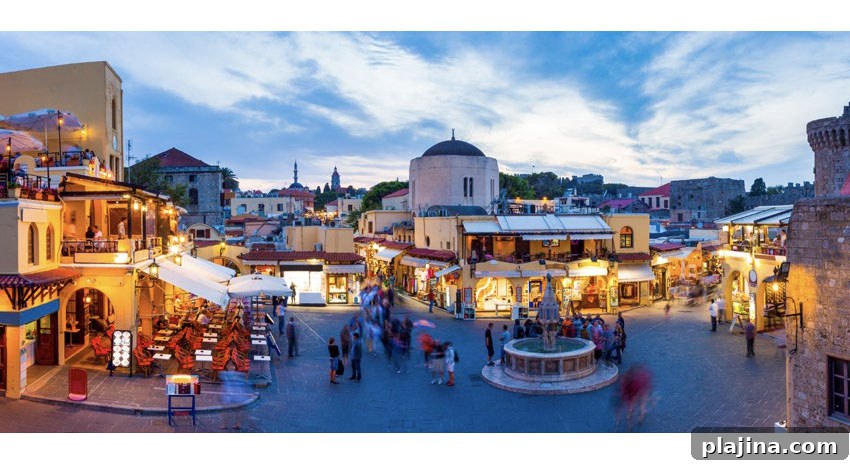
ARRIVE BY CRUISE SHIP, as many travelers do when visiting Rhodes, and you may feel a pleasant sense of déjà vu. From the deck of my Seabourn ship, which calls at Rhodes on various Adriatic and Mediterranean itineraries, my first sight of the ancient walled city inspired awe. The imposing ramparts built by the Knights of St. John in the 1300s still dominate the coastline of this largest island in the Dodecanese, recalling the days when crusaders paused here on their way to the Holy Land.
The UNESCO-listed Old Town of Rhodes seems to suspend time. Weathered and tawny with age, the fortification towers punctuate the skyline. Inside the walls, narrow cobblestone lanes twist among churches with flying buttresses, frescoed interiors, slender minarets and buildings that blend Moorish, Byzantine and Italian influences. That mix of styles reflects centuries of shifting powers and cultures, giving the city a layered, historic charm that feels both vivid and authentic despite the crowds of camera-toting visitors.
Rhodes sits at a natural crossroads where East meets West, a strategic port that grew rich and cosmopolitan through trade and political influence. It is often called one of Europe’s earliest true medieval towns, yet its character was shaped by a long succession of occupants. Traces of those cultures remain—in the cuisine, the architecture and everyday life—and make the island’s heritage both visible and flavorful. While many travelers explore the island’s rolling interior, ancient ruins and sandy beaches, Old Town alone offers a full-day itinerary for most visitors.
Start your visit at the Palace of the Grand Master of the Knights of Rhodes, a standout of medieval Gothic architecture perched on a hill and rebuilt after centuries of occupancy. The palace houses arcades, mosaics and artifacts that evoke the island’s chivalric past. Nearby, the Archaeological Museum adds depth with finds that chart Rhodes’s development from antiquity through the medieval era.
Old Town is also a place to savor local food. Tavernas line the streets offering fresh seafood and traditional Greek dishes such as stifado, a slow-cooked beef or rabbit stew flavored with onions and spices. After dinner, bars along Miltiadou buzz with evening energy, while New Town’s Diakonou Street provides an alternative nightlife scene. Shoppers can hunt for bargains on silver and gold in the market lanes of Old Town; for high-end jewelry and designer pieces, boutiques like the longstanding shop on Plateia Alexandrou are excellent choices.
Though the island rewards a longer stay, compact Rhodes gives cruise passengers an efficient and richly rewarding experience. Within hours you can walk its medieval lanes, visit world-class monuments and taste island cuisine, all while absorbing centuries of history that remain remarkably present in the stone, food and atmosphere of this storied Greek destination.