There is something magical about looking up at the velvety sky on a dark night when stars hang low and seem almost within reach. One star appears, then another. As your eyes adjust, the entire Milky Way unfolds like a river of diamonds across the heavens.
Whether you are an amateur astronomer or someone who simply enjoys stepping into the backyard to gaze upward, certified dark sky locations around the United States and the world can elevate your night-sky experiences. DarkSky International, the recognized authority on protecting the night sky from light pollution, has certified more than 200 dark sky communities, parks, and protected areas across 22 countries on six continents.
Flagstaff, Arizona, became the world’s first International Dark Sky City in 2001, a milestone that reflected a long-standing local commitment to preserving night skies. Flagstaff passed the world’s first outdoor lighting ordinance in 1958 and continues to balance night-sky preservation with public safety. The city is home to Lowell Observatory and the U.S. Naval Observatory Flagstaff Station, and even features a brewery named Dark Sky Brewing Co. in honor of this heritage.
Nearly every U.S. state includes designated dark sky parks, sanctuaries, reserves, or communities. Some states—such as Arizona, California, Texas, and Utah—boast a higher concentration of certified sites. Utah has the most International Dark Sky Places of any state, with 26 locations. A road trip through southern Utah can take you to outstanding stargazing destinations like Bryce Canyon National Park and Capitol Reef National Park. For the best visibility of the Milky Way, plan your visit around the new moon.
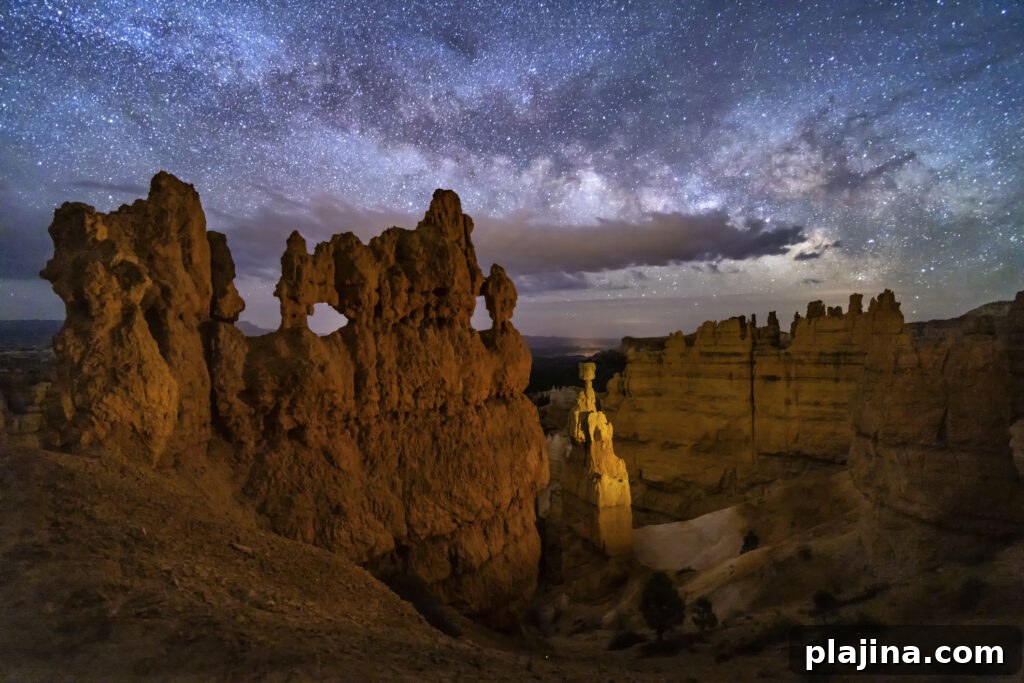
Sunset Point in Bryce Canyon National Park, Utah © Colin Young | Dreamstime.com
Upscale outdoor hospitality brands such as Under Canvas, approved by DarkSky International, offer glamping accommodations near many dark sky parks and monuments across the Mountain West. Their off-grid, safari-inspired tents—complete with king-sized beds and wood-burning stoves—let visitors enjoy comfort while staying close to prime stargazing locations.
In 2024, a 2.5-million-acre region of southeastern Oregon was designated the Oregon Outback International Dark Sky Sanctuary, the world’s largest dark sky sanctuary. In places like this, galaxies and nebulas become visible to the naked eye on a clear night.
Everything does seem bigger in Texas: the Greater Big Bend International Dark Sky Reserve, covering some 9 million acres across both Texas and Mexico, is currently the world’s largest reserve and the first binational International Dark Sky Reserve. Nearby MacDonald Observatory hosts guided star parties, telescope viewing sessions, and educational astronomy events for visitors.
Joshua Tree National Park is one of California’s premier stargazing locations. Its remote desert setting and dry climate produce exceptionally clear skies. Cottonwood Campground is noted for especially dark skies, and the park’s wilderness areas offer excellent backpacking and camping opportunities. Winter nights reveal Orion’s Belt low in the southern sky, while the Milky Way stands out most brightly in the summer months.
San Pedro de Atacama’s private observatory, Chile © Explora
New Mexico’s Chaco Canyon offers boundless night skies where visitors can see the same constellations that guided the Ancestral Puebloans. Valles Caldera National Preserve is the state’s newest International Dark Sky Park, and Cosmic Campground provides a remote campsite where the stars appear strikingly vivid against an unpolluted horizon.
In Georgia, Stephen C. Foster State Park sits within the Okefenokee Swamp and provides an exceptional vantage point for meteor showers, planetary alignments, and other celestial events. Campgrounds with water and electric sites sit amid massive oaks draped in Spanish moss, and evenings are scored by the calls of swamp wildlife.
Even the American Midwest hosts impressive dark sky locales. Middle Fork River Forest Preserve in northeastern Illinois protects more than 1,700 dark-sky acres, while Headlands International Dark Sky Park in Michigan features 550 acres of woodlands and two miles of Lake Michigan shoreline. Some sites host family-friendly events—starry lake cruises, astrophotography nights, and storytelling sessions—that invite visitors to bring blankets, chairs, and refreshments for a full night under the stars.
Down Under, stargazing is a major draw. New Zealand contains five Dark Sky Reserves and promotes astronomy to visitors, with Aoraki Mackenzie International Dark Sky Reserve—the largest in the Southern Hemisphere—offering dedicated viewing facilities and expert guides. Australia has six officially recognized dark sky sites, and Indigenous sky knowledge remains a central part of many tours, such as those around Uluru where ancient sky stories accompany stargazing experiences.
South America’s Atacama Desert provides some of the world’s clearest Southern Hemisphere skies. With minimal light pollution and dry air, the desert reveals the southern Milky Way, the Southern Cross, nebulae, and countless star clusters. On a moonless night, thousands of stars fill the sky; winter months (June–September) often deliver the best viewing. In San Pedro de Atacama, private observatories equipped with advanced telescopes allow visitors to observe Saturn’s rings and Jupiter’s moons in impressive detail.
African wilderness reserves also offer spectacular dark skies. Vast protected areas such as Singita Grumeti Reserve in the Serengeti provide near-pristine nightscapes where constellations blaze overhead and guests can view celestial features with high-powered scopes. Remote camps on the Makgadikgadi Salt Pans offer immersive experiences, sleeping on bedrolls beneath incredibly dark skies.
Saudi Arabia is emerging as a new hub for astro-tourism, with DarkSky International recognizing locations such as AlUla Manara and AlGharameel Nature Reserve. The region now hosts guided night hikes and festivals that celebrate the night sky, echoing the traditions of travelers who once navigated by stars along ancient trade routes.
Wherever you go, the best stargazing often depends on timing and conditions: choose a moonless night, seek locations with low light pollution, and allow your eyes time to adapt to the dark. With so many protected and certified dark sky places around the globe, the chance to stand beneath a spectacular night sky is closer—and more accessible—than you might think.