
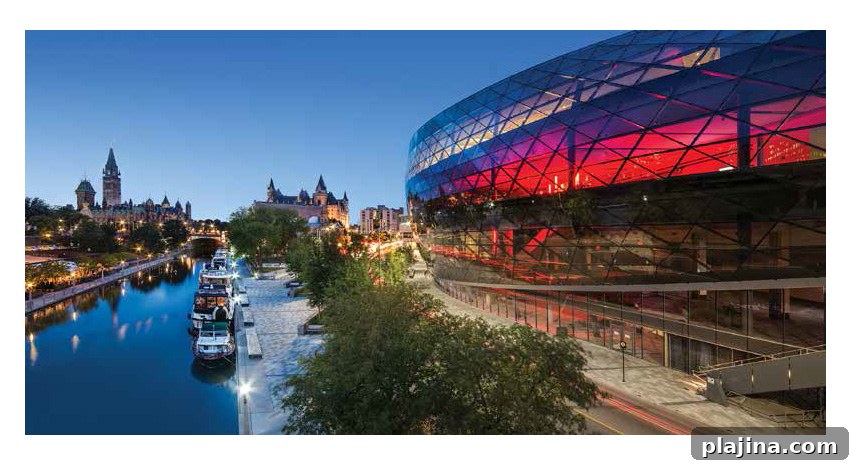
During winter, Ottawa’s many trees stand bare. The frozen Rideau Canal—Ontario’s only designated UNESCO World Heritage Site—transforms into the Rideau Canal Skateway, a winding, five-mile-long ice rink. Snow blankets the hills surrounding Canada’s stately Parliament buildings, creating a postcard-perfect winter scene.
By late spring, Ottawa bursts into a vibrant, green landscape. Sugar maples leaf out, lindens fill the air with fragrant blossoms, honey locusts edge the riverbanks, and towering Turkish hazel trees offer cool shade during Ontario’s luminous summers. Colorful sailboats glide along the Ottawa River, while dairy cows graze on fields across many of the 1,000 farms located within the city limits. Ottawa has more farms inside its boundaries than any other Canadian city and provides roughly 20 acres of green space for every 1,000 residents—more than most cities worldwide—so despite being Canada’s political and cultural hub, it often feels like a peaceful rural town. The city’s francophone suburbs across the river add a touch of Quebecois character.
For MICE planners, Ottawa’s venues emphasize sustainability and energy efficiency. Energy Ottawa, an affiliate of Hydro Ottawa, is installing solar panels on eight municipal rooftops—including recreation centres and bus garages—to feed clean electricity into the local grid. “We understand how important green energy solutions are to our customers, our city and province,” said Greg Clarke, chief electricity generation officer at Energy Ottawa.
When the glass-fronted Shaw Centre, the city’s largest convention facility, opened in 2011 it set a new standard for eco-conscious meeting spaces. The redesign of the former Ottawa Convention Centre met strict environmental sustainability requirements, resulting in energy savings of about 25 percent. Improvements include high-efficiency mechanical systems, a high-performance building envelope, enhanced insulation, variable-speed pumps and motors, high-performance windows and frames, occupancy and daylight sensors to cut interior lighting use, and low-flow water fixtures.
The Shaw Centre also saves approximately 225,000 gallons of water annually by harvesting rainwater in a cistern beneath the building and reusing it for gray-water needs such as landscape irrigation. The building features The Wall of Three Rivers, an artwork comprised of reclaimed logs that sank to the bottom of the Ottawa River during the logging era. The Shaw earned LEED Gold certification from the Canada Green Building Council.
“Clients want to understand the true cost of their event, at a very detailed level,” said Mathieu Murphy, director of facilities at the Shaw Centre. “Our guests and suppliers are more eco-conscious than ever; that encourages us to continually refine our operations, increasing waste diversion and using automation technology to reduce electricity, heating and cooling consumption.”
The Shaw Centre offers 192,000 square feet of usable space, including the 57,740-square-foot Canada Hall, the 19,032-square-foot Trillium Ballroom, and 28 flexible, fully carpeted meeting rooms. Located in the heart of downtown, the venue is within walking distance of roughly 6,000 hotel rooms and about a 20-minute drive from Ottawa Macdonald-Cartier International Airport. The Shaw hosts close to 500 conventions, meetings and trade or consumer shows each year, including green-focused conferences such as the International Conference on Technology and Environmental Science, the International Conference on Water, Informatics, Sustainability and Environment, and the International Conference on Sustainable Development.
The 496-room Westin Ottawa, physically connected to the Shaw Centre and the Rideau Centre Mall by an indoor walkway, provides 44,000 square feet of meeting space, 27 tech-focused meeting rooms, a 16,500-square-foot Grand Ballroom, and another ballroom with windows overlooking the Rideau Canal and Parliament. The property received the 2013 Energy & Environment Award from the Hotel Association of Canada.
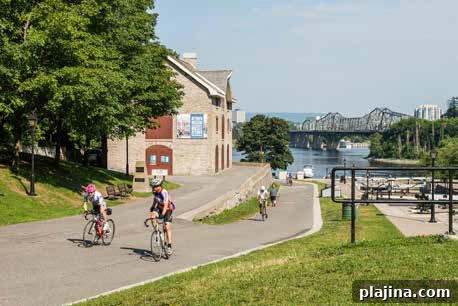
The entrance to the Rideau Canal bike path near ByTown Museum © OTTAWA TOURISM
Other prominent downtown hotels include the historic Fairmont Château Laurier, opened in 1912 and located across the street from the Shaw Centre. The Château offers 427 rooms, 36,000 square feet of meeting space and 16 meeting rooms, and it is expanding facilities with views of the Rideau Canal. The Ottawa Marriott provides 481 rooms, 36,162 square feet of meeting space, 26 meeting rooms and multiple concierge levels.
Newer boutique properties that opened in 2016 include the Alt Hotel Ottawa, featuring 148 guestrooms and nine colorfully named meeting rooms totaling 5,370 square feet, and the Andaz Ottawa ByWard Market, with 200 guestrooms, flexible studio-style function spaces totaling about 4,500 square feet, and the 16th-floor Copper Spirits & Sights rooftop lounge, bar and restaurant.
The Ottawa Conference and Event Centre, located about 15 minutes from downtown, offers 43,000 square feet of convention space, 37 meeting rooms, comprehensive food and beverage services and complimentary underground parking. It connects to the Courtyard by Marriott Ottawa East (397 rooms) and the Hampton Inn Ottawa by Hilton (179 rooms).
Several national museums offer distinctive spaces for private dinners, conferences and incentive events, including the Canadian Museum of History, the Canada Agriculture and Food Museum, the Canada Science and Technology Museum, the Canada Aviation and Space Museum and the National Gallery of Canada.
The $28.7 million Ottawa Art Gallery Expansion and Arts Court Redevelopment is part of the continued revitalization of downtown. The ArtHaus Residences at Arts Court will be among the first North American developments to combine a boutique hotel (Hôtel Le Germain), an art gallery and theater space within a condominium project. When the expanded Ottawa Art Gallery opens this fall, it will offer around 80,000 square feet across five floors, creating an important cultural venue for residents and a flexible off-site event location.
Ottawa’s transportation master plan includes 21 miles of new light-rail rapid transit and 19 stations, with full operations targeted by 2023. The Confederation Line’s downtown segment is expected to be mostly completed this year, marking a milestone during Canada’s 150th anniversary. The full project carries an estimated cost of approximately $3.7 billion, representing the largest infrastructure investment in the city’s history.
Unique Venues
The Outaouais region, just across the Ottawa River, offers distinctive MICE venues such as Nordik Spa-Nature—the largest spa in North America—and Fairmont Le Château Montebello. Nordik Spa-Nature promotes an eco-minded philosophy: “What is good for the body should be good for nature.” It accommodates group bookings and provides cabin or lodge accommodations for overnight guests. Fairmont Le Château Montebello, constructed in 1930 from red cedar logs and centered by an iconic six-sided stone fireplace, offers 211 guestrooms, a scenic golf course and an Eco-Meet green conference option that reduces the environmental footprint of events.
Within the revitalized Lansdowne Park—an 18-acre mixed-use complex near downtown—planners can consider venues such as the redesigned TD Place Stadium, the Craft Beer Market brewpub and the restored 1898 Aberdeen Pavilion, a national historic site. The nearby ByWard Market district, within walking distance of downtown, provides a lively year-round outdoor food market, numerous restaurants and an array of shops lining busy streets and tucked into quiet courtyards.