
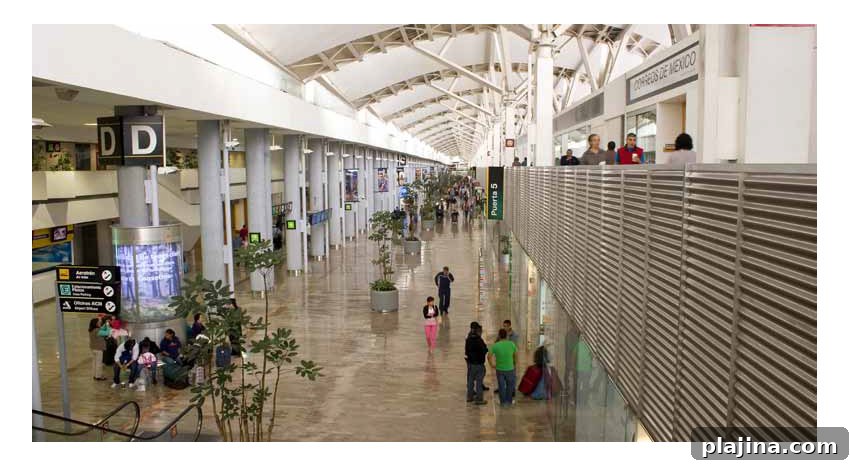
There are clear winners and losers at Mexico City’s Benito Juarez International Airport; unfortunately, the losers are often travelers.
Earlier this year, Mexico’s antitrust agency COFECE published a report highlighting a severe lack of competition at the airport. Two publicly traded carriers—Aeromexico and Volaris—dominate departures, controlling roughly 42 percent and 13 percent of outbound seats respectively, while Interjet holds about 22 percent. That concentration limits consumer choice and contributes to higher fares and fewer convenient schedules.
Aeromexico has developed Benito Juarez into a significant Latin American hub. In 2015 the airline introduced service to Toronto (YYZ), Vancouver (YVR), Medellín (MDE) and Panama City (PTY). More recently, it added routes to Santo Domingo (SDQ) and Amsterdam (AMS) and expanded service to Tokyo Narita. As of May, Aeromexico and Delta Air Lines were pursuing a joint venture to increase U.S. connectivity; government approval for that partnership hinges on Aeromexico surrendering eight slots at the airport.
COFECE’s findings go beyond market share. The report alleges unnamed carriers apply extra fees for takeoffs and landings and that hundreds of daily flights deviate from assigned schedules. An unclear, nontransparent process for allocating desirable time slots enables airlines to monopolize peak periods, while route growth has remained stagnant over the past five years. Routes served by fewer carriers often carry particularly high fares. To address these problems, COFECE recommended greater transparency in slot allocation and operational rules.
For travelers seeking an alternative, Mexico City’s new international airport is scheduled to begin operations as early as October 2020. Planned as one of the world’s largest airports, the new site will occupy more than 10,000 acres about three miles from the current airport and is budgeted at approximately $12.8 billion. At full build-out the facility is expected to handle up to 120 million passengers per year, making it the second-largest airport project under construction after Istanbul New Airport. Initially three runways will operate simultaneously in 2020, with three additional runways planned by 2030. The new airport aims to rank behind only Atlanta’s Hartsfield-Jackson in passenger volume.
After the new airport opens, Benito Juarez International will remain in service through 2022. The government plans to repurpose the existing airport’s land and infrastructure—an area roughly twice the size of Central Park and valued at about $2 billion—for urban development.
Passenger traffic at Benito Juarez International has been rising: in 2015 the airport handled 38.4 million passengers, an increase of 11.9 percent over 2014.