
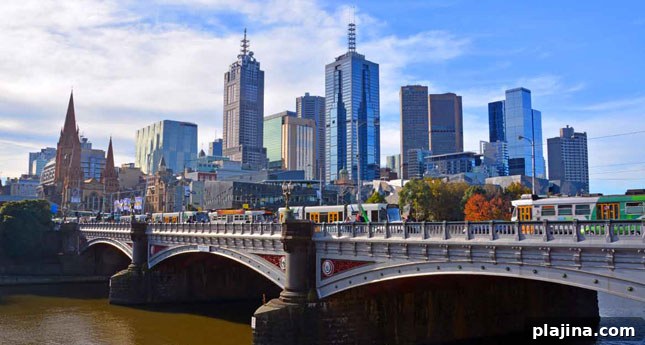
Dashing, edgy, sophisticated and delightful — Melbourne has become Australia’s leading center for the arts, business, culture, education, dining and shopping. From its beginnings as a muddy settlement in 1835 to today’s capital of Victoria, the city has built a global reputation for livability. Evaluations by multiple international organizations have praised Melbourne for its stability, infrastructure, education, health care and rich cultural environment. In recent years it has also shown strong performance in population, income and employment growth.
This vibrant metropolis offers an appealing mix of outdoor spaces, including parks, gardens and the Yarra River; a charming network of central-city lanes; eleven distinctive inner-city suburbs; an impressive range of architecture from heritage buildings to modern designs; and a thriving fashion, art and food scene. Melbourne’s population is culturally diverse, with residents representing many backgrounds including Indigenous Australians, Europeans, Indians and Asians.
One of the city’s most notable changes in recent decades is rapid population growth. In 2013, Greater Melbourne was home to roughly 4.35 million people, a sizable annual increase. At current trends, Melbourne is expected to rival other Australian cities in size by the middle of the century. That growth fuels opportunities for business development across the metropolitan area.
Melbourne’s 19th-century gold rush financed an early boom that later gave way to strong manufacturing and construction sectors. Since the early 2000s the city has transitioned toward new industries—losing manufacturing jobs but gaining momentum in finance, education, health care, life sciences, logistics, tourism and information and communication technology. Over the past decade these sectors have generated substantial employment and economic activity.
The city has also become a hub for startups and innovation. Known informally as a national center for new ventures, Melbourne benefits from a strong research and development base and supportive business programs. The City Council’s Enterprise Melbourne initiative, launched in 2009, offers consultation, research and marketing support for local and international startups. Six major research universities in the city further strengthen growth in areas such as ICT and the life sciences.
Melbourne Cricket Ground © Arnabmaity | Dreamstime.com
The Central Business District is Melbourne’s financial and political core. This roughly 14-square-mile area is currently seeing significant mixed-use development, adding business and residential spaces while preserving major green areas and world-class sports and entertainment venues. Landmarks include the Melbourne Cricket Ground and Rod Laver Arena, the latter hosting the Australian Open tennis tournament since 1988. Sport is central to local life, both for spectators and participants, and the city offers many facilities and wellness initiatives, including programs that promote cycling and expand bike lanes and share schemes.
Leisure in Melbourne is exceptional. Alongside a dynamic arts scene, the city is known for outstanding food and coffee culture. Locals prize breakfast culture as well as diverse dining options that reflect the city’s multicultural population—excellent Asian, Indian and Mediterranean restaurants are common. Melbourne also offers an energetic nightlife with bars, cafés and an array of independent stores and boutiques.
Rapid development across the CBD and inner suburbs creates abundant business opportunities, with each neighborhood offering a distinct character. Docklands, for example, is a lively waterfront precinct with modern dining spots, cafés and promenades that pass historical wharves, marinas and parkland. Like other areas of the city, Docklands attracts residents and visitors for both business and leisure. Travelers should remember that seasons are opposite those in the Northern Hemisphere: when it’s winter in the U.S., it’s summer in Australia, and vice versa.
Pedestrians and cyclists can cross to the Docklands via the unique Webb Bridge © Robyn Mackenzie | Dreamstime.com
Things to Do in Melbourne
Melbourne’s Aboriginal heritage remains a living presence. The Koorie Heritage Trust offers exhibitions and tours that highlight the history and culture of local Indigenous communities, including guided walks through Flagstaff Gardens and along the Yarra. The Melbourne Museum in Carlton Gardens features the First Peoples Bunjilaka Aboriginal Cultural Centre, which presents stories of Victoria’s Aboriginal people and their art.
Explore the city’s famed laneways—narrow streets lined with quirky shops, hidden cafés and intimate restaurants. Flinders Lane, once the heart of Melbourne’s garment trade, is today a bustling strip favored by students, creatives and professionals enjoying specialty coffee, cocktails and casual dining.
A bustling Melbourne laneway © Lucidwaters | Dreamstime.com
For art and culture, head to Southbank, home to the Arts Centre Melbourne, several theaters and the National Gallery of Victoria. Public art is prominent across the city; many building façades display approved, large-scale murals and street art. Urban Scrawl and similar tours guide visitors through these vibrant outdoor galleries. Melbourne’s literary culture earned it the UNESCO City of Literature designation in 2008, and venues like The Wheeler Centre host hundreds of lectures and public programs each year.
CHECKING IN WITH KATE ROFFEY
Chief Executive Officer, Committee for Melbourne
What makes Melbourne an ideal destination for business travelers?
Melbourne is accessible and well organized. The city’s international airport operates with few restrictions and the CBD is a compact, easy-to-navigate grid about 25 minutes by taxi from the airport. The central area offers thousands of hotels, varied dining and coffee options, and close proximity to major sports, arts and exhibition precincts. For business travelers, everything is concentrated and convenient.
What are the city’s fastest-growing industries?
Established strengths remain in health care, education, retail and financial services, while emerging growth areas include wealth management, professional services, international education, advanced manufacturing in specialized materials and health and medical research. Melbourne’s agility and tech-savvy culture support these expanding sectors.
What tips can you offer business travelers regarding work and pleasure in Melbourne?
Plan ahead. The city hosts frequent sporting events, festivals, theater shows and live music, so checking schedules before arrival maximizes leisure time. Within easy reach of the CBD are top-quality golf courses, renowned wineries and significant Aboriginal heritage sites—ideal additions to any business trip.
Melbourne: Just the Facts
Time Zone: GMT +10
Phone Code: Country code: 61 City code: 3
Currency: Australian dollar
Entry/Exit Requirements: U.S. citizens need a valid passport and a visa before travel; the Electronic Travel Authority covers visits up to three months.
Official Language: English
Key Industries: Finance, education, health care, life sciences, logistics, tourism and information and communication technology
Melbourne Info to Go
Melbourne Airport (Tullamarine) serves more than 31 million passengers annually and has plans for significant investment to expand capacity. The airport sits roughly 14 miles from central Melbourne and offers rental cars, taxis and express bus services such as SkyBus, which operates 24/7 between the airport and the city center.
Where to Stay in Melbourne
The Como Melbourne A stylish 107-room boutique hotel located in a fashionable shopping district, popular with visitors seeking chic accommodations. 630 Chapel St., South Yarra $$$
The Langham, Melbourne A luxury, 388-room five-star hotel on Southbank Promenade overlooking the Yarra River, about 20 minutes by car from the airport. Features a full-service spa and refined dining. 1 Southgate Ave., Southbank $$$
Sheraton Melbourne Hotel Situated near the arts quarter on Little Collins Street, this 174-room property offers contemporary comforts and a rooftop bar. 27 Little Collins St. $$$
Restaurants in Melbourne
Attica A leading fine-dining restaurant that highlights local and foraged ingredients in inventive tasting menus, with vegetarian options available. 74 Glen Eira Road, Ripponlea $$$$
Cumulus Inc. A lively restaurant known for its shareable plates and rustic flavors, from mussels to roasted meats. 45 Flinders Lane $$
Vue du Monde Located on the 55th floor, this restaurant pairs contemporary Australian cuisine with panoramic city views and curated wine pairings. Level 55, Rialto, 525 Collins St. $$$
Read more about Melbourne’s coffee shops.