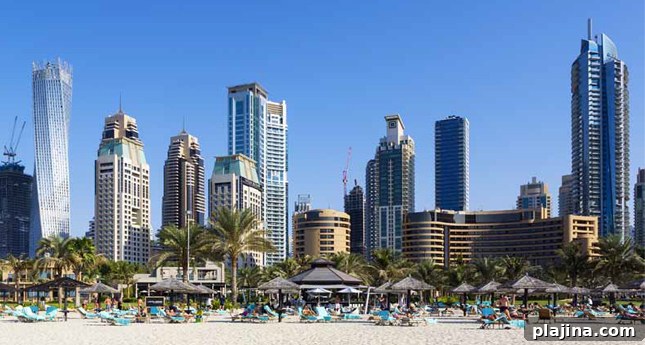
It’s not a mirage, but Dubai is also not quite what first impressions suggest. At a glance the city looks like an ultramodern skyline of glass and steel, a skyline that has risen from the pale Arabian Gulf shore within two decades. In that short span Dubai has become a major global hub for business and aviation and a thriving international tourist destination—part spectacle, part showpiece.
However, visitors expecting Dubai to operate exactly like a contemporary Western metropolis will notice important differences. Beneath the glitz and gleam, Dubai remains essentially Arabian. Daily life and public routines are shaped by local culture, religion and the demands of a harsh climate.
Business travelers should be prepared for a different weekly rhythm. The working week runs Sunday through Thursday, with Friday and Saturday as the weekend. Typical office hours are roughly 8 a.m. to 1 p.m., followed by a long midday break during the hottest hours, and then a return from about 4 p.m. to 7 p.m.
During the month of Ramadan businesses are required to reduce working hours by two hours or to compensate staff accordingly. Many restaurants close during daytime hours, and visitors should avoid eating or drinking in public places (including inside vehicles) until the daily fast is broken at sunset.
Local customs carry potential pitfalls, particularly in business settings. Meetings often proceed with polite informality, and working breakfasts or lunches are common. Keep small talk neutral and avoid sensitive topics such as religion or politics. Some local contacts—especially of the older or more conservative generation—may not shake hands with members of the opposite sex; in those situations it’s better to wait and respond to an introduction rather than initiate contact.
Adapting to cultural subtleties is only one challenge for business travelers. Managing the climate is another. Dubai’s summer months (roughly May to August) can be ferociously hot, with temperatures soaring and humidity rising, so daily life tends to be a sequence of short outdoor stints and longer stays in air-conditioned spaces. Scheduling meetings in the coolest parts of the day—early morning or evening—can make a big difference.
Breakfast meetings are a practical way to avoid the midday heat and remain productive. The Ivy Dubai, located on the ground floor of Jumeirah Emirates Towers, offers a polished breakfast environment with British-style options served on weekdays. In Business Bay, which has emerged as a hub south of the Burj Khalifa, casual morning options include El3ezba with its European and Egyptian specialties, while Kitchen6 at the JW Marriott Marquis lays out an extensive international buffet from early morning for a more upscale choice (reservations recommended).
The area known as New Dubai—southwest of downtown and including the Palm Jumeirah, Dubai Media City, Dubai Marina and Jumeirah Beach Residence (JBR)—hosts a wide range of dining choices. Eggspectation in JBR is a popular casual spot for all things egg-based, while the grand Imperium at Jumeirah Zabeel Saray offers a luxurious though pricier setting suitable for business brunches.
Sheikh Zayed Road, Dubai’s main artery through downtown, provides many lunchtime options. When heat makes a lighter meal preferable, cafes like Zaroob serve regional specialties in an informal atmosphere, and Shakespeare and Co. offers a calm, pastel-hued environment for a light lunch or afternoon cake. For a formal, memorable luncheon, At.Mosphere on the 122nd floor of the Burj Khalifa is the city’s premier choice and is guaranteed to impress with its dramatic setting and high-end menu.
Getting around Dubai can be unpredictable. Peak-period traffic can stretch what would normally be a 15-minute drive into an hour or more, and roadworks or accidents add to delays. The metro offers a predictable, traffic-free alternative, albeit sometimes slower depending on your origin and destination. To minimize travel stress, base yourself near the area where most meetings will occur.
Accommodation choices vary by neighborhood and needs. In New Dubai, The Ritz-Carlton provides beachfront comfort close to JBR’s high-rises, while The Oberoi in Business Bay offers a refined, convenient base with easy access to downtown. Choosing a hotel near your appointments saves travel time and reduces uncertainty.
Alcohol policy in Dubai is nuanced. While many hotels and bars serve alcoholic drinks and some supermarkets carry alcohol sections, the law technically requires a license to purchase alcohol; such licenses are issued to non-Muslim residents, not visitors. In practice tourists who drink in licensed hotel bars and restaurants rarely face issues, but incidents that involve the police and suspected intoxication can result in charges for drinking without a license. Exercise discretion and be aware of local rules.
Despite these constraints, sundowners remain a popular ritual among residents and visitors alike. Rooftop bars and waterfront venues provide spectacular evening backdrops. One notable spot is 360°, at the end of the Jumeirah Beach Hotel marina walkway near the Burj al Arab, where happy hour and sunset views attract a lively crowd.
As daylight fades, the skyline’s towers and lights transform the city into a glittering panorama: at once familiar and intriguingly different. For business visitors who adapt to local rhythms and plan around climate and culture, Dubai offers an efficient, striking and memorable setting for work and leisure alike.